

- When food is fortified with vitamins, the manufacturer must check whether the vitamin content declared on the packaging is actually present in the product. This analysis is challenging because there are many vitamins with different chemical properties, which need to be analyzed at many concentrations and in different sample matrices.
- Moreover, complex sample preparation is sometimes required. Microbiological tests, based on the growth of specific microorganisms, are an established method for determining vitamins. However, this method has several drawbacks because it is cumbersome, requires a great deal of experience, and delivers results at the earliest after a week.
- HPLC (high-performance liquid chromatography) is an alternative method, but it requires a substantial investment in equipment. As a result, only a few laboratories carry out this analysis themselves; instead, they hire external laboratories — and accept longer turnaround times.
- However, there is a way for laboratories to carry out vitamin analysis easily and cost-effectively themselves: VitaFast®. In our video, Ronald Niemeijer explains how it works:
https://www.youtube.com/watch?v=F1a-aL6jv0A
1. Define the goal of the vitamin analysis
- Which vitamin to analyze? (e.g. vitamin C, B12, A...)
- In which type of sample? (food, beverages, medicines, milk...)
- For what purpose? (quality control, research, nutrition labeling...)
2. Choose a suitable vitamin analysis method
- UV-Vis spectrophotometry: commonly used for vitamin C, B1, B2 (simple, low cost).
- HPLC (high-performance liquid chromatography): the most popular method, covering most vitamins, with high accuracy.
- LC-MS/MS (liquid chromatography coupled to mass spectrometry): highly accurate, used for complex analyses or traceability work.
- Microbiological method (bioassay): used in a few special cases such as vitamin B12.
3. The principle of VitaFast®
- The VitaFast® test is a convenient microtiter-plate-format microbiological test. Like traditional microbiological methods, the test system is based on the growth of specific microorganisms, but the ready-to-use format makes the VitaFast® test easy to use and relatively fast, delivering results within 48 hours.
- Depending on the vitamin concentration in the sample, the microorganism grows, and the resulting turbidity can be measured with a microtiter plate reader. In this way, many water-soluble vitamins can be determined easily, accurately, and cost-effectively. The performance of the VitaFast® test has been tested and certified by the AOAC Research Institute.
- See the catalog of the vitamin test kits we supply here.
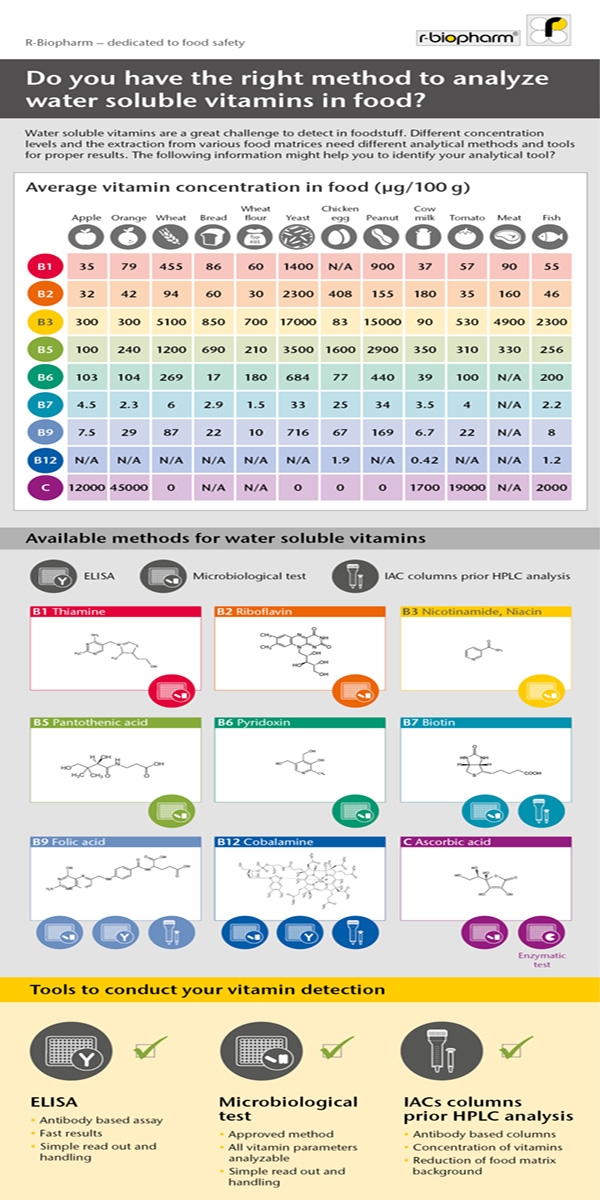
* Our infographic provides further information on vitamin analysis:
Source: food.r-biopharm.com