
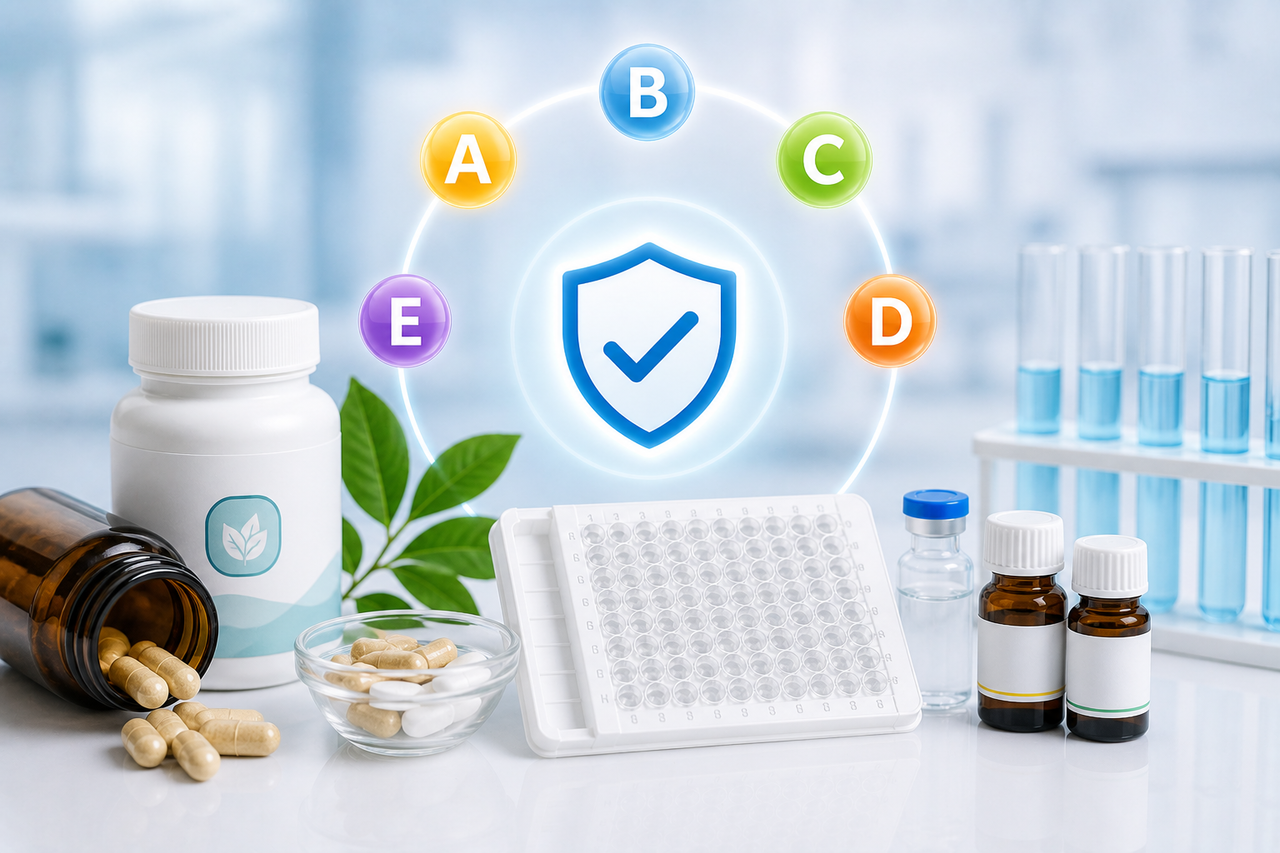
In the functional food industry, vitamins are the core component determining:
- Nutritional value
- Product effectiveness
- Consumer trust
However, a major problem many businesses face is:
👉 The actual vitamin content does not match the label declaration
This leads to:
- Inspections and fines
- Product recalls
- Loss of brand reputation
👉 So how can you prove the vitamin content matches the declaration?
Why does vitamin content in functional foods easily deviate?
1. Losses during production
Vitamins can be affected by:
- Temperature
- Humidity
- Oxidation
- Light
👉 In particular:
- Vitamin C degrades very easily
- Vitamins A and D are light-sensitive
2. Raw material input deviations
- Uneven vitamin premix
- Unstable suppliers
- Improper storage
👉 If you do not test vitamins in functional foods from the start, it is hard to control the final quality
3. Non-optimized formulas
Many businesses:
- Add excess vitamins to "make sure there's enough"
- But do not control the losses
Leading to:
- Higher costs
- Uncontrolled deviations
⚠️ Why must vitamin content match the declaration?
✔️ A mandatory legal requirement
- By regulation, the vitamin content must match the declaration
✔️ A condition for product circulation
- The declaration dossier needs testing data
- Clear analysis results are required
✔️ Meeting export standards
- In markets such as the EU, USA, and Japan, vitamin testing is mandatory
Methods of vitamin analysis in functional foods
1. HPLC (liquid chromatography)
- Very high accuracy
- Used for official testing
* Disadvantages:
- High cost
- Long duration
2. Vitamin rapid test (test kit)
This is the solution being chosen by many businesses.
R-Biopharm kits help you:
- Test quickly
- Easy to use
- Suited to internal QC
🚀 Procedure to prove the vitamin content matches the declaration
- Step 1: Check incoming raw materials 👉 test the vitamin premix
- Step 2: Check during production 👉 track losses
- Step 3: Check the finished product 👉 compare against the declaration
- Step 4: Official testing 👉 confirm with HPLC
The optimal solution for businesses
- The most effective model: rapid test + periodic testing
- Rapid tests with R-Biopharm kits → daily testing
- HPLC → official confirmation
➡️ Helping you:
- Proactively control
- Reduce costs
- Increase accuracy
⚠️ Mistakes to avoid
- Not testing incoming raw materials
- Testing only when declaring
- Not testing during production
- Relying entirely on outside labs
These are the main causes of vitamin deviations
Benefits of effective vitamin control
To control vitamins effectively the business needs:
- Ensure the declaration is correct
- Avoid legal risks
- Raise brand reputation
- Optimize production costs
Conclusion
In the functional food industry, vitamin testing in functional foods is a mandatory factor for:
- Ensuring quality
- Complying with regulations
- Raising product value
👉 In particular, using the rapid test combined with HPLC solution will help businesses control more effectively.
📞 Contact for advice
If you are looking for:
- A functional food vitamin analysis solution
- A fast vitamin test kit
- An optimized QC system
👉 Contact us for detailed advice.