

- Tool for continuous hygiene monitoring
- Evidence during HACCP – ISO audits
- Solution for preventing the risk of contamination
👉 However, many businesses still do not know how often an ATP test should be done is reasonable.

Principles for determining ATP testing frequency
ATP testing frequency depends on 3 main factors:
1. Product risk level
- Fresh food → test more
- Packaged food → test less
👉 The higher the risk → the more frequent the testing
2. Testing area
- Surfaces in direct contact with food → test regularly
- Secondary areas → test periodically
3. Production frequency
- Continuous production → continuous testing needed
- Shift production → test per shift
How often should you do an ATP test? (Expert recommendation)
For food factories
- Before production starts: 1 time/day
- After cleaning: 1 time/shift
- After an incident: test immediately
👉 Total: 2–3 times/day/area
For restaurants – hotels
- Before opening: 1 time
- After peak hours: 1 time
- After general cleaning: 1 time
👉 Total: 2–3 times/day
For hospitals
- Operating rooms: several times/day
- Public areas: 1–2 times/day
For the drinking water industry
- Production line: every shift
- Bottling area: continuous testing
Summary table of ATP testing frequency

Mistakes when setting ATP test frequency
- Testing too little → risks cannot be controlled
- Testing too much → wasted cost
- No fixed criteria
- Data not saved
👉 Solution: a clear SOP must be established
Optimal solution: rapid testing with ATP
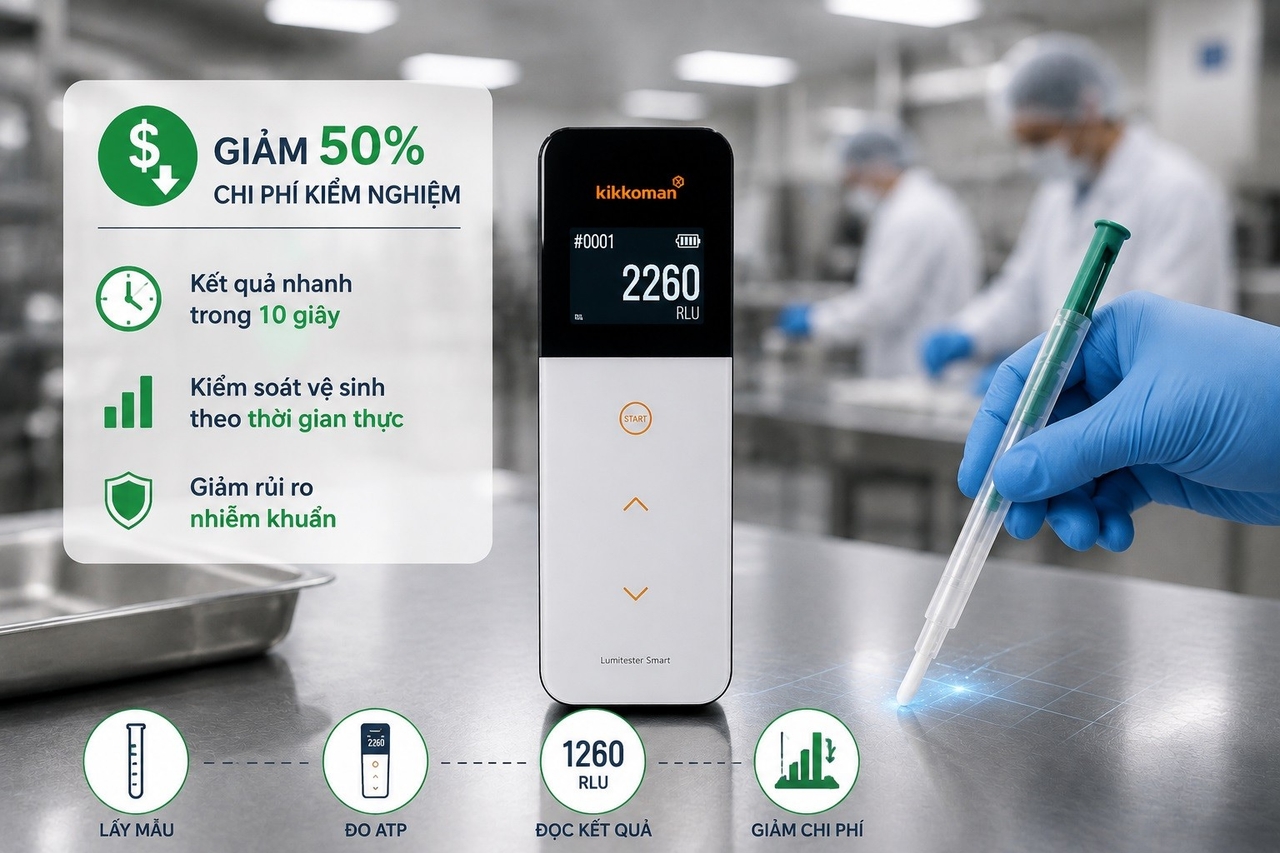
Lumitester Smart is a device that helps you test ATP effectively:
✔ Results in 10 seconds
✔ Quantified by the RLU index
✔ Easy to build Pass/Fail criteria
✔ Suitable for HACCP – ISO
👉 Thanks to this, customers can:
- Test many times without wasting time
- Control hygiene in real time
How to build an effective ATP test schedule
- Step 1: Identify the key areas
- Step 2: Set the RLU threshold
- Step 3: Make a testing schedule by shift
- Step 4: Save the data and evaluate
👉 This is the method that large businesses are applying
Conclusion
There is no single fixed number for all businesses, but:
👉 2–3 times/day/area is the common standard
To ensure:
- Hygiene safety
- HACCP – ISO compliance
- Reduction of production risk
👉 Businesses should apply ATP testing with a device such as Lumitester Smart to:
✔ Fast control
✔ Easy management
✔ Cost optimisation