
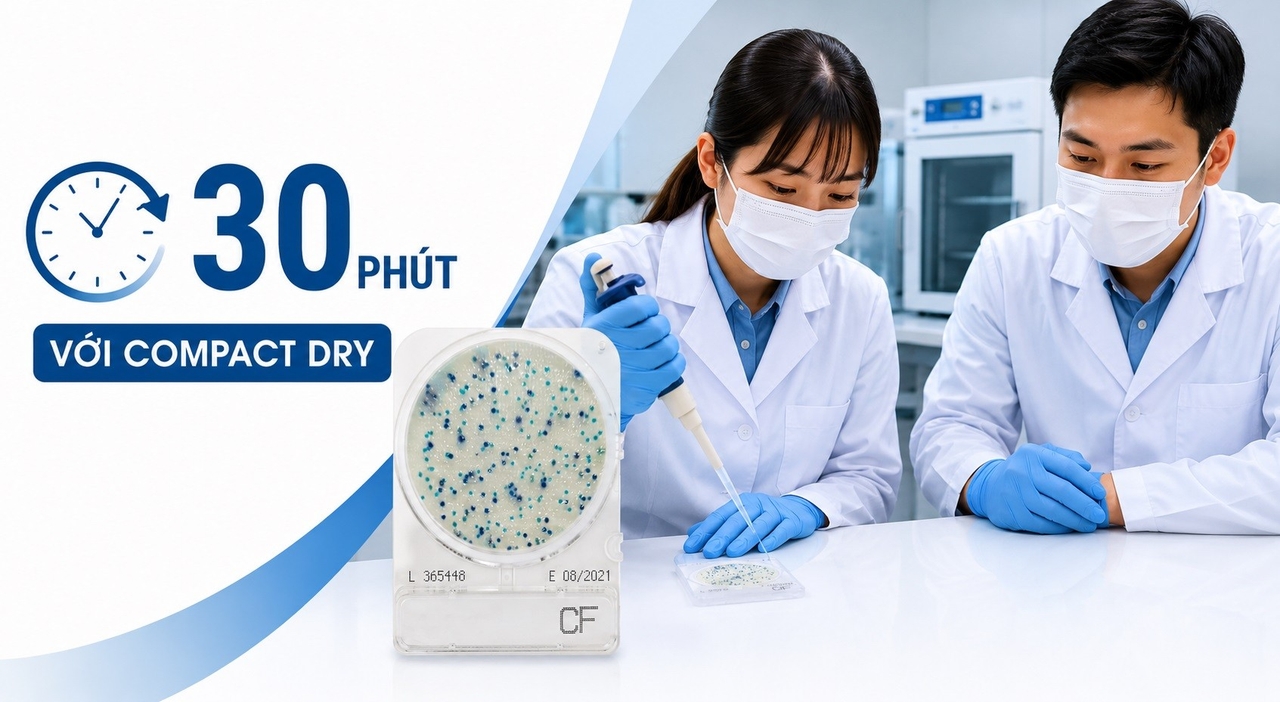
- However, with Compact Dry plates, the whole process is dramatically simplified. New staff can master the basic operations in about 30 minutes and start wor
- This is exactly why more and more food, beverage, seafood, dairy, and animal feed factories choose Shimadzu Compact Dry to streamline their microbiology testing operations.
The Compact Dry plate
- Compact Dry is a ready-to-use dry culture medium system developed for testing microorganisms in food, water, and environmental
- Just drop the sample onto the plate surface; the sample self-diffuses evenly and gels instantly with no medium preparation or plate pouring.
* Common analytes include:
- Total aerobic bacteria (Compact Dry TC)
- Coliform (Compact Dry CF)
- E. coli and Coliform (Compact Dry EC)
- Yeasts and molds (Compact Dry YMR)
- Staphylococcus aureus (Compact Dry X-SA)
- Enterobacteriaceae (Compact Dry ETB)
- Salmonella (Compact Dry SL)
- .............................
A 30-minute training program for new staff
Part 1: Introducing the principles (5 minutes)
Staff need to understand:
- The purpose of microbiological testing
- What each Compact Dry type means
- How bacteria grow on the medium
- The principle of recognizing colonies by color
After this part, staff have understood the role of each plate type in quality control.
Part 2: Guide to sample preparation (10 minutes)
Training steps:
1. Homogenize the sample
2. Dilute the sample if needed
3. Use a micropipette correctly
4. Avoid cross-contamination
Because there is no agar medium preparation, the training time is considerably shortened.
Part 3: Handling the Compact Dry plate (5 minutes)
The procedure consists only of:
1. Open the plate package
2. Drop 1 mL of sample into the center of the plate
3. Close the lid
4. Put it in the incubator
- The sample will spread evenly over the surface without any spreader.
- This is the advantage that lets new staff handle easily and reduces mistakes.
Part 4: Reading results (10 minutes)
The trainer shows the trainee:
- Standard colony images
- The characteristic colors of each analyte
- How to count colonies
- How to record results
* Example:
- Compact Dry EC: E. coli usually appears blue or blue-violet.
- Compact Dry CF: blue and blue-green colonies are Coliform.
- Compact Dry YMR: yeasts have blue, white, or off-white colonies. Molds: filamentous colonies with the characteristic color of each mold type.
After viewing a few real samples, most staff can read basic results on their own.
Why does Compact Dry cut training time?
No medium-mixing learning needed
With the traditional method, staff must learn:
- Weighing chemicals
- Mixing the medium
- Adjusting the pH
- Sterilizing
- Pouring agar
Compact Dry eliminates all these steps.
No plate-pouring technique to learn
Agar pouring requires:
- Temperature control
- Avoiding air bubbles
- Avoiding contamination
Compact Dry comes with the dry medium prepared, so staff don't need to learn this skill.
Lower risk of mistakes
Common new-staff errors:
- Pouring the medium too thick or too thin
- Cross-contamination
- Uneven sample spreading
- Wrong result reading
Compact Dry dramatically reduces these errors thanks to its simplified procedure.
Benefits for the business
Shorter time to work
New staff can join the work faster instead of spending days in training.
Training cost savings
Reduces:
- Culture medium costs
- Consumables costs
- Trainer staffing costs
Standardized results
The simple procedure reduces the variation between technicians.
Suited to understaffed factories
Small and medium businesses can quickly train new QC staff without an experienced microbiology team.
Conclusion
- If your business is looking for a solution to train testing staff quickly, easy to apply, with less dependence on technical ski the Compact Dry plate is a choice well worth considering.
- Thanks to the simple operating procedure, the ready-to-use dry medium, and visually color-based result reading, new staff can le