
- Therefore, for food manufacturing and trading businesses, especially those that declare or aim for gluten-free, the gluten testing, gluten testing in raw materials, products and the production environment is an important part of the food safety control programme.
- R-Biopharm currently offers a range of gluten detection solutions using immunochromatographic rapid tests and the ELISA method, suitable for various control purposes in the food production chain.
1. What is gluten and why do businesses need to control it?
- Gluten is a protein mixture characteristic of certain cereals, in which the main prolamins are gliadin in wheat, secalin in rye and hordein in barley.
- Gluten can occur in many food products such as:
- Bread, biscuits, cakes.
- Noodles, pasta and flour-based products.
- Breakfast cereals.
- Snacks and processed foods.
- Vegetarian foods, processed meat.
- Sauces and products using cereal-based ingredients.
- Beer, starch and starch syrup.
- Products declared or manufactured according to the gluten-free.
- The issue is not only whether the product formula uses gluten-containing ingredients. Gluten cross-contamination during production can also cause the final product to no longer meet gluten-free control requirements.
- Therefore, businesses need to control gluten at multiple points rather than only testing the final product.
2. Where do businesses need to test for gluten?
An effective gluten control programme should be implemented throughout the production process.
* Checking input materials
- Businesses can test materials at risk of containing or being contaminated with gluten before they enter production.
- Materials of concern include:
- Flour and cereal flours.
- Starch.
- Cereals.
- Spices and additives.
- Processed food ingredients.
- Ingredients sourced from external suppliers.
- raw material gluten testing helps businesses reduce the risk of introducing gluten-contaminated materials into the production line.
* Checking equipment surfaces and the production line
- This is one of the important points for factories producing multiple product lines. For example, a line that previously produced products containing flour is then cleaned to switch to producing gluten-free products. If the cleaning process does not completely remove gluten, the risk of cross-contamination can still occur. Businesses can check:
- Conveyor belts.
- Mixers.
- Tanks.
- Food contact surfaces.
- Packaging equipment.
- Production areas.
- CIP cleaning water.
* Checking the finished product
- For products declared gluten-free, testing the finished product is an important step to confirm that the gluten level in the product is within the business control limits and the applicable regulations.
- According to information cited by R-Biopharm from Codex Alimentarius, the limit of 20 mg/kg gluten is used as the threshold for “gluten-free” labelling in many regulatory systems. However, businesses need to check the labelling regulations and standards applicable in each market.
3. Gluten-free does not mean “no gluten molecules at all”
- This is a point businesses should pay particular attention to when building a gluten testing programme. In practice, gluten-free control usually focuses on ensuring that the gluten level in the product is below the regulatory threshold, rather than simply assuming that the product must be completely free of gluten.
- According to Codex, the 20 mg/kg level is used as the gluten-free threshold in the context cited by R-Biopharm. Therefore, gluten testing is not only about answering the question: “Is there gluten or not?” It may also need to answer: “What is the gluten content, and does it meet gluten-free control requirements?”
- This is precisely why businesses need to select a gluten testing method suited to the testing purpose.
4. When should a rapid gluten test be used?
- In production control, businesses cannot always wait a long time for test results. For activities such as checking production line hygiene, verification after CIP, or rapid testing in the production area, a rapid gluten test using the LFD (lateral flow device) method can offer advantages in time and convenience. R-Biopharm offers two representative solutions:
* RIDA®QUICK Gliadin – qualitative rapid gluten test
- RIDA®QUICK Gliadin – Art. No. R7003 is an immunochromatographic rapid test using the R5 antibody to detect gluten from wheat, rye and barley. The test can be used for:
- Raw food materials.
- Processed foods.
- Surfaces.
- CIP water.
- Checking gluten contamination during the cleaning process.
- One notable advantage is that the test can be used directly for surface swabbing, without needing an additional external sampling swab. The stated incubation time is approximately 5 minutes, depending on the procedure and matrix.
- According to the R-Biopharm catalogue, the detection limit of RIDA®QUICK Gliadin depends on the matrix; for example approximately 1,6–3,0 µg gluten/100 cm² for surfaces and approximately 6,3 mg/kg for processed foods.

* RIDA®QUICK Gluten quant. – quantitative rapid gluten test
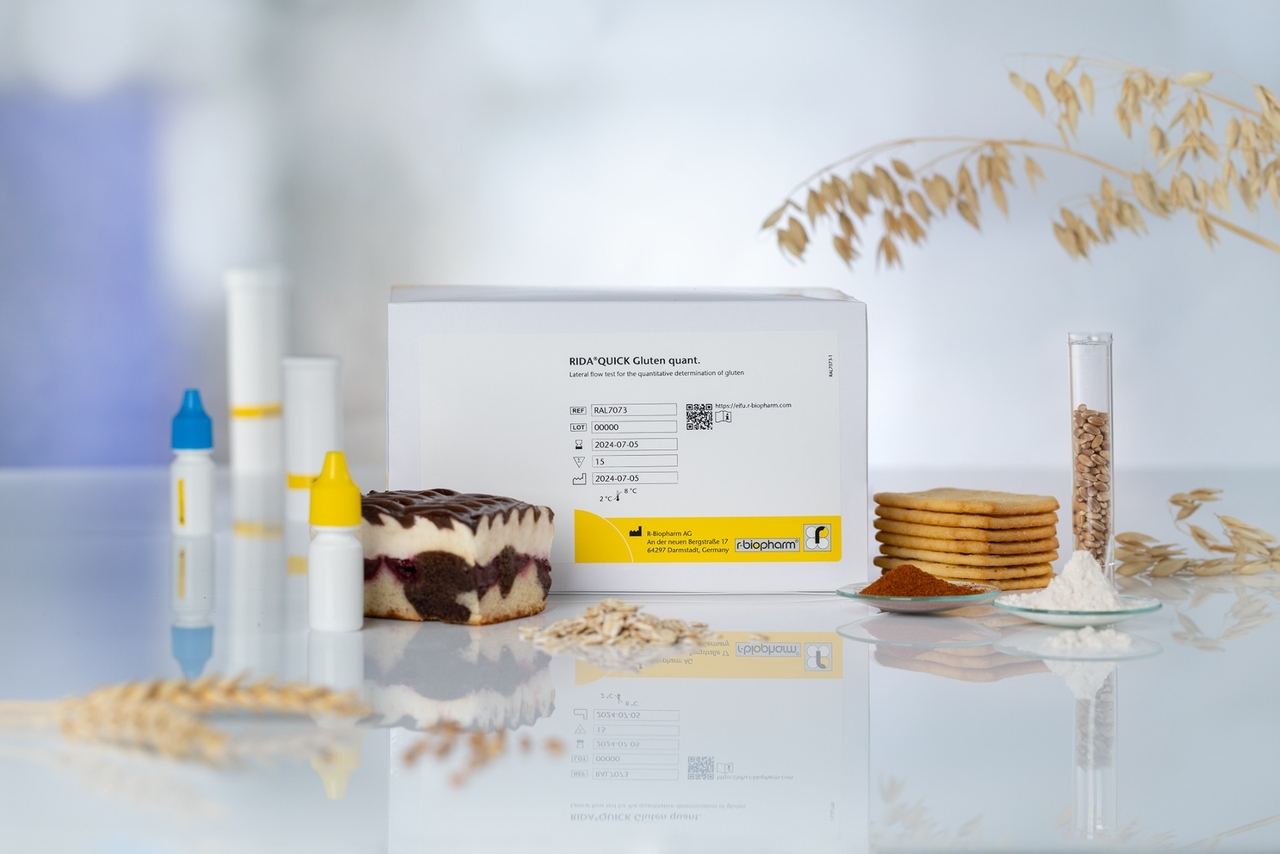
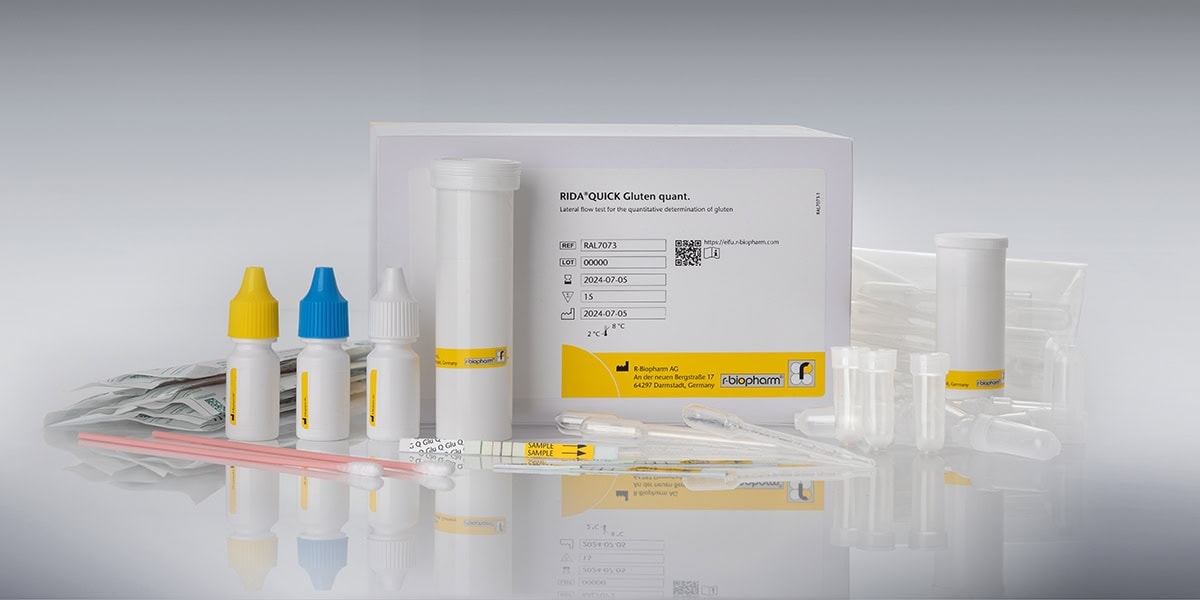
- If businesses not only want to know whether there is gluten contamination but need quantitative results, they can choose RIDA®QUICK Gluten quant. – Art. No. RAL7073.
- This is an LFD method using the R5 antibody to quantify gluten from wheat, rye and barley in:
- Foods.
- Surfaces.
- CIP water.
- A notable point is that RIDA®QUICK Gluten quant. is calibrated to gluten and gives direct results in the form of mg gluten/kg of food, helping limit the need to convert from gliadin content.
- According to the R-Biopharm 2026 catalogue, the incubation time of the method is approximately 10 minutes, with the detection limit depending on the matrix.
5. When should businesses use ELISA for gluten testing?
- If the goal is to quantify gluten in the laboratory, especially for gluten-free products, ELISA is an important option.
- R-Biopharm offers many RIDASCREEN® ELISA ranges for different needs.
* RIDASCREEN® Gliadin – reference ELISA for gluten testing
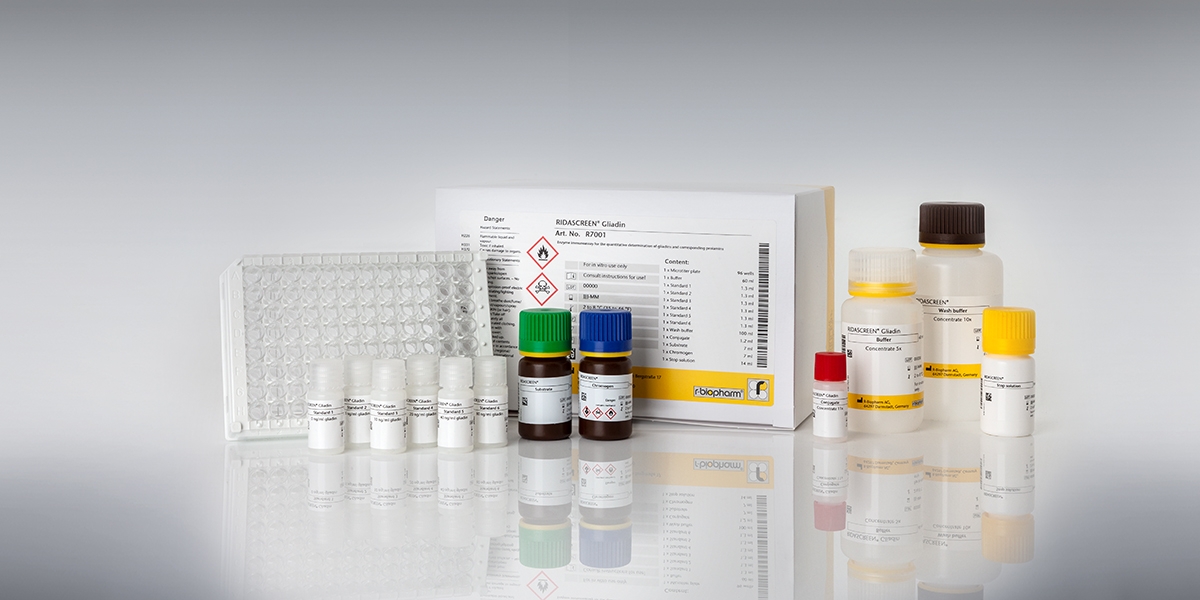
- RIDASCREEN® Gliadin – Art. No. R7001 is a sandwich ELISA method using the R5 antibody to quantify prolamins from:
- Wheat.
- Rye.
- Barley.
- The method is used to quantify gluten in many types of unprocessed and processed foods, especially in food groups declared gluten-free.
- R-Biopharm states that RIDASCREEN® Gliadin combined with Cocktail extraction meets the Codex Alimentarius Type I method and AOAC Official Method of Analysis 2012.01.
- According to the R-Biopharm 2026 catalogue, the stated detection limit is approximately 0,5 mg/kg gliadin or 1,0 mg/kg gluten, depending on the matrix.
* RIDASCREEN® FAST Gliadin sensitive – an option when fast and sensitive ELISA is needed
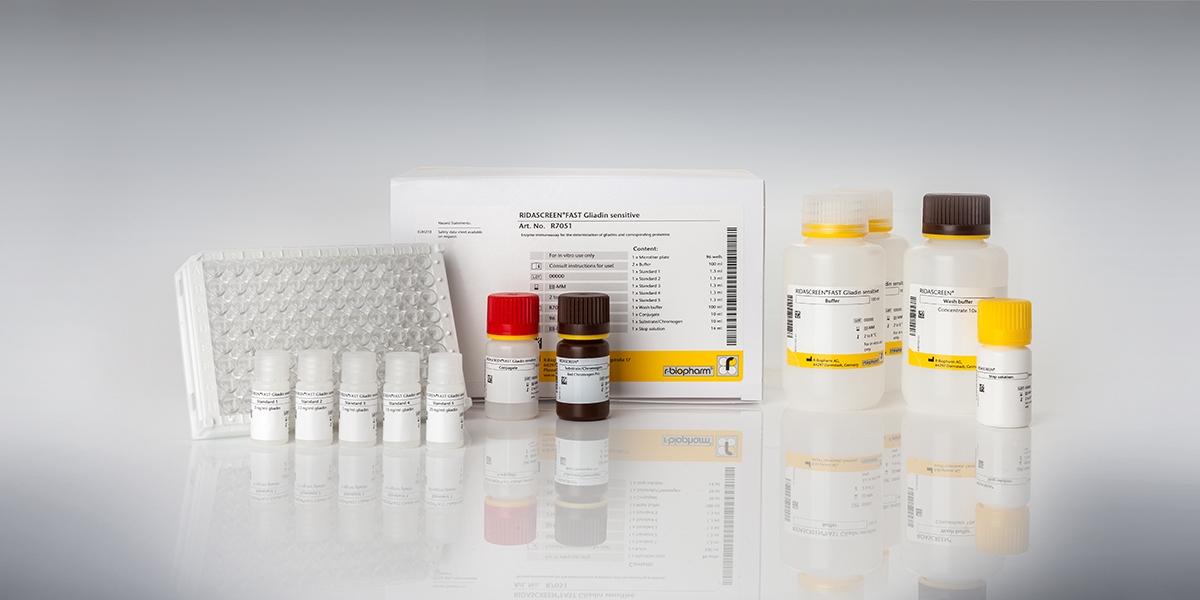
- For laboratories that need to shorten analysis time but still want to carry out quantification by ELISA, RIDASCREEN® FAST Gliadin sensitive – Art. No. R7051 is an option in the R-Biopharm range.
- According to the product catalogue, the method has an incubation time of approximately 30 minutes and a stated detection limit of approximately 0,2 mg/kg gliadin or 0,4 mg/kg gluten, depending on the matrix.
6. Gluten in oats: why is a specific method needed?
- Oats are a case that businesses should pay particular attention to. The control issue not only relates to oat ingredients but also carries the risk of gluten from wheat, rye or barley appearing through cross-contamination during harvesting, transport or production.
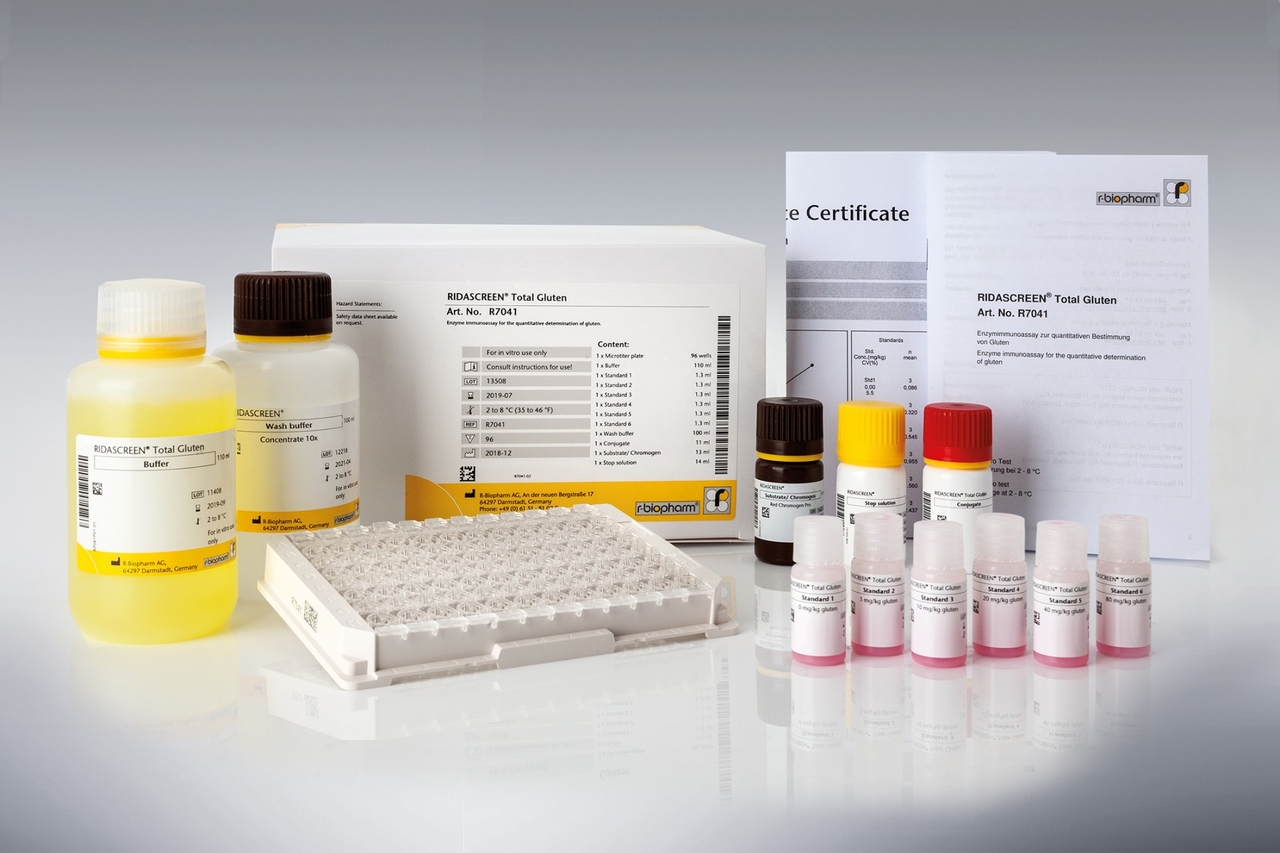
- R-Biopharm offers RIDASCREEN® Total Gluten – Art. No. R7041, a specific ELISA method for quantifying gluten from gluten-containing cereals in oats and oat products. R-Biopharm lists this method with AOAC-OMA 2018.15 First Action.
- This may be a solution of interest to businesses producing:
- Oat milk.
- Oat flour.
- Breakfast cereals.
- Oat biscuits.
- Nutrition bars.
- Products declared gluten-free that use oats.
7. For fermented or hydrolysed foods, one method should not be applied to every matrix
- One challenge in gluten testing is that the production process can change the protein structure. For fermented or hydrolysed foods such as beer, starch and starch syrup, R-Biopharm offers RIDASCREEN® Gliadin competitive – Art. No. R7021.
- This is a competitive ELISA method using R5 to quantify potentially toxic peptide sequences from the prolamins of wheat, rye and barley in fermented or hydrolysed foods.
- This shows that choosing a gluten testing should be based on both the product type and the processing step, rather than using one kit for all matrices.

8. Rapid test or ELISA for gluten: which method should businesses choose?
- Two groups of methods can be visualised according to the control purpose:
- R-Biopharm also builds its gluten testing range by combining rapid tests in the field/on the production line with ELISA in the laboratory, helping businesses control everything from raw materials and line cleaning to the finished product.
9. How should a gluten-free control process be built?
- Instead of only sampling the finished product for testing, businesses can build a multi-tiered control programme.
* Step 1: Supplier control
Identify materials at risk of containing gluten and request appropriate control documentation from suppliers.
* Step 2: Raw material testing
Use a suitable method for gluten testing on materials at risk before they enter production.
* Step 3: Production line control
- After cleaning, test surfaces or CIP water to confirm that the risk of gluten cross-contamination is controlled.
- This is the group of applications suited to the RIDA®QUICK Gliadin rapid test.
* Step 4: Product testing
For gluten-free products, businesses can use ELISA to quantify gluten in the finished product.
* Step 5: Periodic verification
- Combine rapid test data and laboratory results to assess the effectiveness of the cleaning programme, raw material control and cross-contamination control.
10. Why should businesses combine rapid tests and ELISA?
In production practice, rapid tests and ELISA do not necessarily have to be seen as two alternative methods. They can complement each other. Rapid tests are suitable for making quick decisions on the production line:
- Has cleaning been achieved?
- Is there still a risk of gluten contamination on surfaces?
- Is re-cleaning needed before running a gluten-free product?
In contrast, ELISA is more suitable for quantification and control in the laboratory:
- What is the gluten content in the product?
- Does the product meet gluten-free requirements according to the applicable criteria?
- How can the test results be used in quality control activities?
R-Biopharm currently offers both groups of solutions, and the products are all based on the R5 antibody platform in the corresponding gluten immunoassay methods, helping to increase consistency when controlling gluten in the production chain.
11. R-Biopharm – a comprehensive gluten testing solution for businesses
- For food manufacturing businesses, gluten control is not just testing one finished product sample. An effective programme needs to consider:
Raw materials → production line → cleaning/CIP → finished product → periodic verification.
- R-Biopharm offers a range of gluten testing solutions including:
- RIDA®QUICK Gliadin – qualitative rapid gluten test.
- RIDA®QUICK Gluten quant. – quantitative rapid gluten test.
- RIDASCREEN® Gliadin – ELISA for gluten quantification following the R5 Mendez/Codex Type I method.
- RIDASCREEN® FAST Gliadin sensitive – fast and sensitive ELISA.
- RIDASCREEN® Total Gluten – a specific solution for oats and oat products.
- RIDASCREEN® Gliadin competitive – for fermented and hydrolysed matrices.
- Product selection needs to be based on the matrix type, the testing purpose, qualitative/quantitative requirements and the laboratory workflow of each business.
Conclusion
- For food manufacturing businesses gluten-free, gluten control needs to be carried out throughout the production process rather than only testing the final product.
- From input materials and equipment surfaces to CIP water and the finished product, businesses can establish suitable control points.
- In which:
- RIDA®QUICK rapid test helps with quick and convenient testing in the production area.
- RIDA®QUICK Gluten quant. supports rapid quantification of gluten.
- ELISA RIDASCREEN® is suitable for quantitative testing in the laboratory.
- The specialised ELISA ranges help businesses handle specific matrices such as oats, fermented foods and hydrolysed foods.
- If a business is building a process for gluten testing, cross-contamination control or confirming gluten-free products, choosing the right test method from the start will make the quality control programme more effective and better suited to each product type.
- Contact us for advice on choosing an R-Biopharm gluten test suited to your matrix and laboratory workflow.