Is ATP measurement effective compared with A3 measurement when monitoring surface hygiene in healthcare settings ?
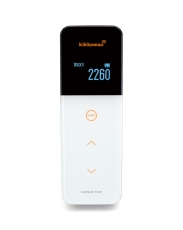
Evaluating the effectiveness of surface hygiene is the first step in preventing infections in healthcare settings. The ATP tests are widely used to evaluate the effectiveness of cleaning processes. This test is easy to use and gives immediate results. However, ATP can be metabolised and broken down into ADP and AMP. Recently, a monitoring test for total adenylate [ATP + ADP + AMP] (abbreviated as A3) has been developed by Kikkoman. The study by M. BAKKE and colleagues used the LuciPac A3 Surface/Lumitester PD-30 ATP measuring instrument (Kikkoman Biochemifa, Tokyo , Japan). The study results evaluated the usefulness of the A3 test in monitoring the surface hygiene process.
1. Study comparing the ATP measurement method and the A3 measurement method
Methods
The sensitivity of the ATP measurement and A3 were compared using blood and debris collected from used gloves. The performance of the A3 measurement in monitoring the cleanliness of frequently touched surfaces in hospitals and endoscopes at each cleaning step was also evaluated.
Results
For diluted blood samples, the A3 measurement values were stable, even though ATP was rapidly degraded.
In glove debris, the A3 amount was 20 times the ATP amount.
1.1 General introduction to the study comparing the ATP measurement method and the A3 measurement method
Frequently touched surfaces, surgical instruments and endoscopes that are contaminated are a cause of pathogen transmission in healthcare facilities. Cleaning, disinfection and sanitisation of surfaces, instruments and hands are basic steps to reduce the possibility of contamination and infection. Thorough cleaning is a prerequisite for effective disinfection/sanitisation. According to the disinfection and sanitisation guidelines in healthcare facilities of the US Centers for Disease Control and Prevention (CDC), residual organic matter on surfaces can hinder the disinfection/sanitisation process, and some organic substances can inhibit the antimicrobial activity of the disinfectant. This interference occurs because chemical reactions can take place between the disinfectant and the organic matter, leading to a reduction in the microbicidal. In addition, organic material can act as a physical barrier protecting microorganisms from the disinfectant. Therefore, methods for assessing cleanliness and methods for cleaning that are fast and easy are in demand in healthcare facilities.
In the traditional method, visual inspection is used to assess the cleanliness of a surface, and this method depends on the eyesight of the inspector. Moreover, some specific structures, such as the inner surfaces of endoscopes, are very difficult to inspect. Measuring the number of viable bacteria (VBC) using culture plates has also been used. However, this method takes 24-48 hours to obtain results. Determining contamination through residual protein is also a widely used method. However, the measurement process is often complex and costly and cannot give immediate results. PCR tests have high sensitivity and specifically detect bacterial species, but cannot be performed in the field.
Although Swab test adenosine triphosphate (ATP) cannot accurately identify the type of bacteria, they allow rapid evaluation of surface hygiene processes to prevent healthcare-associated infections.
ATP is found in all living organisms. Intracellular ATP is mainly used to drive energy-requiring processes such as active transport, cell motility and biosynthesis. Extracellular ATP is regarded as a powerful signalling molecule. Therefore, ATP plays more roles than being an energy source for both prokaryotes and eukaryotes. The presence of ATP on a surface indicates improper cleaning and the presence of contamination, including organic and bacterial debris. Although the presence of ATP does not always imply the presence of living cells, a high ATP density after surface cleaning generally indicates a higher risk of bacterial retention than low ATP levels. The US Centers for Disease Control and Prevention (CDC) has listed ATP testing as one of the methods that can be used to quickly and effectively evaluate the surface hygiene process.
However, conventional ATP tests have one limitation: ATP is degraded into adenosine diphosphate (ADP) and adenosine monophosphate (AMP) by heat, acid/base and enzymes. Recently, a new hygiene monitoring system has been developed to measure the total content of adenylate [ATP + ADP + AMP] based on the A3 test, which, with the combination of two enzymes, pyruvate kinase and pyruvate phosphate dikinase, can convert ADP into ATP and AMP into ATP respectively. The newly developed A3 test system simultaneously provides stable bioluminescence signals for ATP, ADP and AMP.
1.2 Reagents and devices LuciPac A3 / Lumitester used in the comparative study of ATP and A3 measurement
Reagents for the analysis of ATP·2Na, ADP·K and AMP·2Na were purchased from Oriental Yeast (Tokyo, Japan).
ATP, ATP + AMP and A3 were measured using commercially available test kits, LuciPac II / Lumitester C-110, LuciPac Pen / Lumitester PD-30 and LuciPac A3 Surface/Lumitester PD-30 (Kikkoman Biochemifa, Tokyo , Japan),
The sampling swabs and test devices with pre-integrated reagents and extraction buffers are included in these kits. After removing the test swab from the tube, use a pipette to apply the sample solution onto the swab. Then the swab is returned to the reaction tube and the lid is closed. Shake the tube to thoroughly mix the sample, extraction solution and reagent. Then insert the reaction tube into the Lumitester .
1. 3 Comparison of the ATP measurement method and the A3 measurement method on two sample matrices
1.3.1 In diluted blood samples
The experiment was carried out at the Nippon Biological Research Laboratories, Saitama, Japan. Diluted blood samples were prepared by diluting blood 10 times with nuclease-free water and incubating at 35 °C for 2 hours. The ATP, ATP + AMP and A3 tests were performed within the same period. The measurements were repeated 5 times and the average values were calculated. The ratios are expressed as relative values via the RLU value.
The ATP, ATP + AMP and A3 tests showed the ratios (ATP + AMP)/ATP and A3/ATP of 1.4 and 1.7 respectively, and the ATP: ADP: AMP ratio was 1: 0.3: 0.4.
In freshly diluted blood samples ATP is predominant. Next, after incubating the samples at 35 °C for 2 hours, the RLU measurement results of ATP, ATP + AMP and A3 were: 3882, 34733 and 39314 after 1 hour and 226, 33616 and 33996 after 2 hours. The ratios (ATP + AMP) / ATP and A3 / ATP after 2 hours were 148.7 and 150.4, and the ATP: ADP: AMP ratio was 1: 1.7: 147.7..
These results demonstrate that the ATP content has decreased to below 20% after 1 hour and is almost completely degraded into AMP after 2 hours. Therefore, the A3 test is an effective tool for evaluating the cleaning process of blood-contaminated surgical instruments, especially for instruments that have been used after 2h.


1.3.1 In used glove blood samples
Powder-free and nitrile gloves were worn on the hands for 3 hours. Then 5 ml of nuclease-free water was put into the gloves and the sample solution was recovered. A blank sample was also prepared as described above with unused gloves. The ATP, ATP + AMP tests and A3 were performed with 100 µl of each sample. The sample RLU was calibrated against the RLU of the blank. The measurements were repeated 3 times. The ATP + AMP and A3 to ATP ratios for each sample were calculated, and their average values were then obtained.Glove samples usually contain sweat, skin cells and bacteria. The values of (ATP + AMP)/ATP and A3/ATP were 8.2 and 20.1. The relative values of ADP and AMP were 11.8 and 7.2 times higher than ATP. This shows that ATP is the minor component and ADP is the main component of adenylate in glove samples.
The A3 measurement method can achieve sensitivities 20 and 2.4 times higher in detecting debris from hands than the conventional ATP test and the ATP + AMP test respectively. This is also a useful method for evaluating environmental cleanliness during hand washing.
2. ATP/ A3 measurement to assess viable microorganisms on frequently touched surfaces in hospitals
The cleanliness of frequently touched surfaces in healthcare facilities before and after cleaning was assessed by adenylate measurement and VBC. After cleaning, the A3 amount decreased at all measurement points and the average reduction rate was 87%. For example: the A3 and VBC values decreased from 1280 RLU and 1670 cfu before cleaning to 100 RLU and 0 cfu after wiping. For the bed rail, 1100 RLU and 50 cfu before cleaning improved to 160 RLU and 0 cfu after cleaning. The values of (ATP + AMP)/ATP and A3/ATP for all measurement points were 4.3 and 7.5 respectively. The relative values of ADP and AMP were 3.2 and 3.3 times that of ATP. Samples containing a large amount of microorganisms tend to show high A3 values. If the standard RLU value is set at a typical value for high-contact surfaces (for example: 200 RLU), then the ATP measurement method shows many false negatives. These data indicate that the sensitivity of the ATP test may not be sufficient to monitor hygiene of frequently touched surfaces in hospitals and the A3 test can detect better.
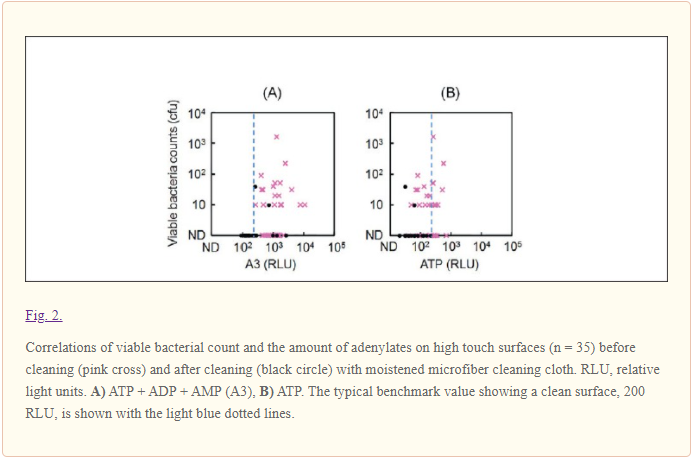
The ATP hygiene monitoring tests are widely used in healthcare facilities. However, the study by M. BAKKE has demonstrated that checking ATP levels alone may be ineffective in checking cleaning processes for blood-contaminated instruments and frequently touched surfaces in healthcare facilities. In diluted blood samples, ATP is rapidly degraded into AMP via ADP, and AMP accumulates. In used glove samples and on frequently touched surfaces, ATP accounts for only about 5% and 13% of A3 respectively. As a result, if the standard value is not appropriate, the ATP method can produce false negative results for frequently touched surfaces. On the other hand, the A3 measurement provides higher sensitivity for the positive signal even when ATP is degraded.
3. Effect of chemicals on the A3 measurement method on the Lumitester smart device
A previous study has shown that inhibition by antimicrobial compounds, such as sodium hypochlorite (500 ppm available chlorine), ethanol (about 80%) and benzalkonium chloride (0,1%) on the A3 measurement process at a 10% volume dilution is negligible. Additional studies have also shown that the presence of hydrogen peroxide (3%) and cleaning agents containing detergents, enzymes, e.g. protease, and rust inhibitors has little effect on A3 tests under the same conditions.
Further reading on the study above:
https://www.ncbi.nlm.nih.gov/pmc/articles/PMC6614569/
Lumitester Smart measuring device and Lucipac A3 test strips
https://pacificlab.vn/vi/news/blog-kien-thuc/kiem-tra-vi-sinh-be-mat-bang-may-do-atp-cong-nghe-moi-lucipac-a3-32.html
Source: Evaluation of the total adenylate (ATP + ADP + AMP) test for cleaning verification in healthcare settings