
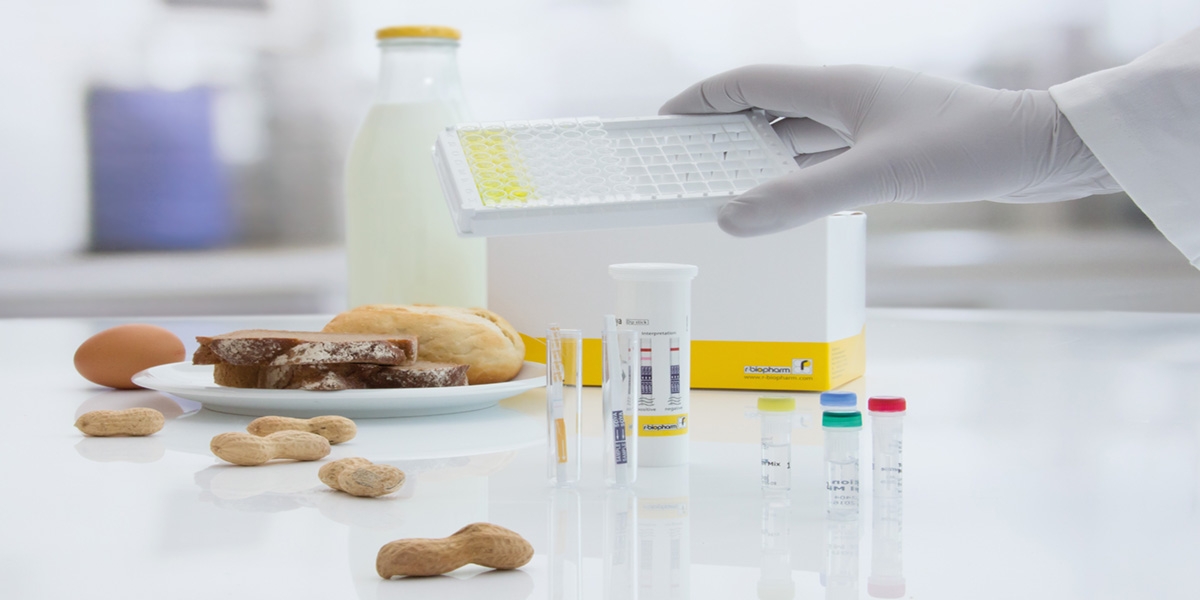
- One of the most accurate and reliable analysis methods today is allergen ELISA testing. The company R-Biopharm – a leading test kit manufacturer from Germany – provides dedicated kits that help to detect and quantify common allergens such as: gluten, milk, egg, soy, hazelnut, peanut (groundnut), crustacean shellfish, etc.
- To perform allergen testing using the ELISA method of R-Biopharm, users need to prepare adequate ancillary equipment and consumables as follows:
1. Required ancillary equipment
- ELISA reader (Microplate reader): reads the optical density (OD) at the appropriate wavelength, usually 450 nm.
- Vortex shaker (plate shaker): ensures the reaction solutions are mixed evenly in the wells.
- Centrifuge: separates the solid particles from the solution during sample preparation.
- Water bath (Water Bath): keeps the sample incubation temperature stable (usually at 37°C) if the kit requires it.
- Sample grinding machine or tool (laboratory mincer/grinder, pestle and mortar, Ultra-Turrax, or Homogenisator) (choose whichever is easiest to operate and most convenient to clean before and after preparing each sample, in order to limit cross-contamination between test samples)
- Analytical balance: accurately weigh the sample to be analysed.
- Refrigerator/cold storage: store chemicals and ELISA kits at 2–8°C.
2. Consumables to prepare
- ELISA plates (microplates): some test kits already include them, otherwise some should be available as replacements.
- Single-channel micropipettes with a volume range from 10 - 100µl, 100 - 1000µl or from 20 - 200µl, 200 - 1000µl. Multi-channel micropipettes (8 or 12): volume range from 5 - 50µl, 50-300µl.
- Sterile tips in various sizes: suitable for the pipette.
- Test tubes, centrifuge tubes, eppendorf tubes: used for the sample extraction step and solution preparation.
- Laboratory wipes, gloves, masks: ensure hygiene and biosafety.
- Wash solution (Wash Buffer): usually included in the kit or needs to be prepared according to the instructions.
- Distilled water or ultrapure water: used to prepare reagents or as an extraction solvent for samples.
- Reservoir (reagent trough).
- Neutral glass beakers with a volume of 250 ml or 500 ml or 50 ml centrifuge tubes (holding the test solutions after dilution: Allergen Extraction buffer, wash buffer,…
- In the case of running many test samples at the same time (>24 samples/test run), it is recommended to buy additional low binding ELISA plates (Greiner bio-one Cat. No.655101 or Mikrotiter Assembly Breakable Strip 1x8, Thermo Scientific)
- Stopwatch with a buzzer when the time is up.
3. Chemicals, reagents (depending on each indicator, here we give the example of the Peanut test kit)
- Double-distilled water or deionised water
- Skim milk powder
- 70o alcohol (for cleaning Micropipettes, testing work areas,…
- NaOH 1N (adjust the pH to neutral, in case the sample matrix is alkaline)
- HCl 1N (adjust the pH to neutral, in case the sample matrix is acidic)
4. Notes when performing R-Biopharm allergen ELISA testing
- Every kit from R-Biopharm comes with detailed instructions, including sample extraction methods suitable for each type of food matrix (dairy products, confectionery, meat, canned food...).
- Strictly follow the incubation procedure, reaction time and washing steps to ensure the accuracy and repeatability of the results.
- It can be applied to testing both raw materials and finished products during production or circulation on the market.
Performing allergen testing using the allergen ELISA test method of R-Biopharm is an ideal choice for food testing laboratories, production facilities or food import-export companies. Proper preparation of equipment and consumables will make the testing process smooth, accurate and time-saving.
👉 Read more in the article Which test methods should you choose to control allergens in food?