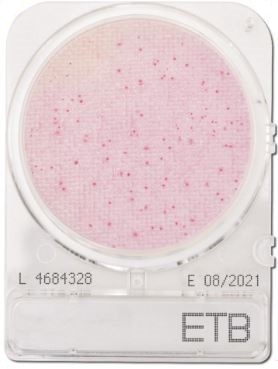
1. Enumerating Enterobacteriaceae by the plate count method
Enumerating Enterobacteriaceae by the plate count method is one of the common ways to assess the presence and number of microorganisms in food, beverages, and other environmental samples. Below are the basic steps of the method:
Step 1: Prepare the test sample
- Initial sample: the food, beverage, or environmental sample needs preparing and diluting (if necessary) so the bacterial count can be determined accurately.
- Dilute the sample: use decimal dilution (for example 1:10, 1:100, 1:1000,...) to reduce the bacterial density in the sample. This helps make sure the countable colonies on the plate fall within a suitable range (about 30–300 colonies/plate).
Step 2: Prepare the culture medium
- Choose a suitable medium: a medium selective for Enterobacteriaceae such as VRBG (Violet Red Bile Glucose Agar) is commonly used. This medium suppresses bacteria that are not Enterobacteriaceae and favors their growth.
- Pour the Petri dishes: once the medium is prepared, pour it into sterilized Petri dishes and leave to cool until it sets.
Step 3: Inoculate the sample
- Inoculate the sample: take a defined volume (usually 1 ml) of the diluted sample and add it to the Petri dish containing the culture medium.
- Overlay the medium: after inoculating the sample, pour an additional layer of VRBG or a similar medium over the top so the bacteria can grow in a suitable environment.
Step 4: Incubate the plates
Put the inoculated Petri dishes into the incubator at a suitable temperature (usually 37°C) for 18–24 hours.
Step 5: Count the colonies
After incubation, count the number of colonies on the plate. Enterobacteriaceae colonies are usually red or pink because of the color indicators in the medium. Plates with 30 to 300 colonies are the ones selected for accurate counting.
Step 6: Calculate the bacterial count
Use the following formula to compute it:

Where:
- Counted colonies: the total number of colonies on the Petri dish.
- Dilution factor: the dilution coefficient of the sample.
- Inoculation volume: the amount of sample plated (usually 1 ml).
* Note:
- Make sure the equipment is carefully sterilized to avoid contaminating the sample.
- The final result is usually expressed as CFU/ml or CFU/g (colony forming units per ml or per gram), depending on the test sample.
- The plate count method is a direct and accurate way to quantify Enterobacteriaceae in many kinds of sample.
2. The method using pre-poured Compact Dry plates
- Compact Dry is a fast and convenient microbial enumeration method, widely used in food testing. With the Compact Dry plate dedicated to Enterobacteriaceae (Compact Dry ETB), enumerating the bacteria of this group becomes simpler and saves time compared with traditional methods. See the product in detail here.
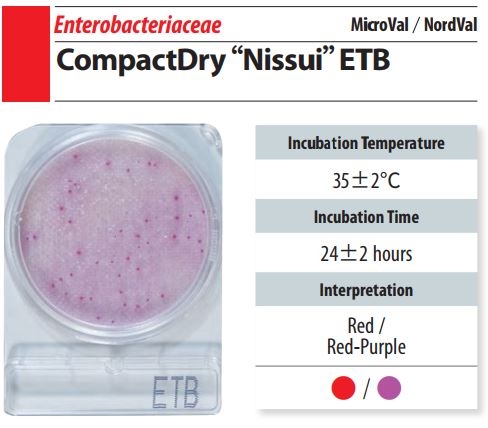
- Below are the detailed steps for enumerating Enterobacteriaceae with Compact Dry ETB plates:
1. Prepare the test sample
- Food sample: take a suitable amount of the food sample for analysis. Depending on the type and form of the sample (solid, liquid), it may need diluting.
- Dilute the sample: if needed, the food sample is diluted with a buffer diluent such as physiological saline (0.85% NaCl) or peptone solution. Usually the sample is diluted in decimal steps such as 1:10, 1:100, or 1:1000, depending on the expected bacterial density.
2. Inoculate onto the Compact Dry ETB Enterobacteriaceae plate
- The Compact Dry ETB plate: this is a plate with dry medium already inside, designed for testing Enterobacteriaceae. The medium includes the necessary nutrients and a color indicator.
* How to use
- Open the lid of the Compact Dry plate.
- Take 1 ml of the diluted sample and drop it directly onto the center of the plate.
- The sample will spread out on its own and be absorbed into the dry medium on the Compact Dry plate.
3. Incubate the sample
- Incubation temperature: once the sample is plated on the plate, put the lid back on and incubate at a suitable temperature, usually 35°C.
- Incubation time: the incubation time is 24 hours.
4. Read the result
- After incubation, the Enterobacteriaceae develop into red or pink colonies, thanks to the reaction mechanism with the color indicator in the Compact Dry ETB Enterobacteriaceae plate.
- Count the colonies: count the number of red or pink colonies on the Compact Dry plate with the naked eye, or use an automated counter if available.
- Bacterial count: the count of colonies found reflects the number of Enterobacteriaceae in 1 ml of the original test sample, or can be recalculated if the sample was diluted.
5. Calculate the bacterial count
- If the sample has been diluted, the number of Enterobacteriaceae is calculated with the formula:
- Where:
- Counted colonies: the number of red/pink colonies on the Compact Dry plate.
- Inoculation volume: the amount of sample used (usually 1 ml).
- Dilution factor: the dilution coefficient of the sample, if it was diluted.
* Advantages of the Compact Dry method
- Fast and easy to carry out: no separate culture medium preparation is needed; the dry medium already on the Compact Dry plate is very convenient.
- Saves time and space: incubating samples on Compact Dry plates takes up less space than traditional Petri dishes.
- Highly accurate: the medium is specifically designed to detect and quantify Enterobacteriaceae precisely.
- Clear results: the colonies have a distinctive color (red/pink), making them easy to distinguish and count.
* Notes when using Compact Dry ETB
- Carry out the correct aseptic technique in sampling and inoculation to avoid cross-contamination.
- Store the Compact Dry plates properly according to the manufacturer's instructions so the quality of the medium is not affected.
- The pre-poured agar medium plate Compact Dry ETB Enterobacteriaceae is an excellent choice for food laboratories because of its convenience and accuracy in testing Enterobacteriaceae.
Choosing the right method not only detects the presence of Enterobacteriaceae quickly and accurately, but also plays an important part in protecting public health and raising product quality. Above are the methods for enumerating Enterobacteriaceae by the plate count method; please contact us for advice on the solution that fits your needs!