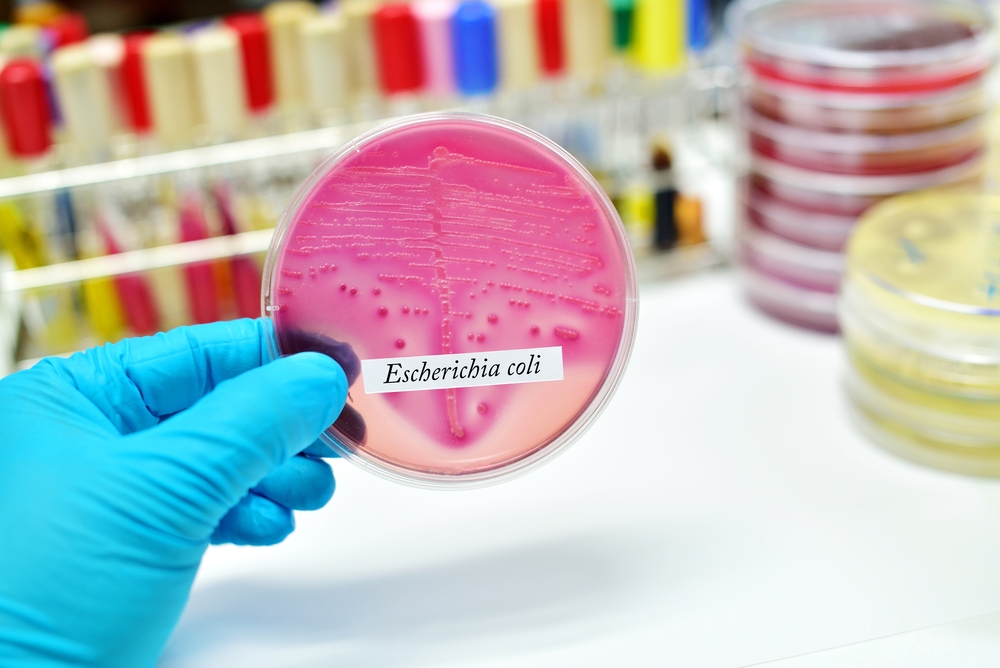
Detecting and distinguishing E. coli from other Coliform bacteria helps assess contamination status and the effectiveness of the disinfection process. To identify and isolate them, specific culture media play an extremely important role. Below are the common media types and application techniques for culturing E. coli and Coliform.
1. MacConkey Agar medium
– MacConkey Agar is one of the first selective culture media, designed to detect and differentiate Gram-negative bacteria, including E. coli and the various Coliforms. This medium contains lactose and a pH indicator (neutral red) that helps distinguish between lactose-fermenting and non-lactose-fermenting bacteria.
* Characteristics
– Colony color
+ Lactose-fermenting bacteria (such as E. coli) produce pink or red colonies.
+ Non-lactose-fermenting Coliforms give colorless or white colonies.
– Selective for Gram-negative bacteria: the bile salt content in the medium suppresses the growth of Gram-positive bacteria, allowing only Gram-negative bacteria to grow.
* Applications
MacConkey Agar is widely used in food safety monitoring and water testing. It allows E. coli and Coliform to be detected in water samples, helping to assess the level of contamination.
2. EMB Agar medium (Eosin Methylene Blue Agar)
EMB Agar is a selective medium dedicated to Gram-negative bacteria, capable of differentiating lactose-fermenting bacteria. This medium contains eosin and methylene blue, two indicators that highlight E. coli colonies with a characteristic color.
* Characteristics
– E. coli colonies: a strong lactose fermenter, producing black colonies with a characteristic green metallic sheen that is easy to recognize.
– Coliforms: give pale purple or colorless colonies if they do not ferment lactose.
* Applications
EMB Agar is particularly effective for isolating and identifying E. coli in water or food samples. Because it gives E. coli colonies the characteristic green metallic sheen, EMB is very useful in the laboratory, especially when fast and accurate results are needed.
3. Chromogenic Coliform Agar medium
Chromogenic Coliform Agar is a modern culture medium developed to quickly identify Coliform bacteria and E. coli through the characteristic enzymes they produce. These enzymes act on the chromogenic substrates in the medium, producing easily recognizable colors.
* Characteristics
– Colony color
+ E. coli colonies are usually blue due to the enzyme β-glucuronidase.
+ Other Coliforms give pink or purple colonies thanks to the enzyme β-galactosidase.
* Applications
This medium can detect E. coli and Coliform without many supporting steps. This reduces the time and effort in food and drinking water testing laboratories.
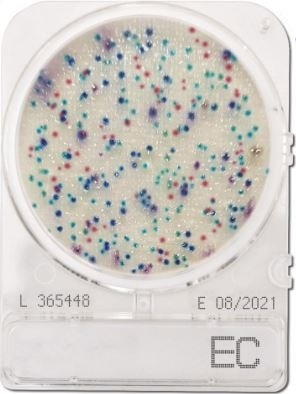
4. Compact Dry EC Ecoli Coliform plate (E. coli/Coliform Count Plate)
The Compact Dry EC Ecoli Coliform plate is a pre-poured, freeze-dried culture plate that is very convenient for counting E. coli and Coliform directly without preparing any medium.

* Characteristics
– Easy to use: the plate comes with a dry medium; just add the sample and culturing can be performed.
– Clear color differentiation: E. coli colonies are usually blue, while other Coliform bacteria are pink.
* Applications
– The Compact Dry EC Ecoli Coliform plate is a convenient choice for laboratories that cannot prepare complex culture media. The Compact Dry EC plate also allows the colonies to be counted quickly and easily. See details on this product here.
5. Brilliance E. coli/Coliform Selective Agar medium
Brilliance E. coli/Coliform Selective Agar is an improved medium that quickly distinguishes E. coli from other Coliform bacteria thanks to proprietary pigments.
* Characteristics
– E. coli colonies: characteristic blue thanks to β-glucuronidase.
– Coliforms: give pink or purple colonies that are easy to distinguish.
* Applications
Brilliance Agar is widely applied in food and drinking water technology to monitor and ensure microbiological safety. With its clear and fast results, this medium is favored in laboratories demanding high efficiency.
6. General culture conditions for E. coli and Coliform
To optimize colony growth and obtain reliable results, the culture conditions usually follow these standards:
– Incubation temperature: 37°C is the ideal temperature for E. coli and Coliform growth.
– Incubation time: depending on the medium and requirements, usually 18–24 hours.
– Inoculation method: depending on the medium, either the spread technique or the point-inoculation method can be used to make colony counting easier.
Choosing the right culture medium plays a key role in detecting and distinguishing E. coli from other Coliform bacteria. Depending on specific needs — such as speed of results, convenience, and method specificity — laboratories can choose the most suitable medium.
With the advancement of culture media such as the Compact Dry EC plate or Brilliance Agar, detecting and controlling microbiological quality is becoming more and more accurate and rapid, contributing importantly to protecting public health.