
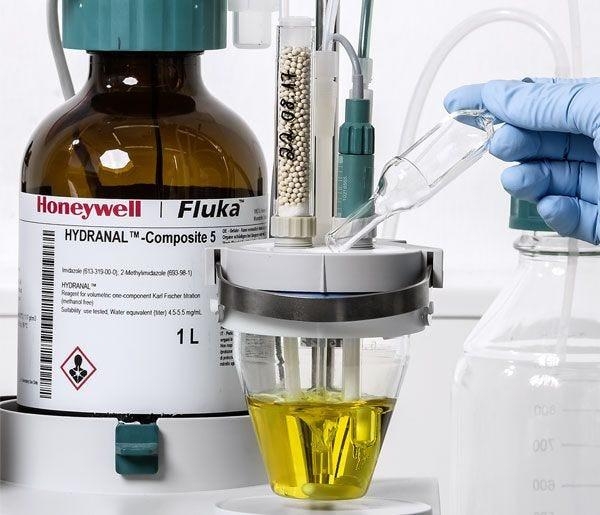
1. The emergence of the Karl Fischer titration method
- The Karl Fischer technique for determining water content, invented in 1935 by Karl Fischer, is a titrimetric method based on the Bunsen reaction. Karl Fischer titration is the widely accepted method for measuring water content in all kinds of substances, including chemicals, oils, pharmaceuticals and food. In 1979, Dr. Eugen Scholz improved the Karl Fischer titration method by replacing the toxic pyridine with imidazole. This innovation became the foundation of the Hydranal™ product line, the world's leading pyridine-free reagents for Karl Fischer titration.
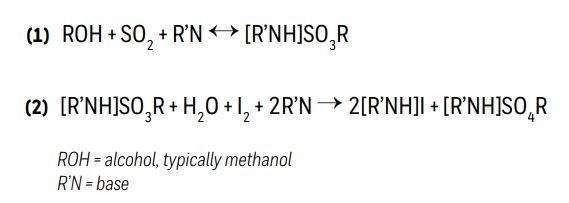
- The oxidation of alkylsulfite to alkylsulfate in reaction (2) consumes water, ideally only from the sample. Because water and iodine are consumed in a 1:1 stoichiometric ratio, the water content of the original sample is calculated from the amount of iodine needed to complete the reaction.
- Iodine is measured by volume or by coulometry
1.1. How the base affects reaction kinetics
- The type of base (R’N) and its concentration affect the overall reaction rate.
- Traditionally, pyridine has been used as the base. However, due to its weak basicity, pyridine cannot fully neutralize the alkyl-sulfurous intermediate. As a result, reaction (1) proceeds slowly, does not go to completion and the endpoint is not stable. Because of this lack of stability, the reproducibility of the results is usually very poor. In addition, pyridine has an unpleasant odor.
1.2. Imidazole and 2-Methylimidazole as alternatives to pyridine
- Dr. E. Scholz and his research group sought to replace pyridine with a stronger base that has a higher affinity for alkylsulfite. Imidazole was even found to offer more advantages over pyridine than just the absence of an unpleasant odor. Imidazole allows reaction (1) to proceed rapidly and yields a stable endpoint.
- Later, researchers found that adding a second base, 2-methylimidazole, to imidazole enhances stability and reduces unwanted crystallization.
- From the pioneering research of Dr. E. Scholz to today's ongoing product improvements, Honeywell offers a wide range of Karl Fischer reagents for both volumetric and coulometric titration for almost every type of sample, refined to meet a variety of standards.
- With the integration of the Fluka™ product line into Honeywell Research Chemicals, Hydranal has become an important part of the overall portfolio. Hydranal reagents and water standards are always developed and produced at our plant in Seelze, Germany, meaning you can rely on composition, quality, service and technical support as you always have.
2. Advantages of HYDRANAL reagents (Honeywell Fluka)
- High titration speed
- Stable endpoint
- Accurate results
- Long shelf life
- Broad application capability
- World-class technical support
3. Overview of the HYDRANAL product line
- Hydranal Composite: The most flexible and most widely used reagent for single-component volumetric titration.
- Hydranal Special Media: Special reagents such as Metanol Rapid, E-Types and K-Types.
- Hydranal Titrant/Solvent: Reagent for two-component volumetric titration.
- Hydranal-Coulomat: Coulometric titration reagent for samples with low water content.
- Hydranal-Water Standards: Standards with verified water content for determining sample dilution factors, monitoring accuracy, accuracy, confirmation and verification of Karl Fischer titrators.
- Hydranal-CRM Water Standards: Reference materials certified for determining sample dilution factors, monitoring accuracy, accuracy, confirmation and verification of Karl Fischer titrators.
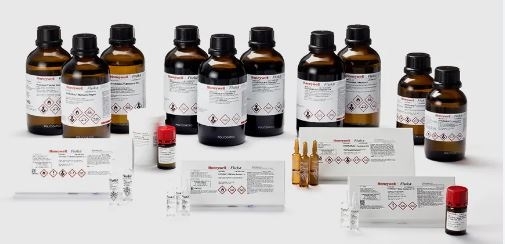
PacificLAB is proud to be the official supplier of chemical products and Hydranal reagents (brand Honewell Fluka) in Vietnam. The Hydranal catalog is always diverse, goods are always in stock, and delivery service is attentive. In particular, pricing is extremely competitive. Customers can refer to the details of the products we supply at the following link:
https://pacificlab.vn/vi/shops/group/honeywell/