
Determination of Moisture in Pharmaceuticals
Moisture determination is an important quality control parameter in pharmaceutical manufacturing, from incoming raw material testing and in-process control to the quality testing of finished products. Moisture determination is considered a pharmacopoeial test, and it is also one of the important quality parameters in stability testing of drugs. Moisture in raw materials: is an important factor in the blending and granulation process in drug manufacturing. Moisture affects the overall flow properties and consistency of the blend. For finished tablets and capsules, moisture is one of the quality parameters that counts toward mechanical strength, dissolution and overall shelf-life stability.
Moisture determination for process quality control
There are many different types of tablets. Based on the granulation method used for tablet compression in manufacturing, there are 3 tablet manufacturing methods (covering both active ingredients and excipients): tablets can be divided into 3 main types: directly compressed tablets, wet granulation tablets and dry granulation tablets. In all of them, size reduction is an important prerequisite step common to both tablet and capsule manufacturing.
In the wet granulation tablet process, the powder mass is first wetted. Then the granules are sieved, dried and screened. After drying, the granules must reach a certain moisture level before they can be compressed into tablets. At this critical point in the process, the residual moisture must be controlled. If the granules are too wet, the tablets will not meet hardness requirements. During storage, microorganisms easily find conditions to grow. At the same time, the quality of the active substance may be altered by the presence of water.
Whatever the tablet manufacturing method, moisture content determination in the material blend must be carefully controlled to ensure the overall shape, strength, dissolution and shelf life of the tablets. As an important quality factor, moisture determination must be performed before tablet compression. If the blend is too dry, the tablets will not be strong enough, and if it is too wet, the tablets will not meet the required hardness.
In gelatin capsule manufacturing, moisture is an important quality parameter for maintaining capsule strength and dissolution. Moisture is typically determined in raw gelatin powder and empty gelatin capsules.
Moisture determination for output quality control
Moisture testing in tablets and capsules is governed by current pharmaceutical regulations. Loss on drying can be determined with a conventional drying oven. However, moisture testing by the drying method usually takes at least two to three hours. This sometimes slows down production because the moisture result is very important for the production and release process. In addition to the drying method, there are also other moisture determination methods that are much faster.
Moisture determination methods by drying
Moisture determination by the drying method
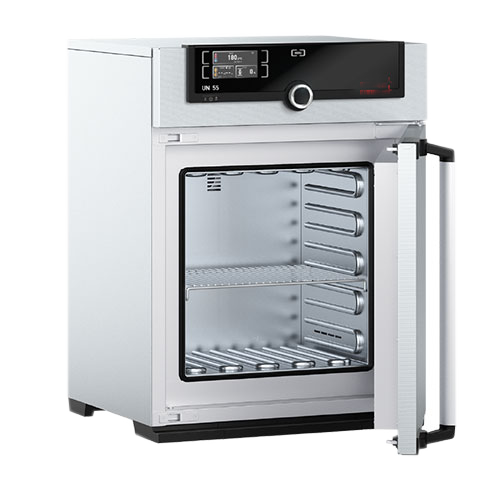
Conventional drying ovens used for moisture determination
Moisture determination by moisture analyzer
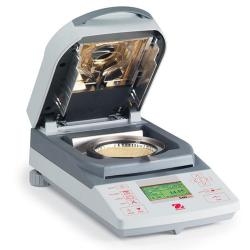
Moisture analyzer for determining moisture in pharmaceuticals
Principle:
The sample is dried at a temperature and for a drying time according to the requirements of the pharmacopoeia. The moisture of the sample is calculated from the mass loss during drying.
Equipment:
- Analytical balance (able to weigh accurately to 1 mg)
- Drying oven conventional drying oven or a drying oven with pressure adjustment and vacuum pump
- Desiccator
- Weighing dish: made of glass or porcelain, with a lid.
Note:
- The time the sample is exposed to air should be as short as possible.
- If the sample is stored in a refrigerator, bring the sample temperature to room temperature before weighing.
- The oven door must be closed throughout the drying process
Advantages: reference method, requires no special equipment, can be combined with the laboratory's drying oven.
Disadvantages: time-consuming
Principle:
A moisture analyzer is a moisture meter operating on the principle of loss on drying (abbreviated as LoD), and is the standard method used to determine the moisture of a material by drying the samples inside the balance.
Equipment:
- Moisture analyzer
Advantages of the moisture determination by moisture analyzer:
- Compact compared with a conventional drying oven, easy to move
- Fast, accurate analytical results, good repeatability
- Can be connected to a computer to monitor the drying process
Note:
For tableted drugs the sample must be converted into a powder blend
* Some typical drying temperatures for drugs/active substances:
- Dry cimicifugin extract, effervescent tablets (90°C)
- Gelatin capsules, multivitamin tablets, Dihydralazine sulfate-2,5-hydrate, Ca methyltetrahydrofolate(120°C).
- Quinine sulfate, Niclosamit monohydrat, tablets packaged in foil(130°C),
- Quinine hydrochloride (135°C),
- Starch-stearic acid mixture, Fe fumarate and Fe gluconate, amino acid mixture (140°C),
- Starch-containing tablets, Levothyroxin natri, Metamizole natri, Cysteine hydrochloride monohydrat, Cyproheptadine hydrochloride, Carbidopa (150°C),
- N- (omega) nitro-L-arginine (160°C)
- Antibiotic tablets, Morphin hydrochloride, Ethacridine lactate monohydrate, Metixene hydrochloride, Quinidine sulfate , (180°C)
- Serotonin, Bupivacaine hydrochloride, Histidine hydrochloride monohydrate (200°C),
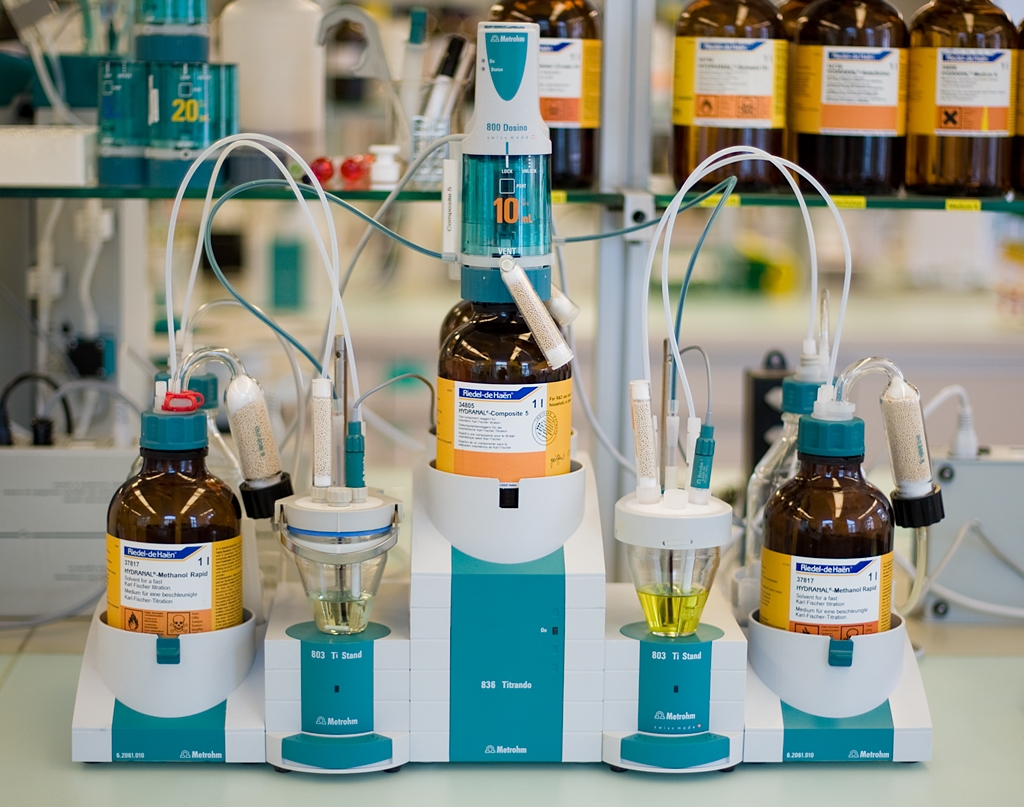
Moisture determination by the Karl Fischer titration method
Principle:
Karl Fischer titration is a titrimetric (electrical) method used to determine the water content of liquid and solid samples. The Karl Ficsher method is also the standard method for determining water content in pharmaceutical samples.
Equipment:
The method used for drug samples is mainly Volumetric Karl Ficsher (>95% for drug samples)
Application scope, solvents and analysis conditions for some pharmaceuticals
The important standards used are: the European Pharmacopoeia (EP - European Pharmacopoeia), the US Pharmacopeia (UP - US Pharmacopoeia), in which details are given on sample size/sample weight, the permitted water content range and the reagents to be used.
According to the European Pharmacopoeia EP:
- - Methanol and pyridine are chosen as solvents (see also the solvents for API moisture analysis here), determination of water content in the following substances by direct Volumetric Karl Ficsher titration method: Pyrazolone, cipofloxacin hydrochloride, effortil, folic acid, nicotinic acid and scopolamine hydrobromide.
- - In methanol at 50°C: determination of water content in Glucose, Na-hyaluronic acid salt, lysine acetylsalicylate, acetylsalicylic acid, Ca folinate and lactose monohydrate.
- - The water content of the following substances has been determined in solvent mixtures (in some cases after heating to 50 ° C)
+ Mannitol and sorbitol (methanol / formamide 2: 1)
+ Erythromycin (pyridine)
+ Isomalt, glucosylmannitol / glucosylsorbitol (metanol / formamit 1: 1, matrix)
+ Mg aspartat, Mg lactat, Ca glycerophosphat, coffein (metanol / formamit 2: 1, 50°C)
+ Glyxerol monostearat and suppositories (metanol / cloroform 2: 1)
+ Lanolin (metanol / cloroform 1: 1)
+ Serine phosphoric acid (metanol /formamide 2: 1, 50°C)
+ Herbal extract (methanol / formamide 2: 1)
Some notes for specific drugs/substances:
- - With some products or substances, side reactions may occur if titration is performed directly in methanol (due to a change in the pH of the Karl Fischer titrationsystem, oxidation by iodine, poor solubility in methanol,...). If such samples cannot be determined by the heated method, we can try the methanol / chloroform solvent system.
- - For lozenges, water content determination is done similarly: the sample is dissolved in formamide under gentle heating and then titrated with Karl Fischer reagent, special for aldehydes and ketones.
- - Bismuth subnitrat: the sample dissolves in methanol, the supernatant solution is separated and titrated.
- - Pentanol has high viscosity; it is diluted with methanol and about 2 g of the mixture is titrated with Karl Fischer reagent special for aldehydes and ketones.
- - For amoxicillin, penicillin G, dobutamine hydrochloride monohydrate, arginine aspartate and norepinephrine hydrochloride, 30 mL methanol + 5 g salicylic acid are added during titration
- - For S-cacboxymetyl-L-cysteine, 20 mL of the 1: 1 methanol / formamit mixture is placed in the titration flask together with 5 mL of Karl Fischer buffer solution and titrated to dryness.
- - With adenosine-5'-triphosphoric acid, imidazole disodium salt (about 3 g) is added to the methanol in the titration cell to stabilise the pH of the Karl Fischer system
- - Vitamin C (ascorbic acid) and ascorbates are oxidised by iodine in the Karl Fischer reagent, leading to a positive error. Therefore, methanol is added to the titration flask. The sample is then titrated with iodine in methanol solution.
- - Lindane containing free chlorine and its water content must also be determined with Karl Fischer reagent special for that purpose: 25 mL of working medium (SO2 + base in methanol), 2g of sample is added, stirred for 5 minutes and the water content is then determined by titration with iodine solution.
- - For N-acetylcystein, 20 mL methanol + 5 mL Karl Ficsher buffer solution + 1 g N-methylmaleimide are placed in the titration flask and titrated to dryness with Karl Fischer solution. About 1 g of sample is added, the solution is stirred for 5 minutes and the water is then titrated.
References: http://www.pharmabiz.com/ArticleDetails.aspx?aid=136662&sid=9
www.metrohm.vn