– Isolating and culturing Vibrio parahaemolyticus plays an important role in medical research, food safety and epidemiological surveillance. This article goes deep into the characteristics and requirements of the culture medium V. parahaemolyticus, as well as the methods and necessary notes when performing the culture procedure.
– Vibrio parahaemolyticus is a halophilic bacterial species, usually found in seawater, estuaries and coastal areas. This bacterium is capable of causing food poisoning and enteritis in humans, with symptoms such as diarrhea, abdominal pain and nausea. An important characteristic of V. parahaemolyticus is its ability to grow in environments with 1–8% salinity, which directly influences laboratory culture conditions.
1. Basic requirements of the Vibrio parahaemolyticus culture medium
To create ideal conditions for V. parahaemolyticus to develop, the culture medium needs to satisfy these requirements:
– Salinity: as a halophilic species, V. parahaemolyticus grows best at 2–3% NaCl salinity. Adding salt to the medium is necessary to optimize the growth rate.
– Temperature: the ideal temperature for V. parahaemolyticus is 35–37 °C. However, the bacterium can also grow at lower temperatures (25–30 °C) in enrichment media.
– pH: V. parahaemolyticus grows well in neutral to slightly alkaline media, from 7.6 to 8.6.
– Nutrients: the medium must contain the full nutritional components such as peptone, meat extract and the trace elements needed for bacterial growth.
2. The specific culture media types for Vibrio parahaemolyticus
There are several common and specific culture media used for V. parahaemolyticus in the laboratory, including:
2.1. The Thiosulfate Citrate Bile Salts Sucrose (TCBS) Agar microbiological medium
– TCBS agar is a selective medium specific for the Vibrio, including V. parahaemolyticus. This medium makes it easy to distinguish Vibrio species thanks to each species' ability to ferment sucrose.
– Composition structure: TCBS agar contains bile salts and thiosulfate to suppress Gram-positive bacteria and many types of Gram-negative bacteria that are not Vibrio. This medium also contains sucrose as the carbon source, together with a slightly alkaline pH creating favorable conditions for Vibrio to develop.
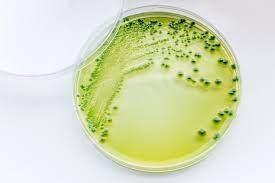
– Distinguishing by color: V. parahaemolyticus does not ferment sucrose, forming green colonies, while V. cholerae ferments sucrose and produces yellow colonies.
2.2. The CHROMagar Vibrio medium
– CHROMagar Vibrio is a chromogenic medium capable of distinguishing Vibrio Vibrio distinguishing the species by colony color, allowing rapid and easy detection.
– Advantage: this is a highly selective medium, clearly distinguishing between the Vibrio species, including V. parahaemolyticus, through the colonies of different species having characteristic colors.
– Suppressing non- Vibrio bacteria: the composition of CHROMagar is designed to limit the growth of bacteria that are not Vibrio, helping ensure accuracy in detection.
2.3. Alkaline Peptone Water (APW)
– APW is a non-selective enrichment medium for Vibrio, raising detection capability when the bacterial density in the sample is low. This medium is usually used as the pre-processing step before plating onto selective media
– High pH: APW has a pH of about 8.5 – 9.0, creating favorable conditions for Vibrio to develop, while many other bacteria do not grow well at this pH.
– Boosting growth: with a composition containing peptone and NaCl, APW helps Vibrio grow strongly before being transferred to selective media.
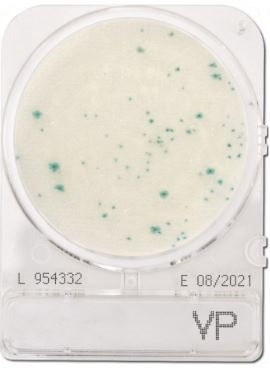
2.4. The Compact Dry Vibrio parahaemolyticus ready-poured freeze-dried agar plate (Compact Dry VP)
– The Compact Dry Vibrio parahaemolyticus (VP) plate is an effective and convenient tool for detecting and quantifying the bacterium Vibrio parahaemolyticus in food and environmental samples. This product is designed as a ready dry medium plate, simplifying the microbiological testing process.
* Standout characteristics of the Compact Dry VP plate
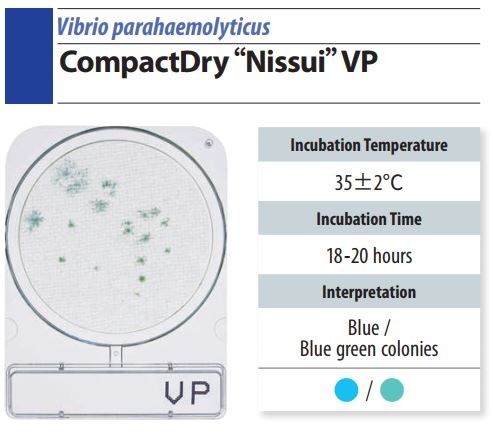
– Easy bacteria differentiation: the plate contains a specific chromogenic substrate, allowing Vibrio parahaemolyticus to grow into blue or green colonies, while other Vibrio species form white colonies.
– Simple to use: no complex medium preparation needed; just drop 1 ml of sample in the middle of the plate and the sample spreads evenly over the surface by itself.
– Short incubation time: incubate the plate at 35–37 °C for about 20–24 hours, after which the results can be read.
– Convenient storage: the plate can be stored at room temperature (1–30 °C), convenient for storing and using.
– See the detailed information for the Compact Dry VP Vibrio parahaemolyticus plate we supply here.
3. The procedure for culturing and isolating Vibrio parahaemolyticus
To culture and isolate V. parahaemolyticus in the laboratory, the procedure usually includes the following steps:
– Sample preparation: the test sample can be seafood, seawater, or a clinical specimen. If the sample has a low bacterial concentration, APW can be used to enrich the bacteria.
– Inoculating the sample: after enrichment, plate the sample onto TCBS agar or CHROMagar Vibrio to isolate the Vibrio species.
– Incubating the sample: incubate in an incubator at 37 °C for 18–24 hours. After incubation, the colonies of V. parahaemolyticus appear with characteristic colors on each type of medium.
– Reading the results: on TCBS agar, the colonies of V. parahaemolyticus are green, not fermenting sucrose. On CHROMagar Vibrio, the colonies of V. parahaemolyticus also have a characteristic color aiding identification.
4. Influencing factors and optimizing culture conditions
To ensure the effectiveness of the culture and isolation process for V. parahaemolyticus, note the following:
– Controlling salinity and pH: adjust the salt concentration and pH of the culture medium to suit the growth requirements of V. parahaemolyticus.
– Sample incubation time and temperature: incubate samples at 37 °C for 18–24 hours to achieve maximum bacterial growth.
– Quality of the culture medium: make sure the culture medium is not contaminated and is prepared in the correct specification to avoid deviations in results.
5. Notes on biosafety when working
Because of the pathogenicity of Vibrio parahaemolyticus, biosafety measures are very important in the laboratory:
– Using personal protective equipment (PPE): wear gloves, protective clothing and safety glasses when handling samples.
– Disinfecting equipment and test samples: tools and waste after sample handling must be disinfected thoroughly.
– Managing waste properly: samples and culture media must be treated safely before disposal.
Culture media play an important role in isolating and studying Vibrio parahaemolyticus. Choosing the right medium such as TCBS agar, CHROMagar Vibrio, and APW optimizes culture conditions and raises diagnostic accuracy. Understanding and applying the requirements of the Vibrio culture medium correctly is also an important factor helping users determine exactly their purpose and needs when using it.