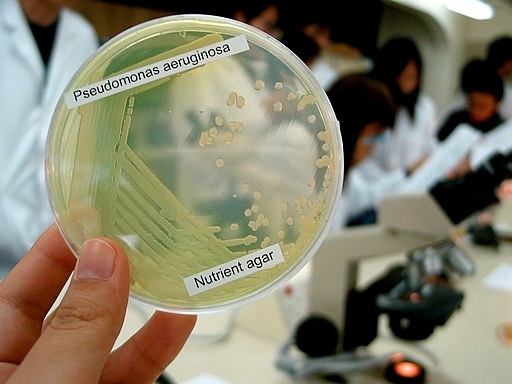
This bacterial species plays an important role in many medical and industrial fields, so understanding how to culture it and its growth conditions is extremely important. In this article, we will look at the types of culture media, growth conditions, and the characteristic features of the bacteria Pseudomonas aeruginosa.
1. Characteristics of Pseudomonas aeruginosa
– Pseudomonas aeruginosa is an obligate aerobic bacterium, capable of surviving in many harsh conditions and growing well in nutrient-poor media. It can cause disease in humans and animals, particularly in healthcare settings such as hospitals, where it often causes serious infections
– In addition, Pseudomonas aeruginosa can produce characteristic biological pigments such as pyocyanin (blue) and pyoverdine (green), which make them easy to identify during culture.
– Below are some types of media for culturing Pseudomonas aeruginosa.
2. Nutrient Agar (NA)
– Description: This is the most basic and commonly used medium for many types of bacteria, including Pseudomonas aeruginosa. It provides the nutrients bacteria need to grow but is not specific for Pseudomonas.
– Application: Used for initial culture or general culture.
– Colony characteristics: Colonies are usually blue or green because this bacterium produces pigments such as pyocyanin and pyoverdine.
3. Pseudomonas Agar P (King A Medium)
– Description: This medium stimulates the production of pyocyanin, a blue pigment characteristic of Pseudomonas aeruginosa.
– Application: Used to detect and isolate bacterial strains that produce pyocyanin.
– Colony characteristics: Colonies are deep blue and easy to recognize.
4. Pseudomonas Agar F (King B Medium)
– Description: This medium encourages the bacteria to produce pyoverdine, a green fluorescent pigment under UV light.
– Application: Used to identify bacterial strains capable of producing pyoverdine.
– Colony characteristics: Colonies emit green light under UV.
5. Cetrimide Agar
– Description: This is a selective medium for Pseudomonas aeruginosa, with cetrimide inhibiting most other bacteria. Pseudomonas aeruginosa is resistant to cetrimide and grows well on this medium.
– Application: Used to isolate Pseudomonas aeruginosa from mixed samples.
– Colony characteristics: Colonies are blue due to pyocyanin, possibly with a pale green tint from pyoverdine.
6. MacConkey Agar
– Description: This is a selective medium for Gram-negative bacteria, including Pseudomonas aeruginosa, but it is not specific. This bacterium does not ferment lactose, so colonies are colorless or slightly pale yellow on this medium.
– Application: Used to differentiate Gram-negative bacteria based on lactose fermentation ability.
– Colony characteristics: Colorless or transparent because Pseudomonas aeruginosa does not ferment lactose.
7. Blood Agar
– Description: It is a general culture medium containing blood, which helps detect the hemolysis activity of bacteria.
– Application: Used to observe hemolysis (red blood cell breakdown) of Pseudomonas aeruginosa, an important characteristic in clinical samples.
– Colony characteristics: Hemolysis (red blood cell breakdown) can be observed on this medium.
8. Tryptic Soy Agar (TSA)
– Description: This is a nutrient-rich, non-selective medium widely used in many culture experiments.
– Application: Used for general bacterial culture and for storing Pseudomonas aeruginosa samples.
– Colony characteristics: Colonies may appear blue-green due to the production of pyocyanin or pyoverdine.
9. Mueller-Hinton Agar
– Description: The medium is used for antibiotic susceptibility testing.
– Application: Especially used for testing the antibiotic sensitivity of Pseudomonas aeruginosa.
– Colony characteristics: Colonies have no distinctive color characteristics on this medium, but they are important in determining antibiotic resistance.
Culture media for Pseudomonas aeruginosa are usually chosen based on the isolation, research, and testing purposes of the user. From selective media such as Cetrimide Agar to antibiotic testing media such as Mueller-Hinton Agar, understanding the characteristics of each medium will make the isolation and study of this bacterium easier.
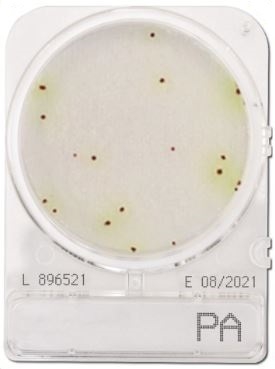
Shimadzu Diagnostics has developed a method using compact dry plates, pre-poured dry agar medium plates that help detect Pseudomonas aeruginosa with the greatest convenience and lowest cost for the user. Please refer to the details of the product we offer at the following link: