Culturing Bacillus requires choosing a suitable medium to ensure the bacteria grow strongly, aiding the isolation, identification and study of their biological and biochemical characteristics.
1. Types of culture media for Bacillus
Each Bacillus culture medium has its own nutritional requirements and growth conditions, so choosing the right medium is extremely important. Below are some common media for culturing Bacillus:
– Nutrient Agar (NA): This is a general-purpose medium providing the basic nutrients to promote the growth of many types of bacteria, including Bacillus species. NA is not selective, so it is suitable for culturing and initial growth testing.
– Tryptic Soy Agar (TSA): This is a nutrient medium richer than NA, used to culture many types of bacteria, including Bacillus. TSA contains amino acids, growth factors and glucose, giving Bacillus good conditions to grow. Notably, TSA is a good medium for Bacillus species that do not grow easily on basic nutrient media.
– PEMBA medium (Polymyxin Egg Yolk Mannitol Bromothymol Blue Agar): This is a selective medium for Bacillus cereus, supplemented with polymyxin B to suppress gram-negative bacteria and some others. On PEMBA, Bacillus cereus forms colonies with a halo around them as the enzyme lecithinase breaks down the lecithin in egg yolk.
– MYP Agar (Mannitol Egg Yolk Polymyxin Agar): This medium contains polymyxin, mannitol and egg yolk, commonly used to isolate and detect Bacillus cereus in food. Bacillus cereus bacteria usually do not ferment mannitol, forming red or pink colonies, while some other bacteria form yellow colonies when they ferment mannitol.
– Starch Agar: This is the medium for testing the starch-degrading ability of Bacillus species. Bacteria capable of producing amylase enzyme break down the starch in the medium, and when stained with iodine solution, the areas around the colonies lose their blue-violet color (because the starch has been broken down).
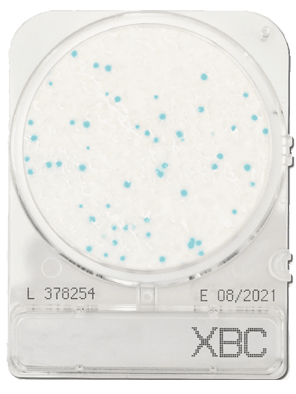
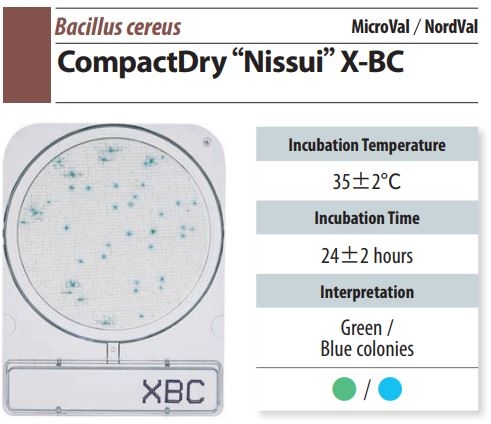
– Compact Dry BC Bacillus cereus plate is a ready-poured freeze-dried medium plate from Shimadzu Diagnostics of Japan, which saves the cost of pouring media by the traditional method, saves time and staffing. See details of the Compact Dry BC plate we supply here.
2. Conditions for the Bacillus culture medium
– Temperature: the optimal temperature for many Bacillus species usually falls between 30 °C and 37 °C. However, some species can grow at lower temperatures (such as Bacillus psychrophilus) or higher temperatures (such as Bacillus stearothermophilus, which grows optimally at 55 °C).
– pH of the medium: Bacillus prefers neutral or slightly alkaline pH, from 6.5 to 7.5. Some species can tolerate lower or higher pH, but their growth may slow down or be inhibited under these conditions.
– Incubation time: Bacillus grows relatively fast, with visible growth after 18–24 hours of incubation. However, for some Bacillus species needing their spore-forming ability checked, incubation can last longer, up to 48–72 hours.
3. Methods for isolating and identifying Bacillus
After culturing, isolation and identification methods for Bacillus are usually carried out to determine the type of bacterium and its biological characteristics:
– Observing colony morphology: Bacillus has translucent colonies with rough or smooth surfaces, depending on the species. Pathogenic Bacillus species (such as Bacillus cereus) usually form large colonies with a halo around them if they contain lecithinase, while non-pathogenic species may form smaller and smoother colonies.
– Biochemical testing: biochemical tests are a useful way to identify each type of Bacillus, including the catalase test (most Bacillus species are catalase positive), the starch hydrolysis test (to detect amylase enzyme), and the urease test. Bacillus subtilis can break down protein and produce special enzymes, while Bacillus cereus can produce toxins causing food poisoning.
– Observation under a microscope: after Gram staining, Bacillus bacteria appear as gram-positive rods. Some Bacillus species can form spores, easily observed under a microscope after spore staining (such as the Schaeffer-Fulton staining method).
4. Applications of Bacillus culture
– The food industry: Bacillus cereus is a bacterial pathogen commonly found in food, so testing and monitoring this bacterium is very important for ensuring food hygiene and safety. The MYP and PEMBA media are widely used to test for the presence of Bacillus cereus in food samples.
– Enzyme production and molecular biology: Bacillus subtilis is a bacterium widely used in the enzyme production industry thanks to its strong enzyme secretion and non-pathogenic nature. Enzymes such as amylase, protease and lipase produced by B. subtilis have applications in food, pharmaceuticals and chemical production.
– Research on bacterial spores: Bacillus spores can survive in harsh conditions, making them a subject of study in biology and biotechnology. Spores of Bacillus stearothermophilus are commonly used in sterilization tests to assess the effectiveness of heat treatments.
5. Notes when culturing Bacillus
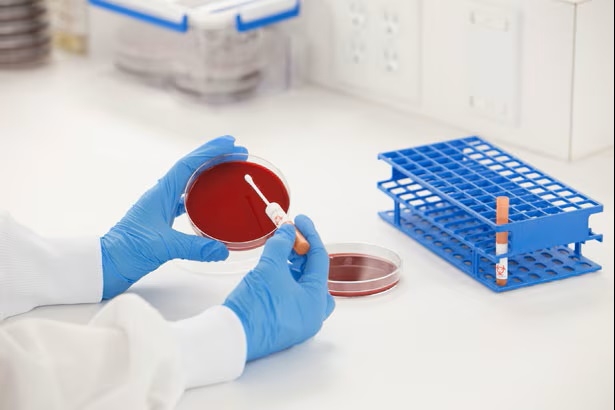
– Biosafety: some Bacillus species are capable of causing disease or producing toxins, so biosafety rules must be followed, especially when working with Bacillus cereus. Using a biosafety cabinet and disinfecting bacterial samples after use are important steps.
– Storing samples: to store Bacillus strains for a long time, they should be kept in deep-freeze conditions at -80 °C, or Bacillus spores can be stored at room temperature (because spores can withstand harsh conditions).
Culturing Bacillus is an important process in microbiological research and testing, from determining pathogenic properties to applications in enzyme production and spore research. Choosing the right medium and culture conditions plays a decisive role in the success of experiments involving Bacillus, contributing to improved quality and accuracy in the biology and food industries.