
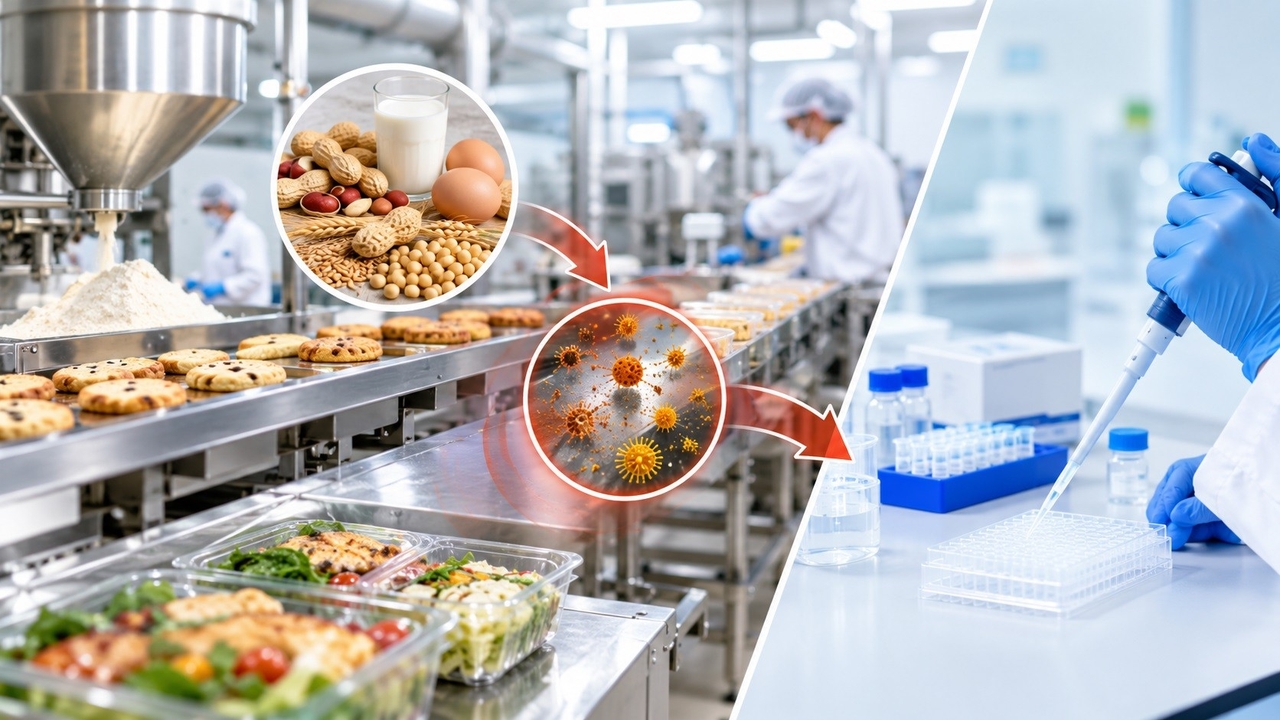
- This is exactly the problem known as cross contamination allergen – the transfer of allergens between raw materials, equipment, production surfaces or products.
- For food businesses, identifying and controlling allergens not only reduces risk to consumer health but also helps protect the brand, limit complaints and meet customer requirements as well as food safety standards.
What is food allergen cross-contamination?
- Food allergen cross-contamination occurs when an allergen from one ingredient or product is unintentionally transferred to another product, when the business did not intend to include that allergen in the formula.
* Example:
- A biscuit factory uses peanuts.
- After producing a peanut-containing product, the line switches to making peanut-free biscuits.
- If the cleaning process does not completely remove peanut residue, the next product can be contaminated with the allergen.
In this case, the second product does not use peanuts in its formula, yet it can still contain allergenic protein.
This is why cross contamination allergen should be treated as a distinct hazard in the food safety management programme.
Where can allergen cross-contamination occur?
- Cross-contamination does not only happen on the production line. The hazard can arise at many different stages.
1. Cross-contamination from raw materials
- Allergen-containing raw materials may be stored next to allergen-free raw materials.
- Small amounts of flour, ingredient crumbs or dust generated during handling can also spread to neighbouring areas.
- Especially powdered ingredients such as:
- Milk powder
- Wheat flour
- Soy flour
- Peanut flour
- Certain nuts
can disperse and create food allergen cross-contamination risk if not well controlled.
2. Cross-contamination from equipment and production lines
- This is one of the common sources of cross contamination allergen. Locations such as:
- Conveyor belts
- Feed hoppers
- Mixers
- Pipework
- Cutting blades
- Moulds
- Storage tanks
- Packaging machines
can retain allergenic protein after production.
- What is worth noting is that equipment that looks clean to the naked eye can still harbour allergenic protein at very low levels.
3. Cross-contamination during cleaning
- An unsuitable cleaning procedure can inadvertently spread allergens from one area to another. For example, sharing:
- Cleaning cloths
- Cleaning tools
- Brushes
- Containers
- Cleaning equipment
across many areas without appropriate control measures.
- So cleaning is not only about removing dirt and microorganisms, it must also be considered from the perspective of allergen control.
5 reasons businesses overlook allergen cross-contamination
1. Checking only the product formula
- A common mistake is relying only on the product formula to identify allergens.
- If the formula has no milk, soy or peanuts, the business may conclude the product has no allergen risk.
- However, that is not enough. Businesses need to assess the possibility of cross-contamination across the whole production process.
2. Believing that "clean" equipment means no allergen remains
- This is a very important point in allergen control. A surface may show no visible food residue yet still contain allergenic protein.
- So checking by eye alone, or a sensory hygiene assessment, cannot prove that allergens have been completely removed.
3. Not assessing risk between products
- If one line produces many different products, the business needs to consider production sequencing. For example:
Peanut-containing product → peanut-free product
creates different control requirements than:
Peanut-free product → peanut-containing product.
- Building a sensible production schedule can significantly reduce the risk of cross contamination allergen.
4. Focusing only on incoming raw material control
- Supplier and ingredient control is necessary but not sufficient. Allergens can reach the product inside the plant via:
Ingredients → equipment → surfaces → staff → utensils → product.
- So the allergen control programme must cover the entire production chain.
5. Not verifying cleaning effectiveness
- A very detailed cleaning procedure does not mean it is always effective. Businesses need a step for verification to assess whether the cleaning procedure really removes the allergen.
- This is where allergen testing methods can play an important role.
Where should effective allergen control start?
- An effective allergen control programme should be built with multiple layers of protection.
Step 1: Build the allergen inventory
- Businesses need to identify all raw materials that contain or may contain allergenic substances. This list must be updated when:
- Suppliers change
- Formulas change
- Ingredients change
- New products are developed
Step 2: Zoning and identifying allergens
- Allergen-containing raw materials should be clearly identified and controlled throughout:
Receiving → storage → weighing and dispensing → production → cleaning → packaging
Step 3: Control the production schedule
Products can be arranged on the principle of reducing cross-contamination risk, while a suitable cleaning procedure is built in between production runs.
Step 4: Control utensils and equipment
- Utensils used for allergen-containing products must be controlled to avoid mix-ups or creating cross contamination allergen.
Step 5: Verify with a suitable test method
- This is the step many businesses have not fully implemented. Instead of asking: "Has the equipment been cleaned?", ask: "What evidence proves the allergen has been removed after cleaning?"
- Sampling and testing for allergens at high-risk locations gives businesses data to assess how effective the cleaning procedure is.
How does allergen testing help businesses control cross-contamination?
- Allergen testing methods, including ELISA, can be used to detect allergenic protein in ingredients, products or samples taken from production surfaces, depending on the test purpose and the method chosen.
- Businesses can build a sampling programme at high-risk points, such as:
- Equipment surfaces
- Production lines
- Areas in direct contact with the product
- After cleaning
- Between two production runs using different allergens
- Test results help the business assess whether the current cleaning procedure is effective enough or needs adjustment.
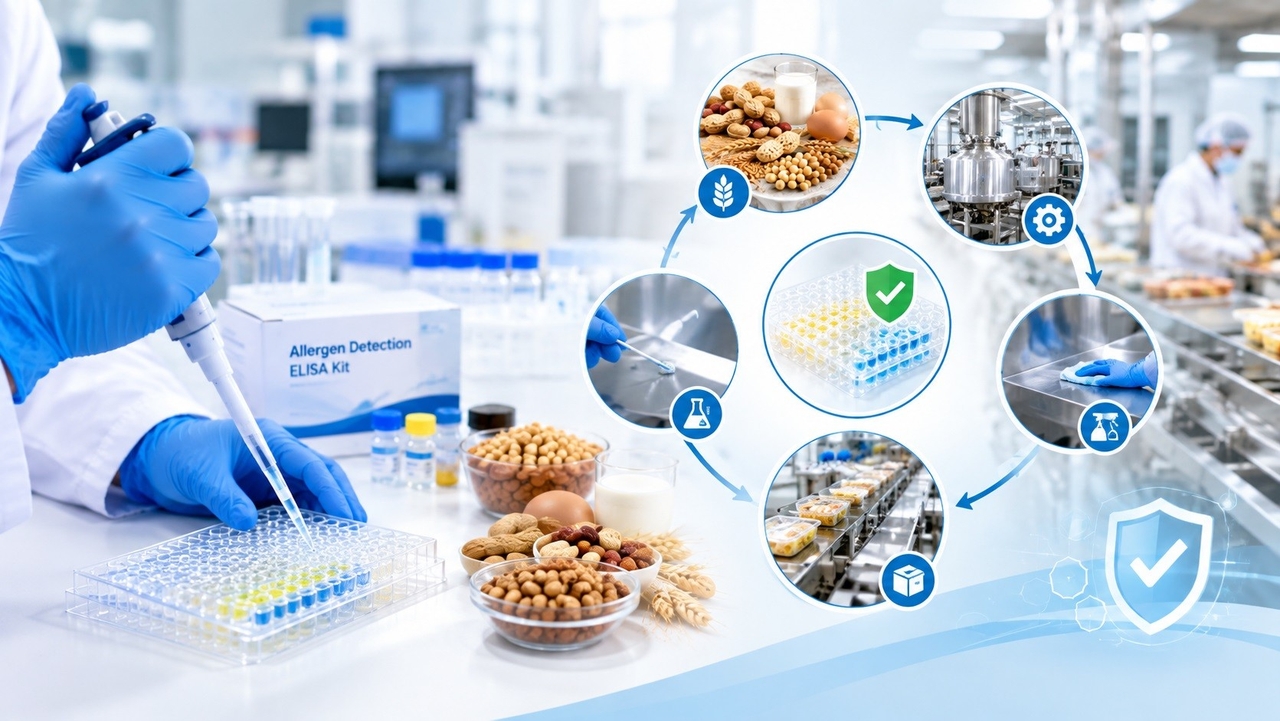
- From there, the business can build a control loop:
Identify allergens → assess risk → clean → sample → test → evaluate results → improve procedures.
- This is a more proactive approach than simply dealing with incidents after they occur.
Why shouldn't food allergen cross-contamination be taken lightly?
- For allergic consumers, even a small amount of allergenic protein can become a serious problem.
- For businesses, an allergen-related incident can bring many consequences:
- Customer complaints
- Product recalls
- Higher incident handling costs
- Damage to brand reputation
- Risk of failing customer requirements
- Difficulties exporting or joining international supply chains
- Therefore, allergen control should be seen as an important part of the food safety management system rather than just a product labelling requirement.
A checklist for controlling food allergen cross-contamination in production
Businesses can start by reviewing these 8 questions:
- Has a complete allergen inventory been built for the plant?
- Have the points at risk of cross-contamination been identified?
- Are allergen-containing raw materials properly identified and stored?
- Are shared utensils controlled?
- Does the production schedule take allergen risk into account?
- Is the cleaning procedure designed to remove allergens?
- Is cleaning effectiveness verified using a suitable test method?
- Are test results and corrective actions recorded?
If a business cannot yet answer "Yes" to all of the questions above, the allergen control programme still has areas needing improvement.
Conclusion
- Food allergen cross-contamination can occur even when the allergen is not in the product formula. From raw materials, equipment and utensils to cleaning procedures, many links in the plant can become a source of cross contamination allergen.
- Therefore, businesses need to move from the mindset of "not using allergens" to the mindset of "controlling allergens across the entire production process".
- Combining hazard analysis, production zoning, ingredient control, proper cleaning and allergen testing will help businesses proactively find risk points and raise product safety levels.
- Good allergen control is not just about protecting consumers – it is also about protecting the brand and the company's reputation.
- See details of the rapid food allergy test kits we supply here.