
- However, the two methods differ in purpose of use, level of accuracy and analytical process.
- If mycotoxin rapid tests suit the need for rapid testing and screening many samples, while IAC immunoaffinity columns combined with HPLC is more suitable when the laboratory needs sample clean-up, quantification and highly reliable results.
- So should you choose a rapid test or an IAC column? Let's take a detailed look in the article below.
1. Why do you need to choose the right mycotoxin testing method?
- Mycotoxins are a group of toxins produced by molds, which can appear in many types of raw materials and foods such as:
- Cereals and cereal products
- Corn, rice, wheat
- Animal feed
- Peanuts and nuts
- Coffee, cocoa
- Spices
- Milk and dairy products
- Some plant-based products
- The mycotoxins of most concern are Aflatoxin, Ochratoxin A, Fumonisin, Zearalenone, Deoxynivalenol (DON) and many other toxins.
- Depending on the testing purpose, companies may need:
- Rapid screening of input raw materials.
- Testing many samples in a short time.
- Detecting samples at risk of exceeding the limit.
- Accurately determining mycotoxin levels.
- Supporting quality control or in-depth testing requirements.
- Therefore, there is no single method suitable for every case. The choice of mycotoxin testing method must be based on the purpose and requirements of the laboratory.
2. What is a Mycotoxin rapid test?
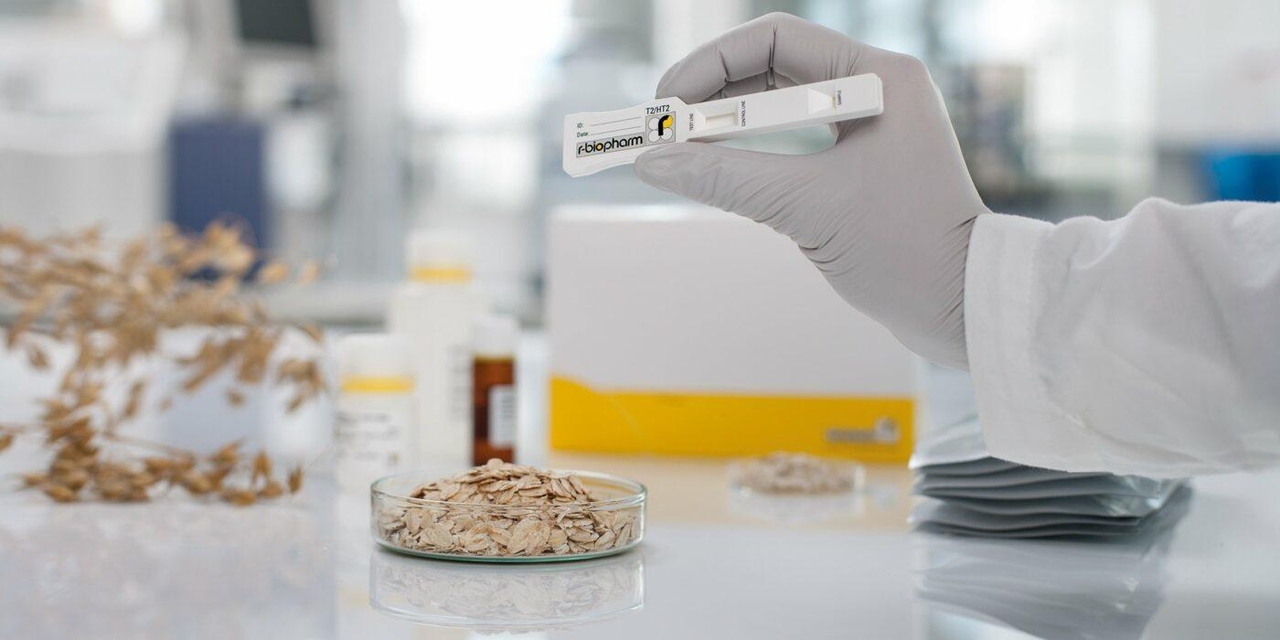
- Mycotoxin rapid test is a method used to screen mycotoxins in samples in a relatively short time.
- Rapid test kits are usually based on immunological principles, such as the antigen – antibody reaction. After sample preparation, results can be read directly or through a reader device depending on the product type.
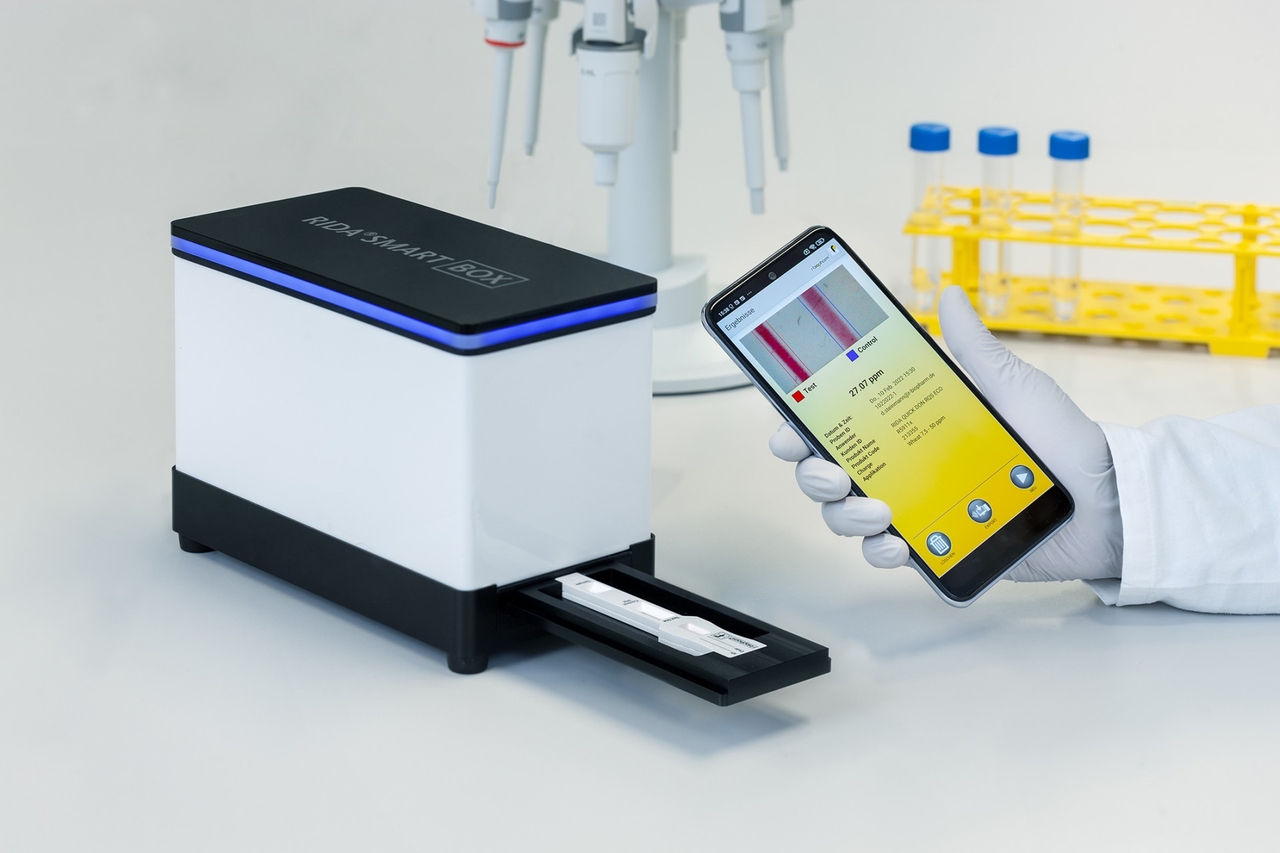
R-Biopharm's RIDA SMART BOX mycotoxin rapid tester
* Advantages of Mycotoxin rapid tests
- Fast: this is the most outstanding advantage. Rapid tests help the QC room or the company quickly assess the condition of raw materials before production.
- Simple procedure: compared with a full chromatographic analysis, rapid tests usually require fewer preparation steps and less equipment.
- Suitable for screening large numbers of samples: when a company needs to check many raw material lots, rapid tests can be used as an initial screening step.
- Saves time and investment cost: rapid tests suit organizations that need testing solutions at the factory, raw material warehouse or QC room without wanting to invest immediately in an advanced chromatographic analysis system.
* Limitations of rapid tests
- Depending on the product, rapid tests may give qualitative or semi-quantitative results, so they cannot always replace quantitative analysis by chromatographic instruments.
- In addition, results can be affected by the sample matrix and the sample preparation process. Therefore, for cases requiring accurate determination of mycotoxin levels, a more suitable analytical method should be used.
3. What is an IAC immunoaffinity column?
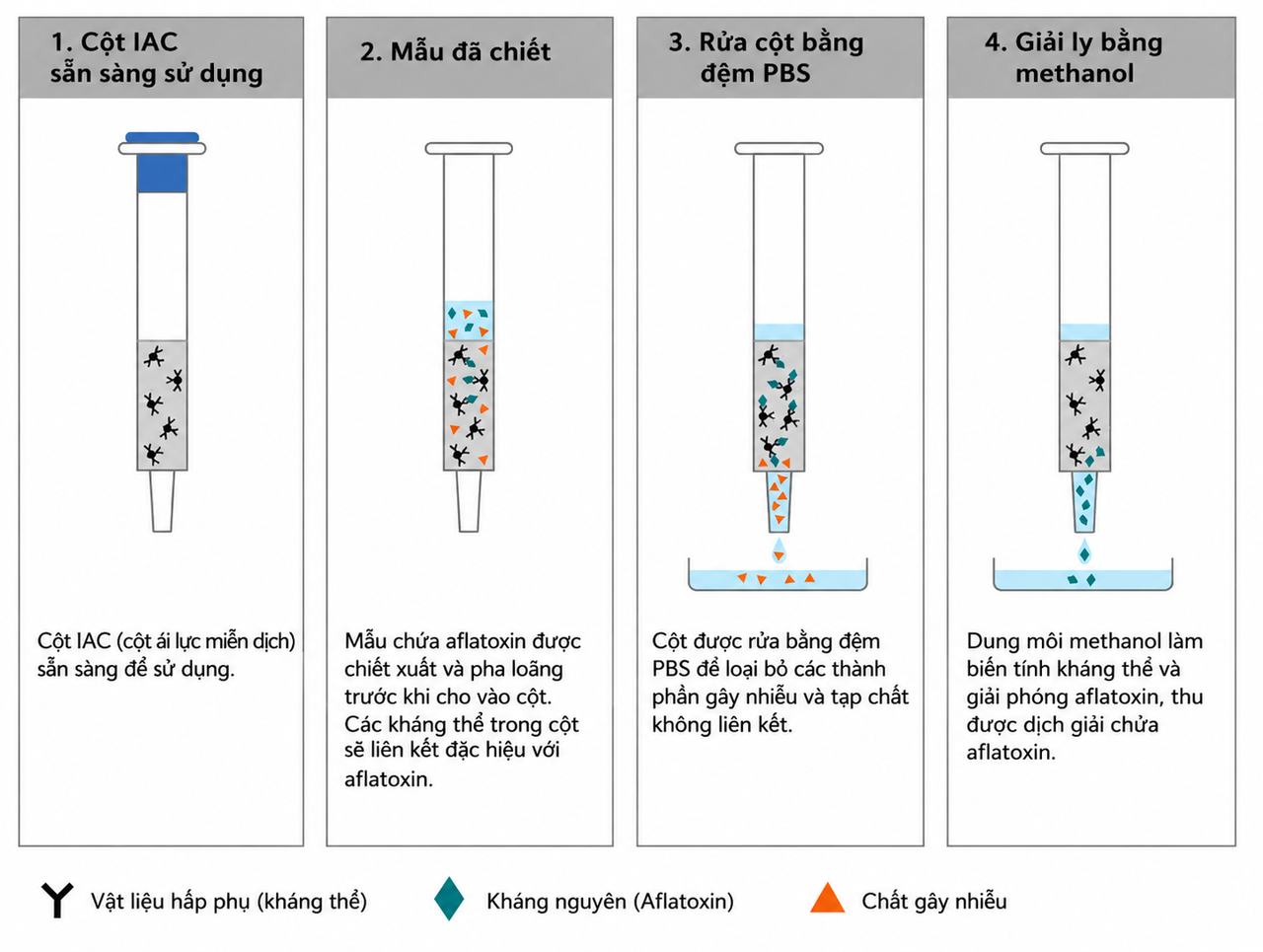
- IAC (Immunoaffinity Column – immunoaffinity column) is a sample processing and clean-up technique based on the specific interaction between antibodies and the target analyte.
- In mycotoxin testing, IAC columns can be used to separate and clean up mycotoxins from the sample matrix, helping reduce interfering components before analysis by instruments such as HPLC.
- The general process can be understood as follows:
Sample → Extraction → Clean-up with IAC → Elution → HPLC → Quantification
- IAC columns are designed with antibodies capable of binding specifically to the target mycotoxin. When the sample extract passes through the column, the analyte is retained in the column while many other matrix components are removed.
- Then the mycotoxin is eluted and introduced into the analysis system.
-
4. Advantages of IAC immunoaffinity columns + HPLC
- High selectivity: thanks to the antigen – antibody interaction mechanism, IAC can selectively retain the target analyte.
- Matrix clean-up: this is one of the most important roles of IAC columns. Removing unwanted matrix components helps reduce matrix effects and supports the chromatographic analysis process.
- Suitable for quantitative analysis: when combined with HPLC, IAC can become part of the mycotoxin quantitative analysis process, especially in tests requiring high accuracy and reliability.
- Suitable for professional laboratories: IAC + HPLC is generally more suitable for laboratories that need to build in-depth testing processes, quality control, or carry out analyses by validated/verified methods.
5. How do Mycotoxin rapid tests differ from IAC + HPLC?
Below is an overview comparison table:
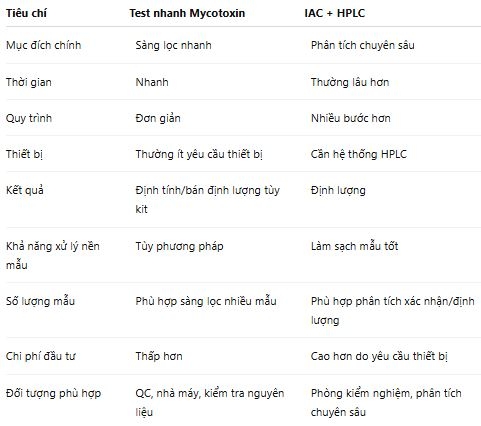
- Note: the specific characteristics of sensitivity, measurement range, analysis time and applicable matrices depend on each kit, IAC column and analytical method used.
6. When should Mycotoxin rapid tests be used?
Rapid tests are a suitable choice when the company prioritizes speed and screening capability. For example:
- Input raw material inspection: a factory receives many lots of corn, peanuts or animal feed materials and needs to quickly assess the risk of mycotoxin contamination.
- Testing many samples in a short time: if the number of samples is large and the goal is to quickly identify samples that need deeper testing, rapid tests can serve as the screening step.
- Quality control at the factory: the QC department can use rapid tests to make raw material control decisions faster.
- Screening before in-depth analysis: this is a very notable application. Companies can use:
Rapid test → identify suspected samples → IAC + HPLC → quantitative analysis
- This approach helps allocate in-depth analytical resources to the samples that truly need them.
7. When should IAC columns + HPLC be used?
- IAC columns are more suitable when the laboratory needs sample processing before chromatographic analysis. Especially in cases where:
- Mycotoxin levels need to be quantified.
- High selectivity is needed during sample processing.
- Complex sample matrices.
- Sample clean-up before HPLC is needed.
- The laboratory already has an HPLC system.
- An in-depth analytical process needs to be established.
- For example, when analysing Aflatoxin B1, B2, G1, G2, Ochratoxin A, Fumonisin, Zearalenone or DON, the type of IAC column must be chosen to match the analyte and the analytical process.
8. Should both rapid tests and IAC columns be used?
- Yes. This can be an effective testing strategy for companies with large numbers of samples. Instead of viewing rapid tests and IAC as two competing methods, companies can use them at two different steps of the quality control process.
* Proposed testing model
- Step 1: Screening
Use mycotoxin rapid tests to check raw materials quickly and identify at-risk samples.
↓
- Step 2: In-depth analysis
- Suspected samples or samples requiring accurate determination are transferred to the following process:
Sample extraction → IAC → Elution → HPLC → Quantification
↓
- Step 3: Evaluate results
Based on the analysis results and the company's control criteria to make a decision on the raw material lot or product.
This model combines the advantages of both methods: rapid tests for speed and IAC + HPLC for sample clean-up and quantitative analysis.
9. Which method should you choose?
- You should not just ask “Is IAC or the rapid test better?” but should ask: “What is the company's testing objective?”
- If speed is the priority → Mycotoxin rapid tests: suitable for raw material screening, rapid checks at the factory and testing large numbers of samples.
- If quantification is needed → IAC + HPLC: suitable for in-depth analysis and cases requiring determination of mycotoxin levels.
- If both speed and in-depth analytical results are needed → Combining Rapid tests + IAC + HPLC. Rapid tests play the role of screening, while IAC + HPLC is used for samples requiring in-depth analysis.
10. R-Biopharm IAC columns – Mycotoxin sample clean-up solution
- In mycotoxin testing processes, IAC immunoaffinity columns are an important solution for sample processing and clean-up before analysis.
- R-Biopharm provides IAC solutions for many mycotoxin groups, helping laboratories choose the column that suits the analyte and the sample matrix.
- Some toxin groups of most concern include:
- Aflatoxin
- Ochratoxin A
- Fumonisin
- Zearalenone
- Deoxynivalenol (DON)
- Choosing the right type of IAC column must be based on the target mycotoxin, the sample matrix and the HPLC method being applied in the laboratory.
11. Conclusion
- Mycotoxin rapid tests and IAC columns do not necessarily have to be mutually exclusive options. If a company needs rapid testing, raw material screening and to handle a large number of samples, rapid tests are a convenient choice.
- If you need sample clean-up and mycotoxin quantification by HPLC, IAC columns will be more suitable.
- For companies that need comprehensive mycotoxin control, a combined process can be built:
RAPID TEST → SCREENING → IAC → HPLC → QUANTIFICATION
- This approach gives the company both active control over raw materials and an in-depth analytical option when accurate determination of mycotoxin levels is needed.
- If you are looking for R-Biopharm IAC columns for Aflatoxin, Ochratoxin A, Fumonisin, Zearalenone or DON, choose the product based on the target mycotoxin and the sample matrix to be analysed to ensure compatibility with the laboratory's testing process.