
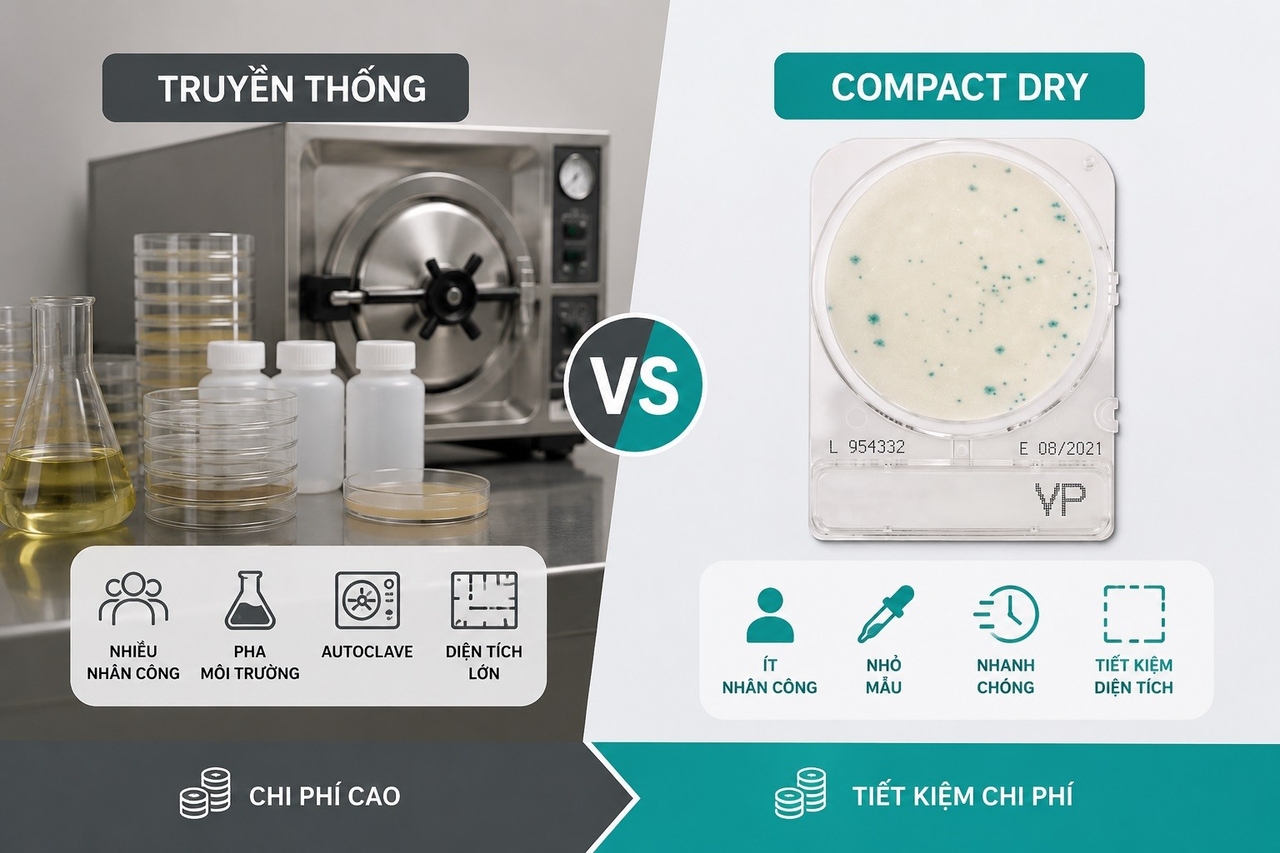
- One of the notable trends today is switching from the traditional agar-pouring method to using Shimadzu Compact Dry plates.
- So what does the business actually save?
1. Labor cost savings
The traditional agar-pouring method
To prepare one microbiology testing round, staff must:
- Weigh the medium
- Prepare the medium
- Adjust the pH
- Divide the medium into bottles or flasks
- Autoclave
- Cool
- Pour the petri dishes
- Wait for setting
- Refrigerate
This whole process can take 2–4 hours per batch of medium.
In addition, experienced staff are needed to avoid:
- Cross-contamination
- A non-uniform medium
- Faulty plate pouring
- Handling mistakes
With Compact Dry
The user only needs to:
1. Prepare the sample
2. Drop 1 mL of sample onto the plate
3. Incubate
4. Read the result
The whole handling takes only about 30–60 seconds per sample.
Practical benefits
Many QC rooms report:
- 50–70% less handling time
- One technician can process more samples
- Reduced dependence on highly skilled staff
2. Culture medium cost savings
The agar-pouring method
Every month the business must buy:
- Microbial medium powder
- Distilled water
- pH-adjusting chemicals
- Petri dishes
- Glass bottles
- Consumables
There are also losses from:
- Over-preparation
- Expiry
- Contaminated medium that must be discarded
These are "hidden" costs that many businesses overlook.
Compact Dry
The plates are already:
- Prepared with the medium
- Pre-sterilized
- Packaged individually
The business does not need to:
- Prepare the medium
- Store the medium
- Quality-check each batch of medium
Savings level
Depending on the laboratory scale, consumable and medium costs can fall by 20–40%.
3. Eliminating autoclave investment and operating costs
With the traditional method
The autoclave is almost mandatory equipment. The business must invest in:
- An autoclave
- Electrical systems
- Periodic maintenance
- Equipment certification
There are also extra costs of:
- Electricity
- Water usage
- Operating time
One autoclave cycle usually takes 1–2 hours.
With Compact Dry
No need for:
- Autoclaving the medium
- Preparing petri dishes
- Sterilizing agar-pouring tools
Benefits
- Lower electricity costs
- Lower equipment depreciation
- Less equipment floor space
- Lower risk of workplace accidents from heat and pressure
Particularly suitable for factories wanting to build a compact QC room.
4. Laboratory space savings
The challenges of the agar-pouring method
A traditional microbiology room usually needs:
- A medium preparation area
- A plate-pouring area
- An autoclave area
- A refrigerator for storing medium
- A chemical storage room
- A relatively large usable area.
Compact Dry
Because the medium is pre-prepared, the business can:
- Eliminate the medium preparation area
- Reduce the chemical storage space
- Reduce auxiliary equipment
Result
Many businesses report the microbiology room area can shrink by 30–50%. This is a very large advantage for:
- Food factories
- Bottled water plants
- Internal QC rooms
- Newly founded laboratories
Quick comparison table
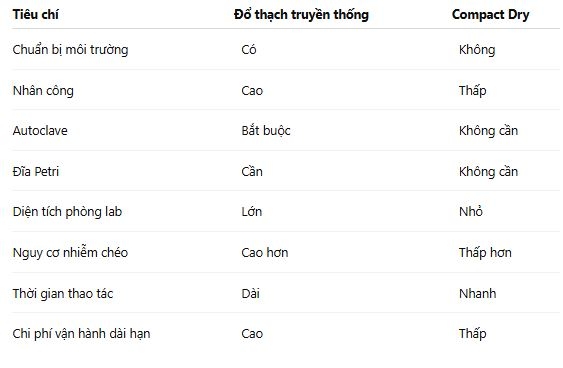
How much does the business save?
For a QC room testing 50–200 samples per month, switching to Compact Dry plates can help:
- Cut handling time by 50–70%
- Cut culture medium costs by 20–40%
- Eliminate most autoclave-related costs
- Reduce laboratory area by 30–50%
- Reduce the risk of mistakes and cross-contamination
When calculating the total cost of ownership (TCO), many businesses find Compact Dry is not only a fast microbiology testing solution but also a tool
Conclusion
- Although the cost per Compact Dry plate can be higher than a self-poured agar plate, once all factors such as labor, culture medium,
- For food, beverage, and seafood businesses and modern QC rooms, switching to Compact Dry plates is becoming a trend that helps