
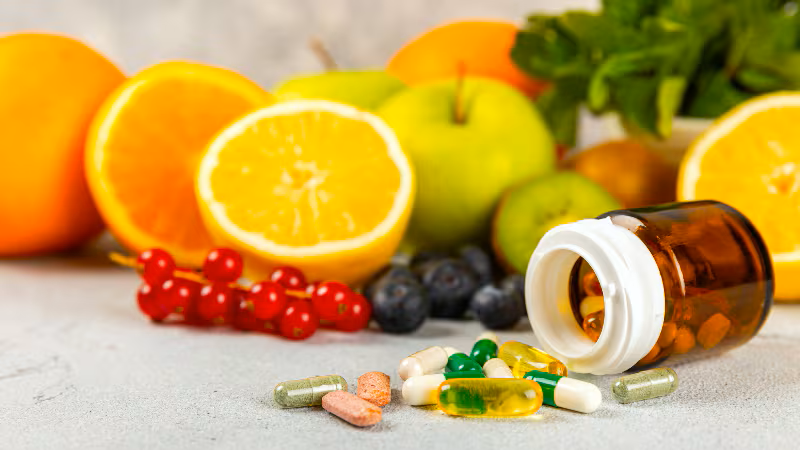
- However, as production speeds increase, the biggest challenge facing pharmaceutical factories is microbiological control.
- Functional foods have diverse origins, and many products use raw materials from herbs, enzymes, plant or yeast extracts – raw materials that are prone to microbiological contamination. To ensure consumer safety, factories must carry out strict testing in accordance with GMP, HACCP, ISO 22000 and the Pharmacopoeia. This requires a microbiological testing process that is fast, accurate, reproducible and still cost-effective.
- In that context, Compact Dry culture plates have emerged as a modern solution, helping QC/QA departments in pharmaceutical factories to cut testing time by 50–70% while improving result consistency. The article below analyses in detail why Compact Dry has become the top choice for functional food microbiological testing, and how this technology is changing the way pharmaceutical factories manage quality.
1. Why is microbiological testing important for functional foods?
Functional foods are formulated in many forms: tablets, capsules, soluble powders, syrups, granules, effervescent tablets… with raw material sources ranging from plants and minerals to animal sources. Each material type carries a different microbiological contamination risk, especially:
- Total aerobic bacteria – indicate the level of general contamination.
- Coliform/E. coli – related to hygiene contamination during production.
- Yeasts – moulds – carry the risk of mycotoxins such as aflatoxin.
- Salmonella, S. aureus – pathogenic bacteria that can seriously affect consumer health.
* If the product violates microbiological limits, the factory must:
- Destroy the batch, causing major cost losses.
- Stop the production line to trace the cause.
- Damage brand reputation if the product reaches the market and an incident occurs.
Therefore, microbiological testing is a mandatory and vital factor for functional food manufacturers.
2. Challenges when using traditional microbiological testing methods
- For many years, QC departments in pharmaceutical factories have used the traditional plate pouring method (plate count agar – PCA). However, this method has many limitations:
2.1 Long preparation time and a complex process
- Cook the medium, adjust the pH, sterilise the utensils.
- Pour the agar into plates and let it cool.
- Prepare different types of agar for each parameter.
The lengthy process easily delays production progress.
2.2 High risk of cross-contamination
Manual pouring easily leads to:
- Air bubbles in the plate.
- Non-uniform medium.
- Microbial contamination from the air or utensils.
2.3 Unstable reproducibility
- Unstable reproducibility affects the testing process and result reading.
- Results depend on the skill of each technician, leading to error.
2.4 Labour-intensive and unsuitable when the number of samples rises
- In large-scale functional food factories, the number of microbiological samples per batch is very large (raw materials – work in progress – finished products), making the traditional method no longer effective.
3. Compact Dry – a new step in microbiological testing in the pharmaceutical industry
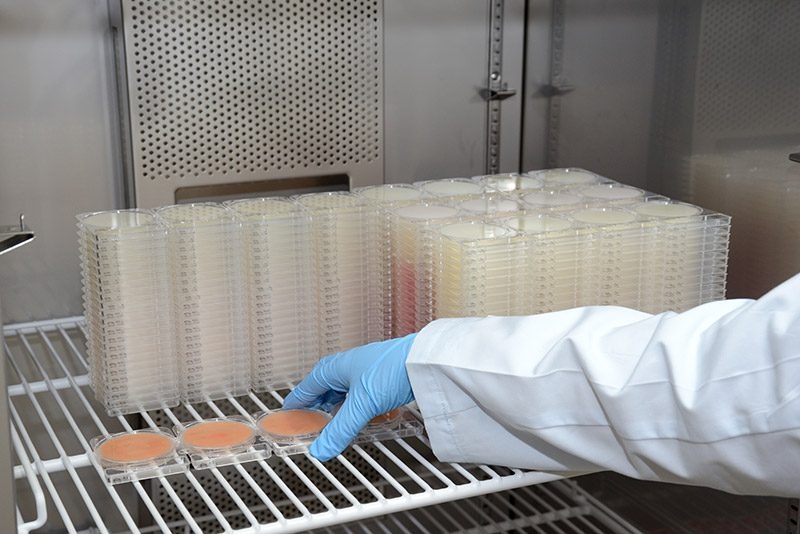
Compact Dry, developed by the Japanese company Shimadzu, is a ready-to-use dry culture plate, completely eliminating the complex medium preparation step. Technicians only need to inoculate the sample onto the plate – no pouring, no sterilisation – while still ensuring accuracy equivalent to or better than the traditional method.
3.1 Operating principle
- The plate contains a dry nutrient medium and a colour indicator.
- After inoculating 1 ml of sample or diluted solution, the dry medium absorbs water and becomes a uniform agar medium.
- Growing microorganisms form colonies with a characteristic colour, making counting easy.
3.2 Key benefits for functional food factories
- Saves 50–70% of time compared with the agar pouring method.
- Avoids cross-contamination; sterile plates individually packaged.
- No refrigerator needed for many plate types – convenient storage.
- Easy counting, clear colony colour.
- Suitable for complex samples such as powders, ground tablets, syrups, granules.
4. Compact Dry culture plates suitable for functional food testing
Compact Dry offers many types, each optimised for a group of microorganisms:
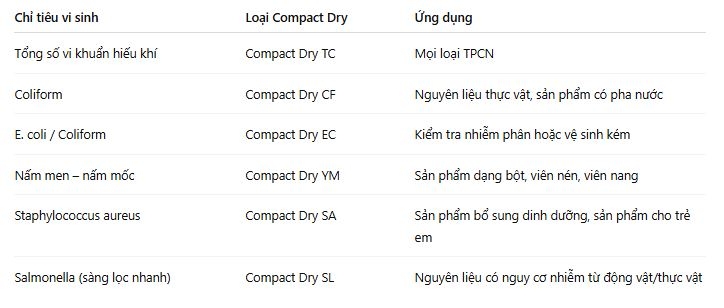
All these parameters comply with the testing standards of:
- Vietnamese Pharmacopoeia
- United States Pharmacopeia (USP)
- Codex Alimentarius
5. The Compact Dry workflow for functional food microbiological testing
The Compact Dry workflow is extremely simple, suitable for both QC laboratories and in-house testing departments:
* Step 1: Sample preparation
- Weigh the sample according to the standard (1g to 10g).
- Dilute according to the specified ratio.
* Step 2: Sample inoculation
- Take 1 ml of sample and inoculate onto the centre of the Compact Dry plate.
- The sample is absorbed within 3–5 minutes.
* Step 3: Incubate the plates
Place the plates in the incubator at a suitable temperature:
- 35–37°C for TC, CF, EC, X-SA plates.
- 25°C for YMR plates.
* Step 4: Read the results
- Count colonies visually or with an automatic counter.
Total handling time is significantly reduced, helping to speed up product clearance, especially when a company ships many batches every day.
6. Benefits of using Compact Dry for functional food manufacturers
6.1 Speeding up production batch approval
Incubation and sample processing time is optimised, helping the factory:
- Reduce queues in the finished goods warehouse area.
- Increase production line turnover speed.
- Improve order fulfilment capability.
6.2 Reducing laboratory operating costs
Compact Dry helps save:
- Electricity for drying ovens and autoclaves.
- The cost of buying agar media in large quantities.
- Preparation labour time.
6.3 Improving result stability
- Plates are manufactured to industrial standards with high uniformity, eliminating variation between self-prepared agar batches.
6.4 Supporting factory hygiene control
In addition to product testing, Compact Dry is also used for:
- RO water and purified water testing.
- Equipment surface testing after CIP/SIP cleaning.
- Air testing in cleanrooms (via the settle plate method).
7. A functional food factory adopts Compact Dry and cuts testing time by 60%
- A functional food factory in Binh Duong with an output of over 1 million products/month struggled with microbiological testing due to the high number of samples. After switching to Compact Dry:
- Plate preparation time fell from 3 hours to 15 minutes.
- The number of samples processed per day doubled.
- Repeatability error reduced by up to 35%, thanks to the stable culture plates.
- Over 70 million VND saved in operating costs/year.
This is clear evidence of the effectiveness of Compact Dry when applied to functional food testing.
8. Compact Dry – a solution aligned with the GMP vision of modernising the QC department
In the trend towards automating and standardising testing systems, Compact Dry fully meets the requirements of a modern QC department:
- Standardised process, easy to train.
- High accuracy.
- Scalability as the number of samples increases.
- Meets the traceability and audit requirements of GMP/ISO.
Beyond saving time, Compact Dry also strengthens quality control capability, thereby increasing the reputation and competitive position of the pharmaceutical factory.
Compact Dry culture plates are the optimal choice for functional food manufacturers who want to:
- Simplify the microbiological testing process.
- Speed up batch approval.
- Reduce labour and equipment costs.
- Improve the stability and reliability of results.
In an increasingly competitive pharmaceutical industry with ever stricter quality standards, Compact Dry is exactly the solution that helps companies move to a more modern, efficient and safer testing model.