
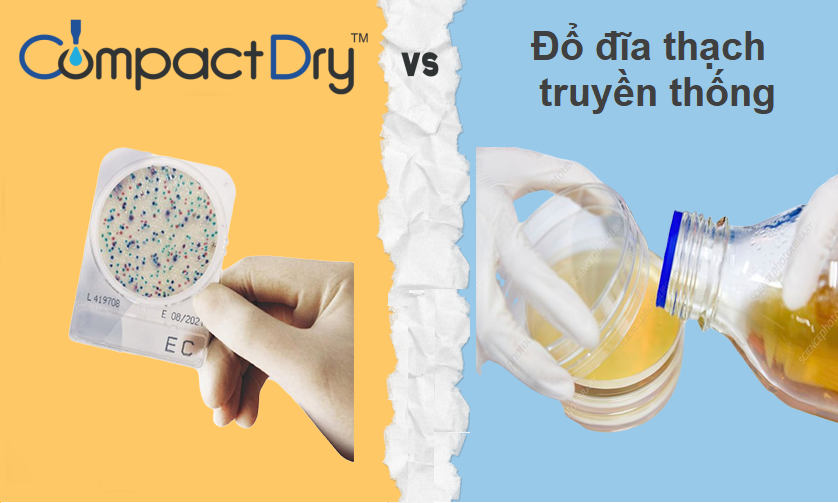
1. Compact Dry (pre-poured, freeze-dried medium plates)
- Ease of use: Very high — just inoculate, incubate, and count. Medium preparation steps are minimal.
- Speed & staffing efficiency: fast, suitable for on-site testing; reduces labor and handling errors.
- Repeatability / consistency: Higher, because the medium is pre-standardized with less batch-to-batch variation.
- Range of analytes: Many Compact Dry types are available (total aerobic count, coliform, E. coli, yeasts, molds, Staphylococcus aureus, etc.) — but they do not cover every specialized microorganism.
- Sensitivity / detection limit: usually equivalent to or better within the analyte range the plate was designed for; but the limit depends on the plate type.
- Direct cost: plate prices are equivalent to or lower than preparing media yourself; but labor cost and mistakes are usually lower.
- Storage & shelf life: store as instructed (usually 1–30°C); expiry date and storage conditions are printed on the plate package.
- Regulatory/standard acceptability: accepted in many places if validated by an internal method; must be cross-checked against national or customer standards.
- Added benefits: less risk of cross-contamination and reduced exposure when handling liquid media.
2. Traditional agar pouring (manual medium preparation)
- Ease of use: requires skilled staff: medium preparation, sterilization, pouring plates, inoculation, counting.
- Speed & staffing: slower; time-consuming preparation, sterilization, and pouring; suits specialized testing laboratories.
- Repeatability / consistency: varies with preparation technique and material quality.
- Range of analytes: highly flexible — any medium can be used (selective, for isolating rare strains, etc.).
- Direct cost: consumables are cheaper per plate, but there are hidden costs (labor, autoclave, chemicals).
- Storage & inventory: powder media and sterile equipment must be stored; riskier if procedures are poor.
- Regulatory/standard acceptability: the traditional method, and many reference standards require this method for some specific analyses.
- Benefit: best when deep analysis is needed (isolation, typing, accurate counting on specialty media).
3. When to choose a Compact Dry plate (recommended)
- In-factory quality control / rapid testing: routine checks (production process, surface hygiene, batch inspection).
- Shortage of skilled staff, or a desire to reduce technical errors.
- Need for high sample throughput with few handling steps (many samples per day).
- Wanting consistent results across shifts/factories (batch standardization, supply chains).
- When the analytes to be tested are common ones that already have corresponding Compact Dry plates (TC, coliform, E. coli, yeasts, molds…).
4. When to choose traditional agar pouring (recommended)
- Requirements for microbial isolation, in-depth culturing analysis, or use of specialized selective media.
- Professional testing laboratories that must comply with legal/comparative analytical standards.
- When the customer/standard mandates the traditional method (check the standard document: AOAC, ISO, Vietnamese standards, etc.).
- Limited consumable budget but available staff and equipment (autoclave, laminar hood, incubator).
5. Practical advice for food businesses
* For ordinary manufacturers (processed food, beverages, dairy processing, seafood):
- Use Compact Dry for daily/internal QA testing to be fast, low-error, and labor-saving.
- Keep agar pouring as a backup method for in-depth analysis, confirming anomalous results, or when strain isolation is needed.
* For partner testing laboratories / batch testing for customers / complex contract testing:
Prefer agar pouring or a combined approach (Compact Dry for rapid screening, agar pouring for confirmation/identification).
* For small businesses/industrial kitchens:
Compact Dry is usually the optimal choice on total cost (fewer mistakes, no autoclave needed, little training).
6. Checklist for deploying Compact Dry plates in the factory
- Check the right plate type (TBC, Coliform, E. coli, molds, etc.).
- Cross-check against legal/customer standards (is Compact Dry accepted for that objective?).
- Build the procedure: sampling, dilution, incubation time, incubation conditions, counting method.
- Initial comparison: compare 20–30 samples between Compact Dry and the agar-pouring method during deployment to confirm equivalence (validation).
- Train the staff, keep testing records, monitor plate quality (expiry date, lot number).
- Establish a procedure for handling anomalous results (confirmation by agar pouring or PCR).
7. Notes / risks
- Some rare analytes or bacteria that are hard to grow may not be detected by Compact Dry — specialized agar/media are needed.
- Compact Dry plates may cost more per plate, but total cost can be lower once time savings and error reduction are counted.
- Always cross-check/validate when changing methods to meet legal requirements or customer standards.
8. Conclusion
- If the goal is fast, consistent quality control, reduced staffing, and in-plant operation: Compact Dry plates are the optimal choice.
- If in-depth analysis, isolation, or compliance with certain mandatory legal standards is needed: agar pouring (or a combination of both) is necessary.
- The best solution for many food businesses is a hybrid model: Compact Dry for daily screening + agar pouring for confirmation and in-depth analysis.
👉 See also the article: Rapid bacterial testing in food with Compact Dry plates