
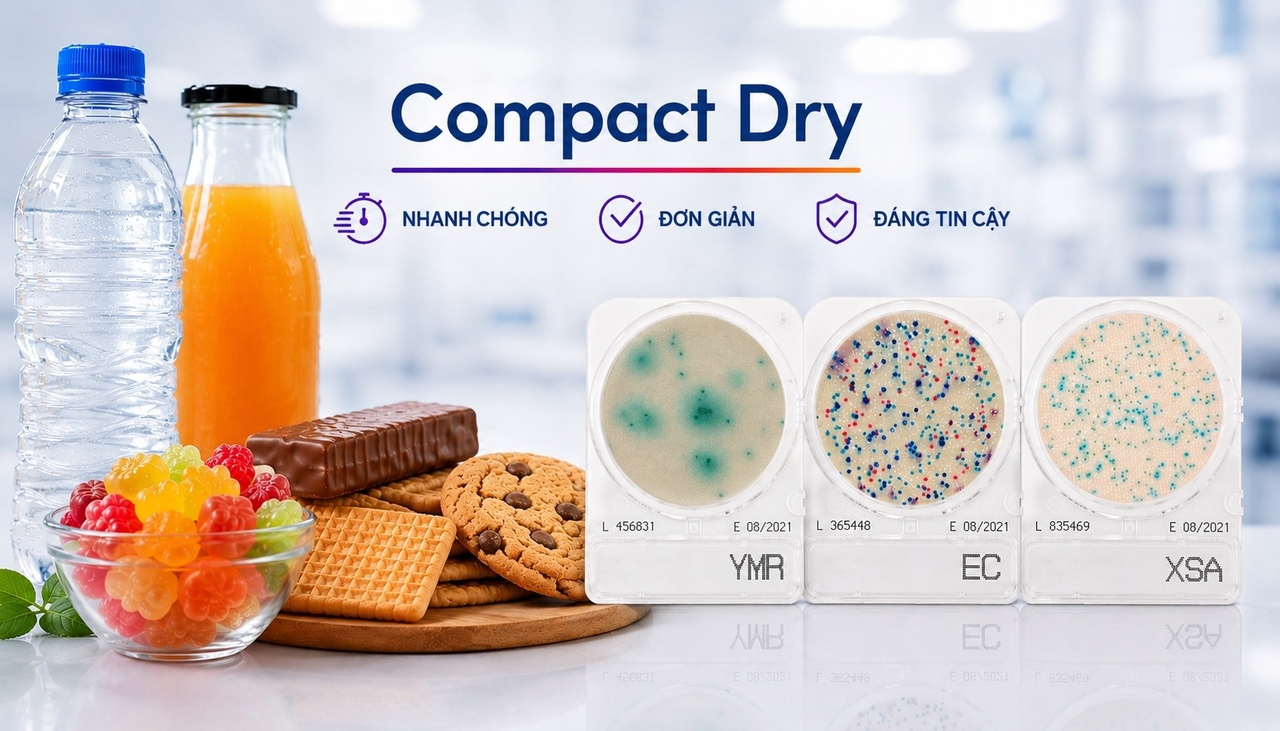
- In the confectionery and beverage manufacturing industry, microbial control plays an extremely important role in maintaining brand quality and reputation.
- Compact Dry is the line of dry microbiological testing plates developed by Shimadzu (Japan), helping food businesses detect contamination risks quickly and reliably.
Why does the confectionery and beverage industry need strict microbial control?
Ingredients such as sugar, milk, cacao, wheat flour, water, flavorings, or fruits all carry the risk of microbiological contamination during storage and processing.
Some important microbiological parameters to monitor are:
- Total aerobic microorganisms (TPC)
- Coliform
- E. coli
- Yeasts and molds
- Staphylococcus aureus
- Enterobacteriaceae
If not properly controlled, businesses may face:
- Products spoiled before the expiry date
- Customer complaints
- Product recalls
- Loss of brand reputation
- Serious economic losses
Therefore, applying the solution of rapid microbiological testing is the trend chosen by many confectionery and beverage plants today.
The applications of Compact Dry in confectionery plants
Testing the incoming raw materials
Compact Dry helps quickly assess the microbiological quality of:
- Wheat flour
- Sugar
- Milk powder
- Cacao
- Margarine
- Dried fruits
- Flavorings
As a result, businesses can detect raw material batches that fail to meet requirements before putting them into production.
Controlling The Production Environment
Confectionery plants often require a high level of hygiene to limit cross-contamination risks.
Compact Dry is used to test:
- Equipment surfaces
- Working tables
- Production tools
- Workers' hands
- Air in the production area
Rapid results help the QA/QC team handle hygiene issues in a timely way as they arise.
Testing finished products
Products such as:
- Biscuits
- Sponge cake
- Soft candy
- Hard candy
- Chocolate
- Soft drinks
- Fruit juice
- Bottled tea
- Plant-based milk
can all be tested with Compact Dry to ensure they meet microbiological standards before leaving the factory.
Applying compact dry in the beverage industry
Water is the most important ingredient in many kinds of drinks and is also a source of microbiological contamination.
* Production water
- Coliform
- E. coli
- Total aerobic microorganisms
* Finished product water
- Bottled drinking water
- Mineral water
- Soft drinks
- Bottled tea
- Fruit juice
- Nutritional drinks
* CIP water and equipment rinsing water
- Testing the efficiency of the cleaning and disinfection process for production equipment.
The kinds of Compact Dry plates commonly used in the confectionery and beverage industry
* Compact Dry TC
- Testing the total aerobic microorganisms (Total Count).
* Compact Dry EC
- Detecting Coliform and E. coli.
* Compact Dry YMR
- Quantifying yeasts and molds.
* Compact Dry X-SA
- Detecting Staphylococcus aureus.
Thanks to the diverse range, businesses can build a comprehensive microbiological testing process with only one platform of plates.
The benefits of using Compact Dry
Saving Time
No need for:
- Preparing media
- Autoclave sterilization
- Pouring agar plates
Just drop the sample and incubate it.
Reducing operating costs
- Reducing QC room labor
- Reducing chemical costs
- Reducing electricity for the autoclave
- Reducing laboratory space
Easy to train staff
- The simple procedure allows new staff to work quickly without much experience in microbiology.
Intuitive results
- The colonies are displayed with a characteristic color making the results easy to read and reducing errors.
High reliability
- Compact Dry has been widely used in the global food industry and meets many international standards.
Why are many confectionery and beverage plants switching to Compact Dry?
The current trend is to optimize cost and increase the speed of quality control. Compared with the traditional agar pour plate method, Compact Dry brings:
- Faster handling
- Less cross-contamination risk
- Lower operating costs
- Standardized testing procedures
- Higher QC room efficiency
This is why more and more businesses producing confectionery, soft drinks, and processed foods choose Compact Dry.
Conclusion
- In the confectionery and beverage industry, effective microbial control is the deciding factor of product quality. The Compact Dry plate is becoming the top choice for modern QA/QC rooms and microbiology laboratories.
- If your business is looking for a solution of rapid microbiological testing , reducing operating costs, and raising quality control efficiency, Compact Dry is a worthwhile investment.