
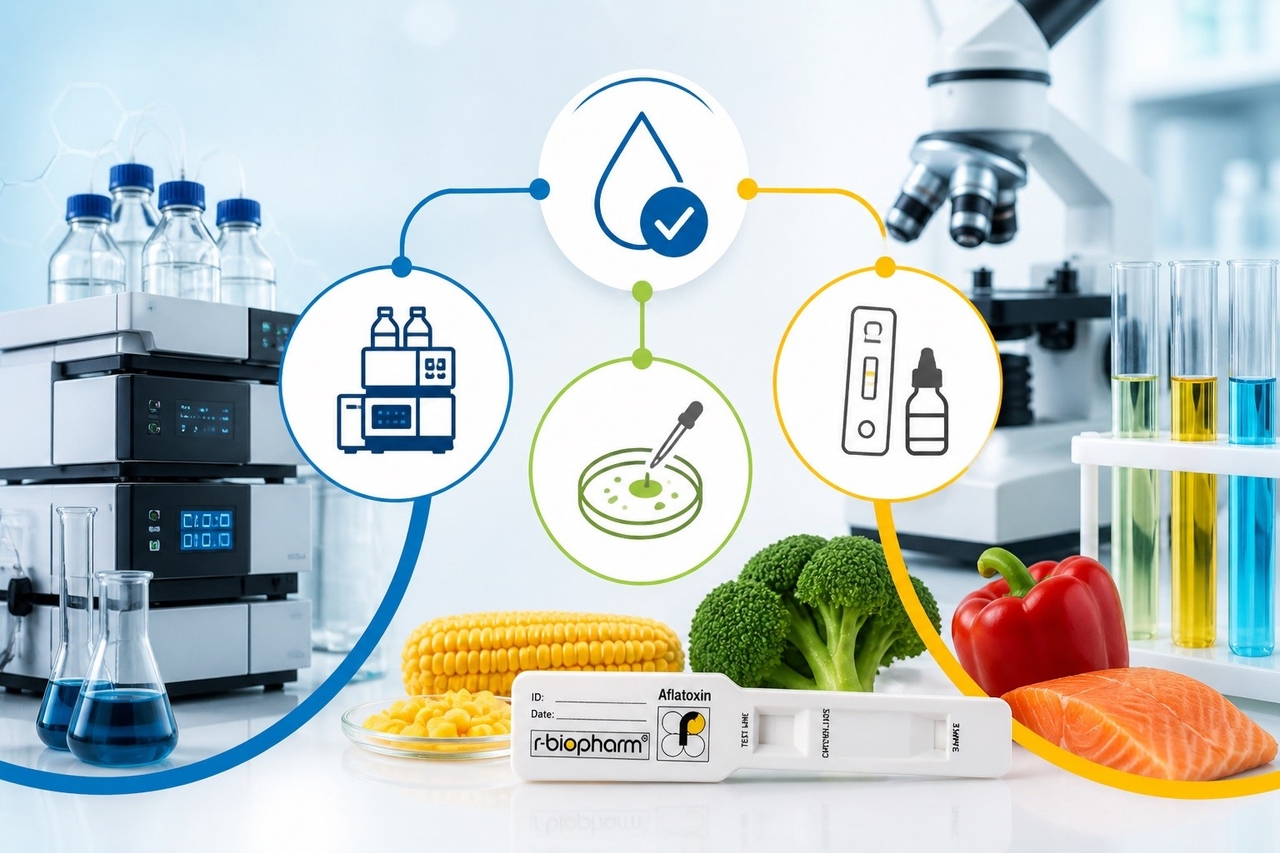
Overview: why it matters to choose the right vitamin analysis method?
In the food, dairy, functional food, and animal feed industries, vitamin analysis plays an extremely important role in:
- Ensuring the declared content is correct
- Controlling product quality
- Meeting export standards
However, many businesses struggle to choose the right method among 👉 HPLC – microbiological test – test kit
So which is the optimal method? This article will help you understand clearly.
1. HPLC (high-performance liquid chromatography)
- HPLC (High Performance Liquid Chromatography) is a modern analytical method for separating and quantifying compounds, including
* Advantages
- Very high accuracy
- Detailed quantitative analysis of each vitamin type
- Widely recognized in testing
* Disadvantages
- High equipment investment cost
- Requires specialized technicians
- Relatively long analysis time
- Complex sample preparation process
When should HPLC be used?
- Official testing
- Product declaration
- Export (EU, USA)
- Advanced analysis
2. Microbiological method (microbiological test)
- This method uses microorganisms to determine vitamin content (especially B-group vitamins).
* Advantages
- Suitable for some vitamins such as B12 and B1
- Cheaper than HPLC
* Disadvantages
- Long analysis time (24–72 hours)
- Accuracy depends heavily on handling
- Hard to control errors
When should it be used?
- Traditional laboratories
- B-group vitamin analysis
- When HPLC is not available
3. Vitamin rapid test (test kit)
- This method uses rapid test kits to determine vitamin content in a short time.
- R-Biopharm products are among the popular solutions today.
* Outstanding advantages
- Fast (a few hours)
- Easy to use
- No complex equipment needed
- Suited to internal QC
- Cheaper than HPLC
* Disadvantages
- Does not completely replace HPLC for official declarations
- Some analytes have limits
When should a test kit be used?
- Rapid testing of incoming raw materials
- Testing during production
- Screening before sending samples to HPLC
- Routine checks
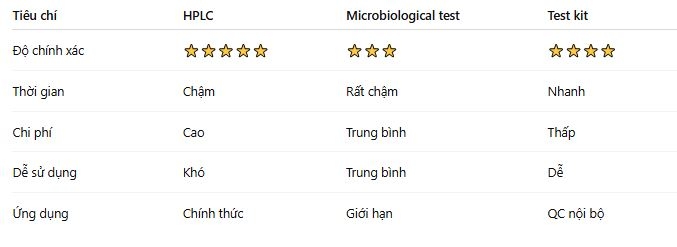
Comparing the 3 vitamin analysis methods
When should you choose a test kit over HPLC?
This is a question many businesses care about. You should choose a vitamin test kit when:
✔️ You need fast results
You cannot wait 1–3 days like HPLC
✔️ You want internal control (QC)
- Test immediately at the factory
- Detect deviations early
✔️ You want to optimize costs
- No large machinery investment needed
- Lower sample shipping costs
✔️ You test large volumes
Checking many samples each day
The optimal combined solution
- In practice, businesses should apply: test kit + HPLC
Specifically:
- Test kit → rapid testing, screening
- HPLC → official confirmation
👉 This is a way to:
- Increase QC efficiency
- Reduce costs
- Optimize time
Mistakes when choosing a vitamin analysis method
- Using only HPLC → costly, slow
- Using only test kits → missing official confirmation
- Not testing periodically
- 👉 The right solution is flexible combination
Conclusion
Today there are 3 main methods for vitamin analysis:
- HPLC → high accuracy, for declarations
- Microbiological test → traditional, slow
- Test kit → fast, economical, suited to QC
👉 Among them, R-Biopharm's vitamin test kits are becoming the trend thanks to their convenience and effectiveness.
Contact for advice
If you are looking for:
- a vitamin test kit
- a rapid vitamin testing solution
- an optimized QC system
👉 Contact us for advice on the most suitable solution.