
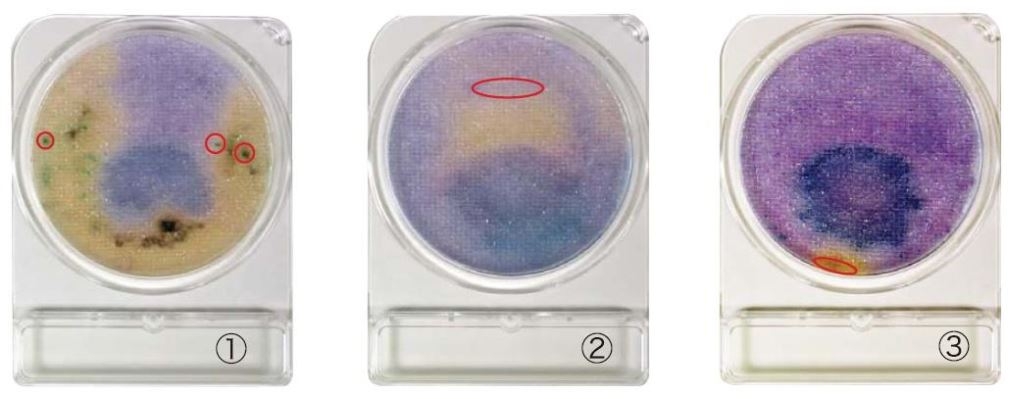
However, in practice many people still make common mistakes that lead to inaccurate results. This article summarizes the most frequent mistakes and effective fixes when using pre-poured Compact Dry medium plates.
1. Using the sample incorrectly
- Using samples that are too thick, contain too many impurities, or have not been diluted properly.
- Not handling the sample correctly before inoculation.
* How to fix it
- For food, beverages, or biological samples, dilute the sample following the manufacturer's instructions.
- Apply pretreatment measures if the sample contains many solid particles, grease, or impurities.
2. Non-uniform sample inoculation
- The sample is spread unevenly over the plate surface, or applied too heavily/thinly, leading to skewed results.
* How to fix it
- Use a pipette or inoculation loop to distribute the sample evenly over the plate surface.
- Work gently, and avoid spilling the medium.
3. Not controlling the incubation temperature
- Incubating at the wrong temperature, or letting the temperature vary during incubation, causes microorganisms to grow outside the expected conditions.
* How to fix it
- Use an incubator with a stable temperature as instructed (usually 35–37°C for total bacteria counts).
- Avoid opening the incubator too often during incubation.
4. Not reading results at the right time
- Reading too early or too late makes the colony count inaccurate or difficult to distinguish clearly.
* How to fix it
- Read results within the instructed time window (for example 24–48 hours depending on the microorganism).
- If needed, take photos for storage so results can be compared and re-checked.
5. Skipping quality control (QA/QC)
- Not using control samples, or not comparing results against reference samples, makes the results less reliable.
* How to fix it
- Always run reference or positive/negative control samples alongside the test.
- Record and evaluate results according to the laboratory's QA/QC procedures.
👉 See the article Quality assurance procedures (QA/QC) when using Compact Dry in the testing laboratory
6. Failing to clean instruments and the work area
- Inoculation tools, pipettes, or work benches are not cleaned, leading to cross-contamination and false results.
* How to fix it
- Clean hands, instruments, and work surfaces with 70% alcohol or a disinfectant solution before and after inoculation.
- Carry out inoculation in a clean environment, away from strong drafts or dust.
* Tips for using Compact Dry plates
To get the best results with Compact Dry, you should:
- Follow the manufacturer's storage and handling instructions.
- Perform quality control checks regularly.
- Record results carefully and evaluate them against industry standards.
This way, a business can control microorganisms safely, quickly, and cost-effectively — especially suitable for food, beverages, cosmetics, and other processed products.