

1. Traditional culture method
- Purpose: qualitative and quantitative detection of microorganisms in a sample.
* How it works:
- Use solid (agar) or liquid (broth) culture media.
- Incubate the sample in an incubator under appropriate temperature and time.
- Count the colonies (CFU – Colony Forming Unit) or observe growth.
* Advantages:
- Simple and economical.
- Allows detection and identification of many kinds of microorganisms.
* Disadvantages:
- Takes a long time (usually 24-72 hours).
- Requires technicians with considerable experience.
2. Turbidimetric method
- Purpose: measuring the density of microorganisms in a liquid medium.
* How it works:
- Measure the turbidity of the medium with a spectrophotometer or a turbidimeter.
- Compare against a calibration curve to determine the number of microorganisms.
- Advantages: fast and easy to perform.
- Disadvantages: cannot distinguish the type of microorganism.
3. Membrane Filtration Method
- Purpose: identifying microorganisms in low-density samples (such as drinking water or wastewater).
* How it works:
- Filter the sample through a microbiological membrane filter.
- Place the membrane on the culture medium.
- Incubate and count the colonies that grow on the membrane.
* Advantages:
- Sensitive, suitable for samples with low microbial density.
- Analyzes large sample volumes.
* Limitations:
Requires specialized equipment.
4. Compact Dry plate culture method
- Purpose: testing total aerobic bacteria or specific microorganisms.
* How it works:
- Spot a measured amount of liquid sample onto a Compact Dry plate with ready-made medium.
- Incubate at an appropriate temperature and count the colonies.
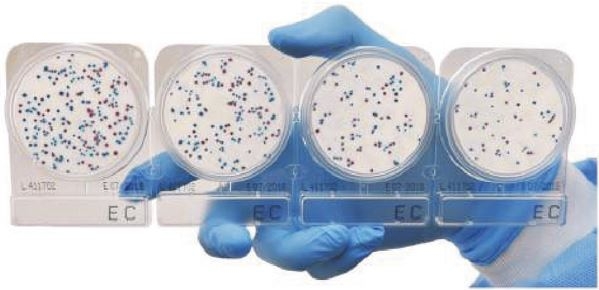
* Advantages:
- Convenient, no need to prepare culture media.
- Fast results that are easy to read.
* Limitations:
- Limitations on some sample matrices
5. Molecular method (PCR - Polymerase Chain Reaction)
- Purpose: determining the presence of microorganisms based on their DNA or RNA.
* How it works:
- Extract DNA from the sample.
- Amplify the organism's characteristic gene segment with a PCR instrument.
- Analyze the amplification products.
* Advantages:
- Fast, highly accurate.
- Detects microorganisms that cannot be cultured.
* Limitations:
- Requires complex equipment and technique, and is costly.
6. Immunological method (ELISA - Enzyme-Linked Immunosorbent Assay)
- Purpose: detecting microorganisms or their toxins.
* How it works:
- Use specific antibodies to detect antigens (or the reverse).
- Read the result through a colour reaction or an optical signal.
* Advantages:
- High sensitivity, short turnaround.
- Suitable for rapid screening.
* Limitations:
- Requires specific antibodies and is costly.
7. Rapid Methods
- Examples: ATP bioluminescence, using biosensors.
- Purpose: quickly assessing the presence or level of microbial contamination.
- - Advantage: extremely short turnaround (a few minutes).
- Limitation: usually for screening only, confirmation by another method is needed.
Depending on the testing requirement (qualitative, quantitative, or rapid detection), these methods can be used individually or in combination for maximum effectiveness. Please contact us for advice on the specific method best suited to your requirements.