
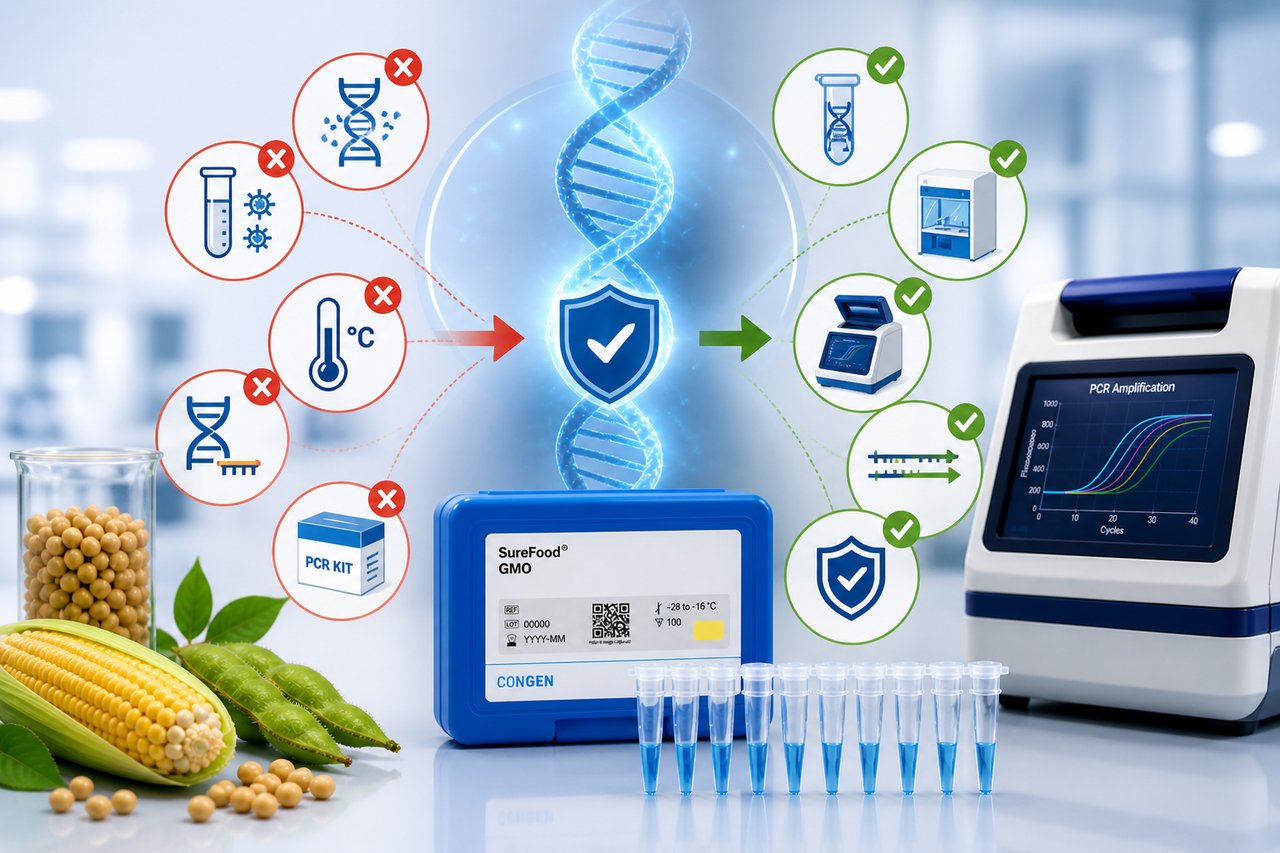
Why are GMO PCR tests prone to error?
The PCR (Polymerase Chain Reaction) method is regarded as the gold standard in GMO testing, but in practice:
👉 Many QC rooms experience:
- Unstable results
- Deviations between test runs
- False positives/negatives
👉 The main causes come from:
- Procedural mistakes
- Laboratory conditions
- Sample quality
1. Mistake 1: Poor-quality DNA — the leading cause
* Symptoms:
- DNA cannot be amplified
- Weak or unclear PCR results
- Deviations between test runs
* Causes:
- The sample has degraded
- A substandard extraction procedure
- Contamination with impurities (proteins, lipids, polysaccharides)
* How to fix it:
- Use a standard-compliant DNA extraction kit
- Store samples under the right conditions
- Check DNA purity before PCR
* Note: DNA is the "input material" → if it is wrong from the start, the PCR result is certainly wrong
2. Mistake 2: Sample cross-contamination — causing false positives
* Symptoms:
- A sample with no GMO still gives a positive result
- Many samples abnormally positive together
* Causes:
- Unclean tools
- Incorrect pipetting technique
- No separation of work areas
* How to fix it:
- Separate areas: extraction – PCR – analysis
- Use filter tips
- Decontaminate regularly with UV or chemicals
👉 This is an extremely dangerous mistake because: it can lead to wrong decisions in production or export
3. Mistake 3: Wrong PCR temperature — inaccurate results
* Symptoms:
- DNA cannot be amplified
- Abnormal PCR curves
- Results not reproducible
* Causes:
- Wrong PCR program settings
- An unstable PCR machine
- Unsuitable primers
* How to fix it:
- Check and calibrate the PCR machine periodically
- Use standard protocols from the manufacturer
- Optimize the annealing temperature
4. Mistake 4: Unsuitable primers — GMO not detected
* Symptoms:
- False negative results
- GMO markers not detected
* Causes:
- Primers not matching the target (35S, NOS, FMV)
- Poor primer design
* How to fix it:
- Use standardized PCR kits
- Choose proven primers
5. Mistake 5: Using substandard kits
* Symptoms:
- Unstable results
- Deviations between test batches
* Causes:
- Kits of unknown origin
- Not meeting international standards
* How to fix it:
Use R-Biopharm kits:
- Standardized
- High accuracy
- Suited to QC rooms
6. Summary of common GMO PCR mistakes

🎯 How to ensure accurate GMO PCR results
To avoid PCR test errors, businesses should:
- Standardize the laboratory procedure
- Train staff
- Use high-quality kits
- Control environmental conditions
🚀 The optimal solution for businesses
Combine:
- A standard procedure
- Stable equipment
- Quality kits from R-Biopharm
✔ Fewer errors
✔ Higher reliability
✔ Meets export standards
Conclusion
Errors in GMO PCR testing come not from the method but from how it is carried out.
Businesses need to:
- Understand the common mistakes
- Apply suitable control measures
👉 This is the key to:
- Ensuring accurate results
- Avoiding legal risks
- Raising brand reputation