
1. What is a GMO marker?
- In food testing, a GMO marker is a characteristic DNA fragment used to identify the presence of genetically modified organisms.
👉 Put simply:
- Marker = a “genetic fingerprint”
- If a marker is detected → the sample likely contains GMO
- These markers are usually detected by the PCR (Polymerase Chain Reaction)
2. Why are markers used in GMO testing?
- Not all GMOs are alike, but most share common genetic elements.
👉 So instead of looking for each GMO individually, the laboratory will:
- Screen for common markers
- Detect faster and more efficiently
✔ Saves time
✔ Cuts costs
✔ Improves accuracy
3. The most common GMO markers today
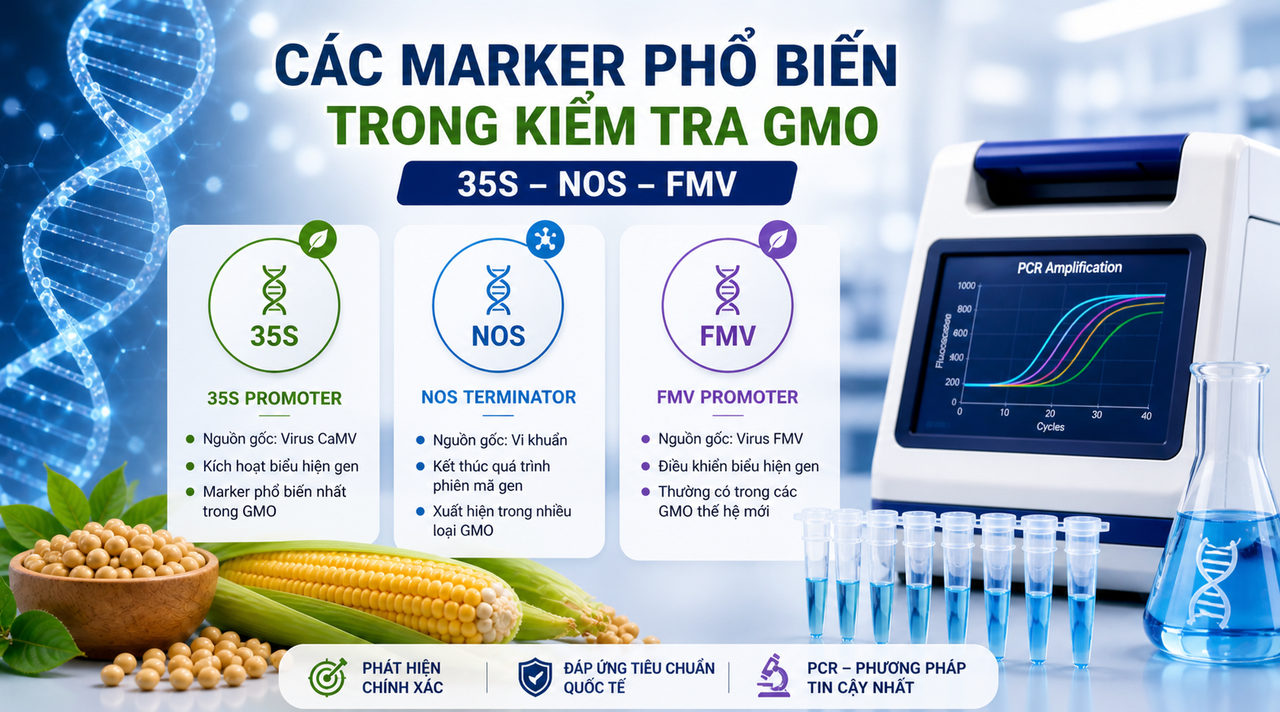
3.1. What is the 35S promoter?
The 35S promoter is a DNA segment derived from the cauliflower mosaic virus (CaMV).
* Role
- Activates gene expression in plants
- Widely used in GMOs
* Characteristics
- Present in the large majority of transgenic plants
- The most common marker
👉 Therefore: if 35S is detected → there is a high chance of GMO
3.2. What is the NOS terminator?
The NOS (Nopaline Synthase) terminator is a DNA segment derived from the bacterium Agrobacterium tumefaciens.
* Role
- Ends DNA transcription
- Stabilizes gene expression
* Characteristics
- Often paired with the 35S promoter
- Present in many GMO types
👉 When PCR finds NOS: it adds further confidence to the GMO result.
3.3. What is the FMV promoter?
The FMV (Figwort Mosaic Virus) promoter is another promoter used in genetic engineering technology.
* Role
- Drives gene expression similarly to 35S
* Characteristics
- Less common than 35S
- Used to detect newer-generation GMOs
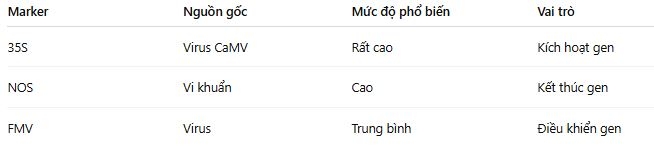
4. Comparing the common GMO markers
5. What GMO-test markers mean
Detecting these markers helps:
- Determine whether a sample contains GMO
- Improve accuracy of PCR analysis
- Support incoming raw-material checks
- Meet export requirements
6. Real-world GMO testing use
GMO markers are commonly tested in:
- Soybean
- Maize (corn)
- Animal feed
- Imported raw materials
👉 Especially important for businesses that:
- Export to the EU
- Produce non-GMO food
- Control their supply chain
7. GMO marker testing solutions from R-Biopharm
The R-Biopharm PCR kits enable:
- Rapid detection of the 35S, NOS, FMV markers
- High accuracy, meeting international standards
- Simple procedures, easy to implement
👉 This helps businesses:
- Control GMOs effectively
- Avoid legal risk
- Strengthen product reputation
⚠️ Notes when testing GMO markers
- Not all GMOs carry 35S
- Several markers should be combined for better accuracy
- Use PCR rather than rapid tests when official results are needed
8. Conclusion
- Markers such as 35S, NOS, FMV play a key role in detecting GMOs, especially when using the PCR method.
👉 Understanding markers helps businesses:
- Control quality better
- Meet international standards
- Reduce risks in production and export