
1. Coliform limits in food
- According to the National Technical Regulation QCVN 8-3:2012/BYT and international Codex standards, coliform limits in food are specified differently depending on each product type:
- Sterilised milk, yoghurt, cream: coliform must not be detected in 1g or 1ml of product.
- Processed foods: the limit is usually ≤100 CFU/g.
- Bottled drinking water: must not be detected in 100ml.
- Seafood, processed meat: total coliform ≤ 10²–10³ CFU/g depending on the type.
Exceeding the coliform limit not only makes the product fail to meet quality requirements but also carries the risk of food poisoning and infectious diseases.
2. Methods for testing Coliform in food
Traditionally, coliform is detected by the tube cultivation method or by plating on agar media. However, these methods are often time-consuming and laborious. In current practice, the testing method using Compact Dry plates is preferred thanks to its convenience, accuracy and ease of use.
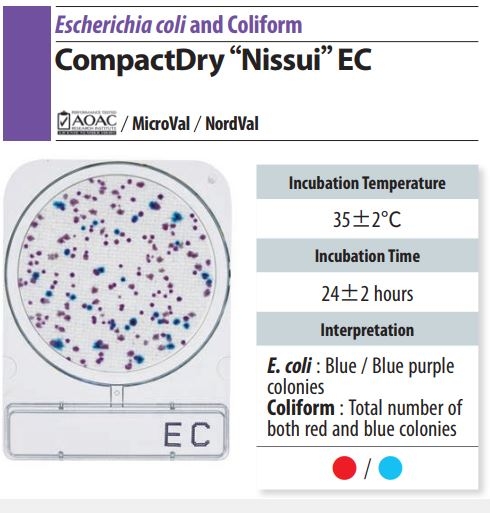
2.1. Compact Dry EC plates – Simultaneous testing for Coliform and E. coli
- Double selective medium: Compact Dry EC plates contain an indicator that helps detect both coliform and E.coli in a single step.
- Principle: Coliform growth forms red, pink colonies, while E. coli forms blue, purple-blue colonies due to the production of β-glucuronidase.
- Application: suitable for testing coliform and E. coli in meat, seafood, vegetables, milk and processed foods.
- Advantages: clearly distinguishes the two bacterial groups, results available after 24 hours, simple operation.
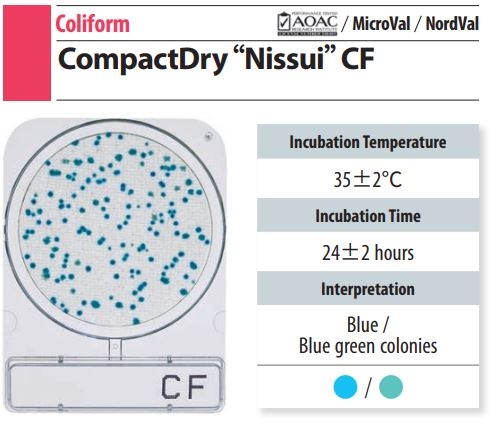
2.2. Compact Dry CF plates – Testing for total Coliform
- Characteristic colour indicator: After growth, Coliform forms blue, blue-green colonies thanks to the β-galactosidase enzyme.
- Application: used to evaluate total coliform in water, processed foods, ice water, and beverages.
- Result reading time: 24–48 hours depending on the level of contamination.
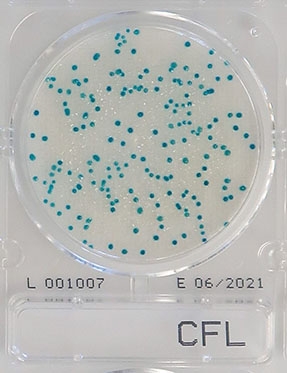
2.3. Compact Dry CF-L plates – for samples with a low bacterial load
- High sensitivity: designed to detect coliform in samples with a low microbial count such as drinking water, equipment rinse water, air, and especially used in milk samples and dairy products.
- Notable feature: can be used for membrane filtration before inoculation, suitable for coliform testing in products requiring low-limit detection.
- Time to results: 24–48 hours.
3. Advantages of the Compact Dry plate method
- Easy to operate, no medium preparation required.
- No special equipment such as a large incubator or colony counter is needed.
- Safe, no toxic gas generated during use.
- Easy to store and transport, long shelf life.
Controlling coliform limits in food is an important part of the quality and food safety management system. Choosing a suitable testing method such as Compact Dry EC, Compact Dry CF and Compact Dry CF-L plates will help businesses save costs while ensuring reliability in microbiological testing. The Compact Dry product lines manufactured by Shimadzu Diagnostics (Japan) are currently widely trusted in Vietnam for food testing according to international standards.