
1. What is the coefficient of variation CV in ELISA?
For the ELISA technique, a low coefficient of variation (CV) between sample replicates is very important to demonstrate that an assay has been performed well and that the data has a high degree of accuracy.
If your analytical results are similar and the number of replicates is large enough, the sample populations can be assessed using the standard deviation; if the analytical results differ widely, you must look at the % CV, to assess the accuracy of the technique in the laboratory.
CV is calculated by dividing the standard deviation (σ) of a set of measurements by the mean (µ) of the set, and is then expressed as a percentage variation from the mean
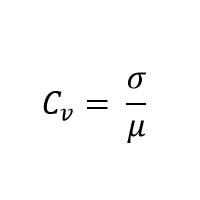
Two types of %CV are used: the CV within an assay (intra-assay CV) and the CV between assays (inter-assay).
- Intra-assay CV: measures the OD variation within one plate (repeatability).
- Inter-assay CV: measures the variation between sample replicates across different wells (reproducibility).Usually, to assess the overall reliability of your immunoassay results, the inter-assay % CV must be below 15% and the intra-assay % CV must be below 10%.
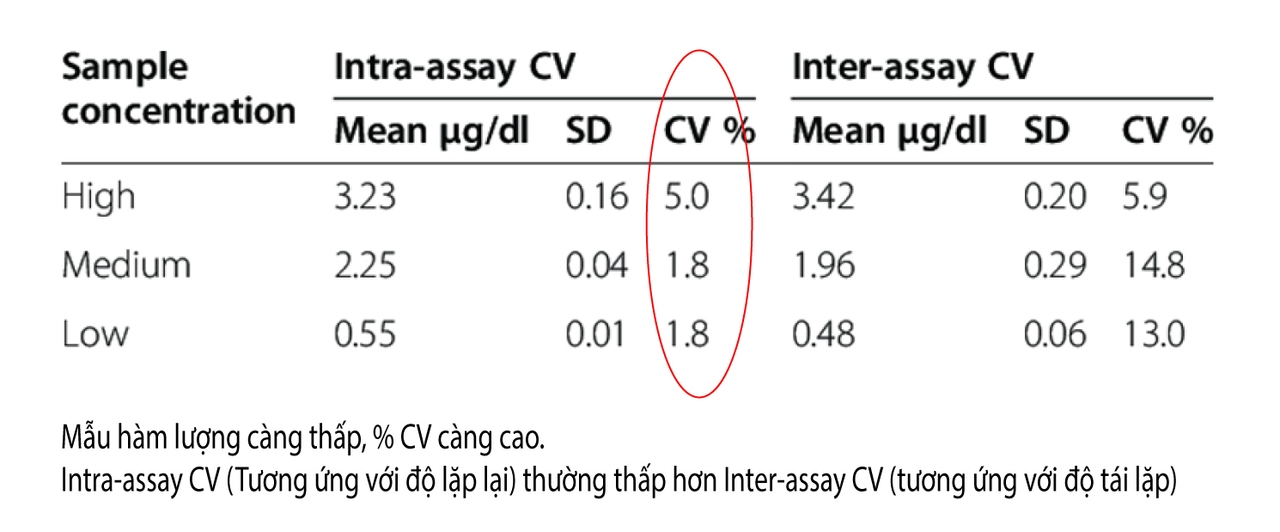
The coefficient of variation in the ELISA technique
2. Causes of a high CV in ELISA:
CV in the ELISA technique is high, usually coming mainly from the following causes:
- Technical operating errors: inaccurate pipetting technique, reagent splashing between wells, letting wells dry out, uneven wetting, inconsistent sample handling, uneven manual reagent addition, freeze/thaw cycles making the sample non-homogeneous....
- Equipment errors: an automatic pipette that is not calibrated, a plate reader that is not calibrated, unsuitable reader software settings.
- Contaminated chemicals or reagents can also lead to a high % CV. in the ELISA technique usually comes mainly from the following causes:
- Technical operating errors: inaccurate pipetting technique, reagent splashing between wells, letting wells dry out, uneven wetting, inconsistent sample handling, uneven manual reagent addition, freeze/thaw cycles making the sample non-homogeneous....
- Equipment errors: an automatic pipette that is not calibrated, a plate reader that is not calibrated, unsuitable reader software settings.
- Contaminated chemicals or reagents can also lead to a high % CV.
3. Fixing a high CV in ELISA:
- Use a fresh pipette tip for every adding/removing of chemicals and samples, to prevent cross-contamination between wells and the tip being wetted on reuse. This keeps the background and % CV low between your sample replicates.
- Do not pour leftover reagents/chemicals back into the original bottle, as this may accidentally contaminate your original reagent/chemical.
- As a technique, pre-wetting the pipette tip 2-3 times in the solution being aspirated can also help improve the % CV. When aspirating, keep the pipette upright, aspirate slowly, and let the tip touch the vessel when withdrawing. The pipette must be calibrated regularly.
- The washer and the ELISA reader also need to be maintained and recalibrated regularly.
- During incubation, make sure the plates are incubated in a sealed environment without convection, to minimize temperature changes across the plate and ensure even heat distribution across the wells. The plates should be covered tightly with aluminum foil to prevent wells from drying out and to avoid light.
- During washing, maintain the same washing procedure from well to well to minimize the %CV between assays. The number of wash cycles must be optimized. Usually, the wash step is repeated three times after each incubation step. A washer can be used to synchronize between wells. Note: the volume of wash solution per well needs to be greater than the total volume of sample/reagent/standard in each well at each incubation.
Some ELISA rapid test kits supplied by Pacific Scientific Equipment Technical Company: https://www.pacificlab.vn/vi/shops/group/elisa.html