1. What is citric acid
Citric acid (with the chemical formula C₆H₈O₇) is a weak organic acid, naturally present in many fruits, especially citrus fruits such as lemon, orange, pomelo. In the food industry, citric acid is widely used in the following roles:
- Acidulant: balances the product pH.
- Natural preservative: inhibits the growth of microorganisms.
- Flavoring agent: gives a mild sour taste.
In addition, citric acid also takes part in color stabilization, supports emulsification, and improves product texture in many food products such as:
- Beverages (soft drinks, fruit juice)
- Jam, jelly, candy
- Dairy products
- Canned and frozen foods
Because of its versatile roles and high safety profile, citric acid is recognized by the U.S. Food and Drug Administration (FDA) as "generally recognized as safe" (GRAS).
2. Why test the citric acid content in food
Testing the citric acid content in food is important:
- Ensure product quality: in accordance with the production formula.
- Comply with legal regulations: many countries set specific limits for food additives.
- Control the production process: ensure the product achieves the desired pH stability and flavor.
- Prove naturalness: distinguish natural citric acid from added citric acid in "organic" products.
- For this reason, using fast, accurate and reliable test methods is an essential requirement for food manufacturers.
3. Method for testing citric acid with the Enzytec™ Liquid Citric Acid E8230 test kit
* Introduction to the kit
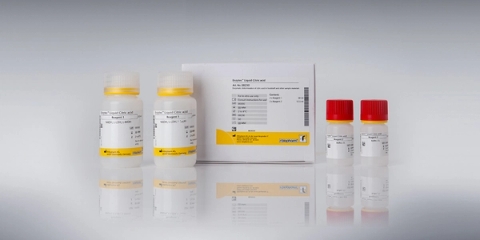
- Enzytec™ Liquid Citric Acid E8230 from R-Biopharm (Germany) is a dedicated enzymatic kit for the determination of citric acid in food and beverages. This is a kit in ready-to-use form, enabling quick and accurate analysis on complex sample matrices.

* Principle
Two-step enzymatic reaction:
- Citrate is converted into oxaloacetate and acetate by citrate lyase.
- Oxaloacetate is further reduced to malate under the catalysis of malate dehydrogenase (MDH), while consuming NADH.
- The decrease in NADH absorbance at the wavelength 340 nm is measured with a UV-Vis spectrophotometer. The extent of the absorbance decrease is directly proportional to the citric acid concentration in the sample.
* Outstanding advantages
- High accuracy: specific enzymatic method.
- Convenient: all reagents are ready-prepared, just add the sample.
- Fast: short turnaround time (~20-30 minutes).
- High sensitivity: suitable even for samples with a low citric acid content.
- Wide application: can measure citric acid in soft drinks, fruits, dairy products, processed foods...
* Basic steps
- Sample preparation: dilute the sample appropriately according to the expected citric acid content.
- Reaction preparation: add the reagents and the sample into the cuvette or microplate well according to the instructions.
- Measurement: read the absorbance at 340 nm after the reaction.
- Calculation: use the calculation formula in the instructions supplied with the kit.
4. Conclusion
- Citric acid plays an important role in food quality and sensory properties. To control and optimize the product, quantitative testing of citric acid is necessary.
- The Enzytec™ Liquid Citric Acid E8230 kit from R-Biopharm provides a fast, accurate and user-friendly analysis solution, helping manufacturers easily control their product quality.
- Refer to the detailed information of the Enzytec™ Liquid Citric Acid E8230 we provide here.