

1. CFU units in microbiological testing
- When scientists want to know how many microorganisms are present in a food or which microorganisms exist on a surface, they must extract or take a sample to determine the total number of those microorganisms. Normally it is very time-consuming to count individual cells under a microscope. The trick is to dilute a bacterial suspension and plate it onto Petri agar dishes or Compact Dry ready-to-use dried agar media plates so that microbiologists can count groups of bacteria collectively called colonies. Each colony is assumed to have developed from a single colony forming unit on its own (Colony Forming Unit – abbreviated as CFU). To determine CFU in practice, bacteria have to be cultured and the cells capable of multiplication, that is the viable cells, have to be counted. Therefore, the visual appearance of CFU in a culture always requires multiplication to take place.
– CFU is an abbreviation of Colony Forming Units and is called a colony forming unit. It is an indicator used to evaluate; and estimate the number of viable fungal or bacterial cells in a given sample.
- The method of counting viable colonies on an agar plate is called the standard plate count, expressed as CFU/ml for liquids and CFU/g for solid samples.
2. Why must CFU be determined
– As the CFU definition above has already referred to the purpose of counting viable cells, based on the ability to form colonies under defined conditions of nutrition, time and temperature.
– Viable cells can produce a set of colonies through replication. But in practice a single cell can also produce a similar colony. Alongside that, many bacteria are also capable of growing into chains or clusters.
- Therefore, estimating the number of microorganisms through CFU may exceed the number of cells present in a sample.
3. Formula for calculating CFU units
- Microbiologists use the counted number of CFU to determine approximately how many bacteria are in the original sample.
- Results are usually reported as CFU / mL (colony forming units per millilitre) for liquids and CFU/g (colony forming units per gram) for solids.
- Calculate the number of bacteria (CFU) per millilitre or gram of sample by dividing the colony count by the dilution factor. CFU/ml, (CFU/g) can be calculated using the formula:
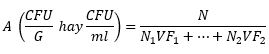
Where:
A : number of bacterial cells (colony forming units) in 1g or 1ml of sample
N : total number of colonies counted on the selected plates
Ni : number of plates inoculated at dilution i
V : volume of sample dilution (ml) inoculated into each plate
Fi : the corresponding dilution
Example : in a case analysing 1g of a specific sample, the following results were obtained:
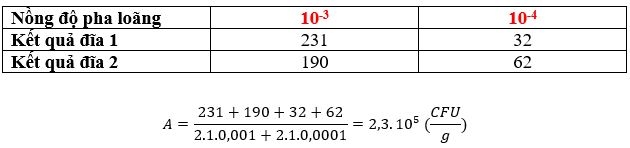
- The number of colonies per ml (g) as reported must reflect the accuracy of the method and should be expressed in scientific notation with 2 significant figures (for example 2,3x10⁵ and should not be shown as 2,34 x10⁵).
- Depending on the method, there are rules on the number of colonies that need to be counted on 1 plate to calculate the result. Normally, 25-250 colonies on one plate is a reliable result.
PacificLAB Scientific and Technical Equipment Co., Ltd is proud to be the exclusive representative in Vietnam of Compact Dry ready-to-use dried agar media plates from the renowned company Shimadzu Diagnostic (Japan). Customers can refer to information on microbiological testing parameters at the following link:
https://pacificlab.vn/vi/shops/group/dia-moi-truong-chuan-bi-san/