
1. ATP testing and the activities of the Hygiene Management Section
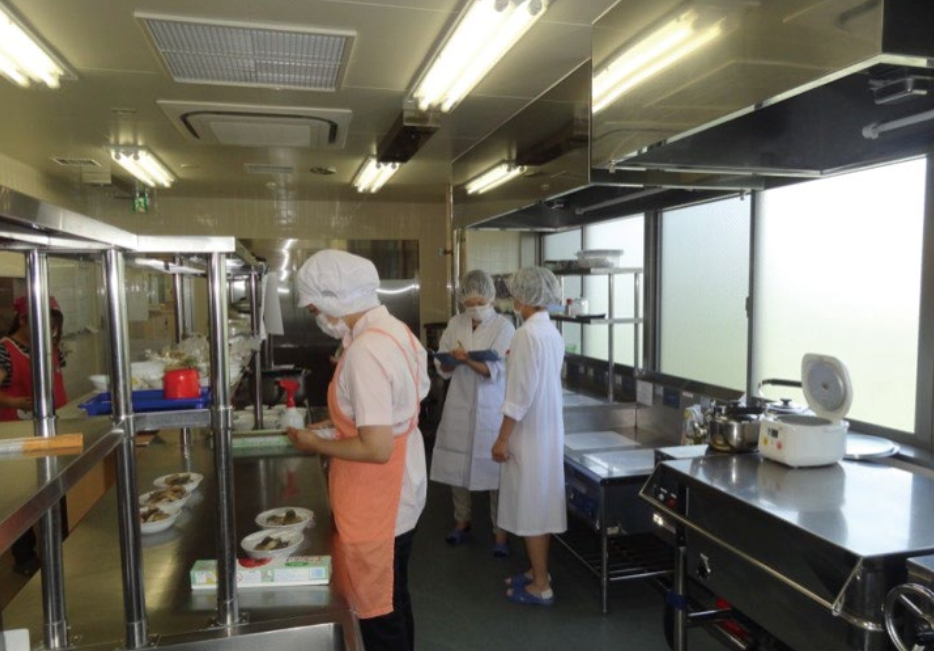
The activities of the Seirei Hygiene Management Section, with the help of ATP measurement instruments from kikkoman, serve to inspect and internally audit hygiene management in the kitchen through the following 3 tasks:
- Assess hygiene management by using the voluntary hygiene management checklist and ATP tests to check the cleanliness of the kitchen.
- Identify unsuitable points at the workplaces and provide guidance and advice for improvement.
- Raise a shared awareness of hygiene management among workers and improve the level of hygiene management.
In the inspections, based on the original voluntary hygiene management checklist of the Seirei Welfare Community (50 hygiene management items, 13 record management items), visual inspection and ATP testing are carried out to manage hygiene. The results are used to provide guidance and advice.
2. Voluntary hygiene management checklist
The voluntary hygiene management checklist used by the Hygiene Management Sections covers:
1) kitchen equipment
(2) refrigerator/freezer
(3) tableware/cooking utensils
(4) hand washing
(5) toilet
(6) waste
(7) raw ingredients
(8) cooking and processing
(9) personal hygiene(10) record book.
In the voluntary hygiene management inspection rounds, inspectors visually check the 50 hygiene items and the 13 record items with the workers at each site. Inspections are usually carried out during working hours. The inspections are carried out without prior notice to the workers at the site (only the manager of the facility is notified in advance).
Each item is scored on a scale from 0 to 2 (2 points: sufficient, 1 point: partly needs improvement and 0 points: needs improvement) and the highest possible score is 100 points.The evaluation criteria are also prepared based on specific standards so that all hygiene inspectors can evaluate in the same way. The results obtained show progress in hygiene management over the past 3 years
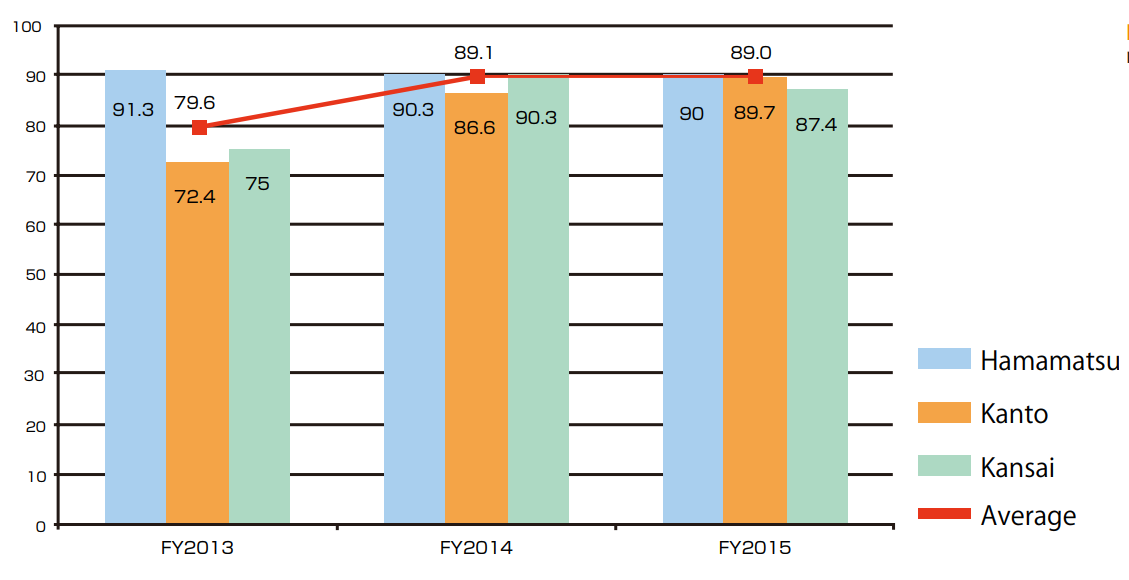
Figure 1 Average data from the voluntary hygiene management inspection rounds over the past 3 years at Seirei, evaluated by the ATP measurement
3. Use of ATP testing
Hygiene inspectors carry out ATP testing (Figure 2) together with visual inspection based on the checklist at 5 locations:
(1) hands after washing, (2) cutting boards in storage
(3) knife handles, (4) refrigerator handles (back side)
(5) blender blades
Table 1 shows the results of ATP testingin 2015, and Figure 2 (charts showing similar results):
Minimum | Maximum | Average value | Standard value | |
Hands | 17 | 19,178 | 2,241 | ≥1,500 |
Cutting board | 7 | 37,348 | 2,814 | ≥500 |
Knife handle | 53 | 34,188 | 7,527 | ≥100 |
Refrigerator handle | 203 | 122,699 | 18,785 | ≥2,000 |
Blender | 19 | 137,663 | 12,462 | ≥500 |
Table 1: Standard values and measurement data in ATP testing (Average)
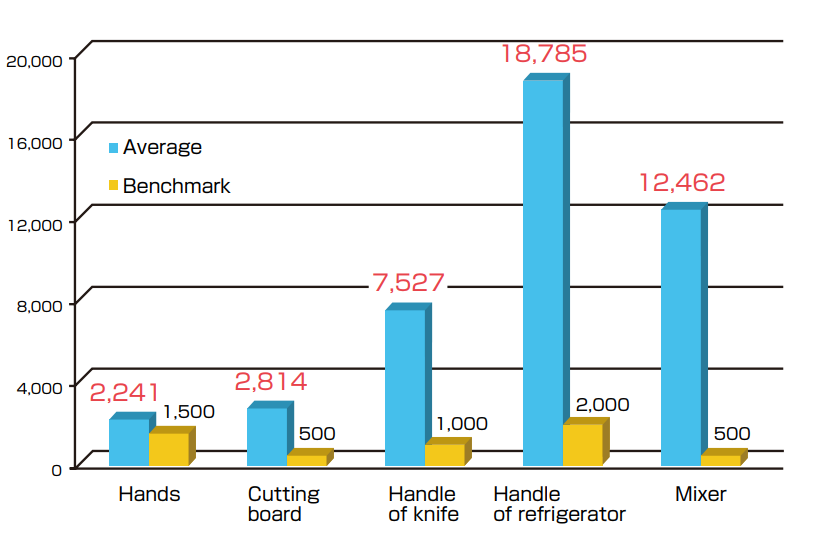
Standard values and measurement data in ATP testing (Average)The average value for hands is 2.241 RLU (minimum: 17 RLU, maximum: 19.178 RLU). This value is higher than the standard value (1.500 RLU*), but not that bad. While some facilities have low values, there are also facilities with extremely high values compared with the standard value, so those facilities need to be improved.
The values for the cutting board, knife handle, refrigerator handle and blender are approximately 5.6, 7.5, 9.4 and 24.9 times higher than the standard value respectively (Table 1, Figure 3).
The basis for choosing the locations for ATP testing
- Locations that are difficult to clean and easily contaminated
- Locations that can cause secondary contamination spread (hands, etc.)
- Locations with frequent contact with food ingredients (cutting boards, etc.). The group believes that the method of reducing the URL test value at individual facilities will encourage hygiene management and prompt a review of the hygiene procedures.
* RLU: Relative Light Unit (a unit dedicated to ATP testing)
| Reference standard value | Equipment with a flat surface that is easy to clean | ≤200 RLU |
| Equipment with an uneven surface that is difficult to clean | ≤500-1000 RLU |
4. Discussion of the ATP test results
① Cutting board
Even cutting boards that look clean can become scratched after long, continuous use, and dirt in such scratches is very difficult to remove, even when cleaning carefully according to the standard procedure. This leads to high ATP measurement values. Where necessary, the cutting board should be replaced.
Therefore, the results of ATP testing can be used not only to confirm hygiene management but also to identify the appropriate time to replace the cooking utensils. High RLU values on the cutting board may also be caused by the dishwashing sponge and the dust cloth used to clean and dry the cutting board.
② Refrigerator handle
The back side of the refrigerator handle is a location that is difficult to clean. However, cleaning it more thoroughly can cause water to splash onto the floor. Therefore, observing the cleaning process of the refrigerator handle can allow an assessment of the workers' shared knowledge and awareness of hygiene management, such as keeping the floor dry.
③ Blender blade
Blenders, grinders… are very difficult to clean because of their complex structure. High RLU values for the blender are considered a problem with the cleaning method. The assessment group usually introduces the cleaning methods used in facilities with lower RLU values. However, it is not easy to establish precise cleaning rules. What is important is that workers must understand how to remove food residue and to wash the blender, the grinder,…
The importance of hygiene education through ATP testing
Before ATP testing was applied, checks were visual inspections using the voluntary hygiene management checklist. However, there is no way to evaluate what the naked eye cannot see. Therefore, differences in hygiene management between facilities could not be detected. In addition, it takes several days to obtain bacteriological test results (the culture method).
ATP measuring instruments allow hygiene management to be digitised and visualised. The ATP measurement method provides numerical data immediately, which is especially important for education and training aimed at raising awareness of hygiene management. ATP testing provides a basis for understanding hygiene management, including the locations that many workers touch and that can cause secondary contamination. Contamination can remain in equipment with a complex structure, and low RLU values can be obtained when proper cleaning is carried out according to the standard procedure of each facility. This understanding leads to the possibility of establishing better cleaning methods.
Inspection item | Method and conditions | Standard | Countermeasures for locations with RLU ≥ Standard value |
Tap water | Use the device to take water from a frequently used tap | 0 - 30 RLU | Let the tap run for a while after cleaning and check again |
Hands | Check dry hands after washing and alcohol spraying
These procedures are carried out in this order for about 3 workers. | ≤1,500 RLU | Clean and check again to confirm the cleaning method and any injuries to the fingers. |
Cutting board | Check cutting boards stored in the sterilisation box ( cutting boards used for cooked food). Check the central 10×10 cm area by swabbing back and forth horizontally and vertically. | ≤500 RLU | Clean again and check again to confirm the cleaning method and damage to the cutting board |
Knife | Check knives stored in the sterilisation box ( knives used for cooked food).
| ≤1000 RLU | Clean again and check again to confirm the cleaning method |
Refrigerator handle | Check the handles frequently used to open and close the door
| ≤2000 RLU | Clean again and check again to confirm the cleaning method |
Blender blade | Check the blender for cooked food
| ≤500 RLU | Clean again and check again to confirm the cleaning method |
Bowl (if the blender is not used in the facility) | Check a clean bowl with a diameter of 20-30 cm
| ≤200 RLU | Clean and check again to confirm the cleaning method/storage |
References
Referenced from the kikkoman website https://biochemifa.kikkoman.com/e/
Learn more about ATP testing and applications: https://pacificlab.vn/vi/news/groups/giai-phap-kiem-tra-ve-sinh/