
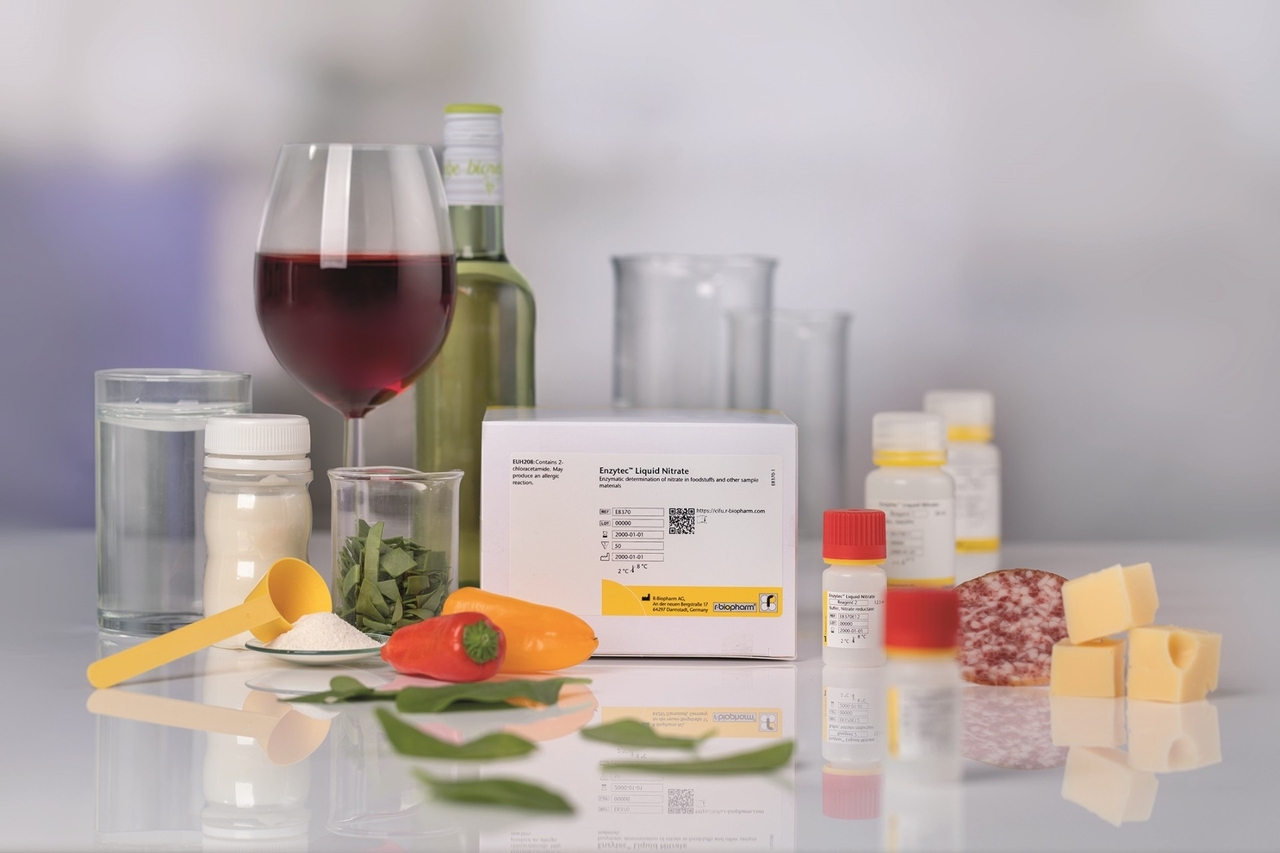
-In food and beverage testing, the accuracy of physicochemical parameters such as sugar, organic acid, ethanol, starch, etc., is a key factor the enzymatic method is regarded as the gold standard thanks to its high accuracy, stable repeatability, and easy application in laboratories as well as on production line
- One of the world's leading brands in enzymatic analysis kits is R-Biopharm (Germany) — a pioneering manufacturer meeting AOAC – ISO – OIV standards, widely used in food, fermented beverage, soft drink, and wine–beer industries.
1. The principle of the enzymatic method — why is its accuracy superior?
- The enzymatic method relies on the cut – convert – specific catalysis ability of enzymes for each sugar, acid, or alcohol molecule. For each analyte, the enzyme converts the measured substance into an interme
- The absorbance intensity (Abs 340 nm) is directly proportional to the concentration of the analyte → this is what gives the enzymatic method extremely high accuracy.
* Outstanding features of enzymes
- Absolutely specific for each substance → no interference from a complex matrix.
- No cross-reaction (e.g. glucose is not mistaken for fructose; lactic is not mistaken for malic).
- Fast, stable reactions.
- Linear results, easy to calculate and automate.
2. Why is the enzymatic method more accurate than traditional tests?

👉 Enzymatic is the ideal method for food–beverage factories that need fast, accurate, repeatable results, suited to process control and
3. The standard enzymatic kit line from R-Biopharm
R-Biopharm enzymatic kits are designed to accurately quantify many important analytes:
✔ The Sugar – Carbohydrate group
- D-Glucose / D-Fructose test kit: applied in fruit juices, beer, wine, yogurt, soft drinks.
- Sucrose test kit: measures free sucrose or hydrolyzed sucrose.
- Starch / Dextrin test kit: suits starch products, syrups, confectionery.
✔ The Organic Acid group
- L-Lactic Acid test kit: important in fermented products: yogurt, sour beer, fermented beverages.
- Acetic Acid test kit: monitors oxidation, vinegar fermentation, and wine.
✔ The Alcohol – Ethanol group
- Ethanol test kit: quantifies ethanol concentration in alcoholic drinks, beer, wine, kombucha.
✔ Other test kits
- Citric Acid, Malic Acid, Tartaric Acid: applied in wine and fruit juices.
- D-Galactose, Lactose: for dairy products.
- Sorbitol, Xylitol: for sugar-free products.
All kits:
- Are internationally standardized (AOAC, OIV, IFU).
- Have low RSD repeatability.
- Are compatible with UV-VIS spectrophotometers and automation systems.
4. Practical applications in wine – beer – soft drink – fermented food production
➤ The wine – spirits industry
- Controlling glucose, fructose to track the fermentation process.
- Quantifying ethanol, glycerol to assess finished product quality.
- Analyzing lactic / malic acid to monitor malolactic fermentation.
➤ The beer industry
- Testing glucose, maltose, maltotriose in wort.
- Controlling main fermentation – secondary fermentation through lactic acid, acetic acid.
- Ensuring product stability and flavor.
➤ Soft drinks – fruit juices
- Accurately quantifying sugar (sucrose – glucose – fructose).
- Controlling citric acid, malic to stabilize the sour–sweet taste.
- Monitoring natural preservatives and raw material quality.
➤ Fermented foods (yogurt, kombucha, kimchi)
- Controlling lactic acid — an important parameter in safety and sensory quality.
- Quantifying the low ethanol in naturally fermented products.
- Tracking glucose during sugar conversion.
5. The R-Biopharm enzymatic kit — the optimal solution for laboratories and factories
The enzymatic kit from R-Biopharm is the ideal solution for:
- Food–beverage testing laboratories
- Wine – beer – soft drink factories
- Fermented food production facilities
- State testing centers and research institutes
* Advantages
- High accuracy
- Easy to use
- Fast speed
- Economical
- Suited to process control.
👉 See more articles on the same topic