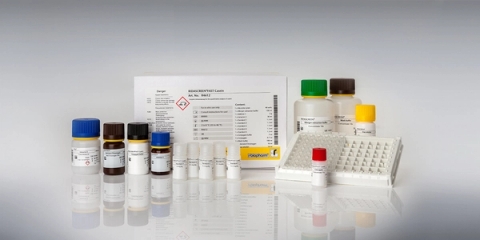
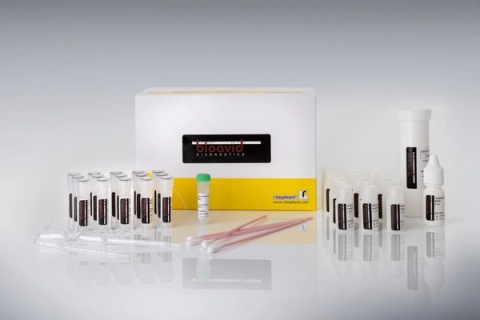
1. RIDASCREEN® FAST Milk R4652
- The sandwich ELISA RIDASCREEN ® FAST Milk (product code R4652) is suitable for testing foods of unknown composition that may contain both casein and β-lactoglobulin (BLG) in unknown ratios.
- This assay contains antibodies against both BLG and casein. In a sample with a natural protein ratio, the assay detects about 50% casein and about 50% BLG — that is, the assay reliably detects traces of both protein types. The value measured in the ELISA is a composite value from the reaction of both antibodies.
- If the unknown sample contains only casein, then only the anti-casein antibody provides a reaction. The same applies to the anti-BLG antibody. The composite result is given in mg/kg (ppm) of milk protein.
- However, this value does not necessarily correspond to the natural ratio in milk. The assay can detect up to 0.7 ppm (mg/kg) of milk protein, which corresponds to a theoretical conversion ratio of 21.9 ppm of milk. NIST SRM 1549A skim milk powder with a protein content of 26.5% is used as the standard.

2. RIDASCREEN® FAST Casein R4612
- The sandwich ELISA RIDASCREEN ® FAST Casein (product code R4612) is suitable for testing foods that may contain mostly casein or caseinate. If the casein content in the sample is known, it can be converted into milk protein. If it is a food with added cow's milk, or contamination from cow's milk, the casein content is 2.6%.
- Whey products, which consist mainly of BLG, also contain traces of casein and can therefore also be tested. The test detects the amount of casein contamination present in the whey sample. The degree of contamination relating to BLG is unknown. Therefore, the measured casein content of a whey sample cannot be converted into a milk concentration.
- However, a positive casein result shows the food is contaminated with milk. The presence of milk protein must be declared on the label.

3. RIDASCREEN® FAST β-Lactoglobulin R4912
- The sandwich ELISA RIDASCREEN® FAST β-Lactoglobulin (code R4912) is suitable for testing foods that may contain mainly whey protein. The amount of BLG indicates the relationship to the amount of whey present in the food, and therefore in every case the presence of milk protein.
- Food must be labeled. Casein and caseinate cannot be produced without BLG in the production process. Existing contamination can be detected in the assay. The degree of contamination relating to casein is unknown. Therefore, the measured BLG of a casein sample cannot be converted into a milk concentration.

4. RIDASCREEN® β-Lactoglobulin R4901
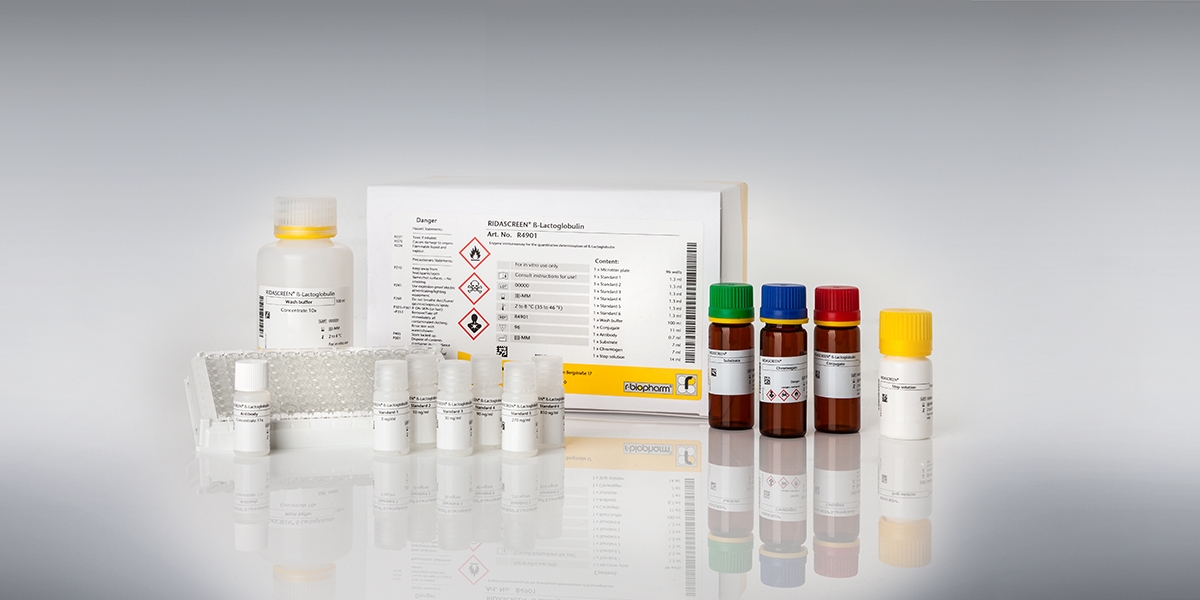
- The competitive ELISA assay RIDASCREEN® β-Lactoglobulin (product code R4901) is suitable for testing hydrolyzed milk products, especially hypoallergenic infant foods, because the competitive format can detect the smallest protein fragments (one epitope) in highly hydrolyzed milk products.
5. bioavid Lateral Flow Milk and Lateral Flow Casein incl. Hook Line
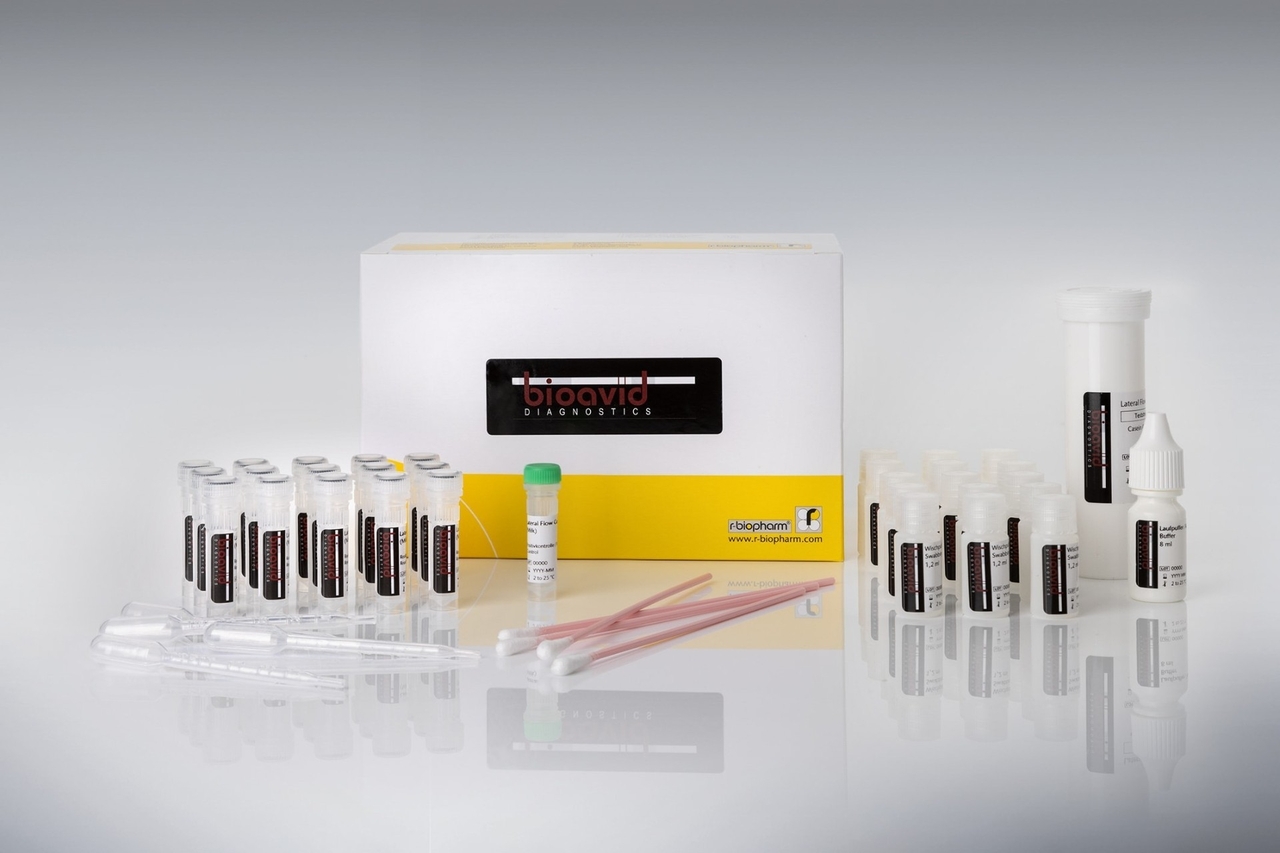
- The qualitative rapid tests (LFD) for bioavid Lateral Flow Milk (Art. No. BL623-15) and Lateral Flow Casein incl. Hook Line (Art. No. BLH714-15) allow rapid and simple but only qualitative (yes/no) detection of milk or casein. They can be used as a qualitative control within HACCP (Hazard Analysis and Critical Control Points) allergen management.
- Surfaces can be tested for milk contamination during food production to detect and prevent cross-contamination. The hygiene effectiveness of equipment and the factory can be tested, and food can be screened for milk/casein contamination. The casein test also includes the hook line effect, allowing the hook line effect to be detected in the case of highly positive samples.
6. Conversion according to the food ingredient
- Converting casein into milk: the result of the RIDASCREEN®FAST Casein assay (product code R4612) is given in mg/kg casein and can be converted into milk or milk protein, if the sample contains casein. If the sample contains cow's milk, the casein content is 80% of the milk protein, which in turn makes up 3.2% of the milk. Example: 10 mg/kg (ppm) of casein has been measured; 12.5 ppm of milk protein has been calculated (10 ppm casein x 100% / 80%) and 390.6 ppm of milk (12.5 ppm milk protein x 100% / 3.2%).
- Converting β-Lactoglobulin (BLG) into milk: the result of the RIDASCREEN®FAST β-Lactoglobulin assay (product code R4912) is given in mg/kg BLG and can be converted into milk or milk protein, if the sample contains whey or BLG. If the sample contains cow's milk, the BLG content is 10% of the milk protein, which in turn makes up 3.2% of the milk. Example: 1 mg/kg (ppm) of BLG has been measured; 10 ppm of milk protein has been calculated (BLG 1 ppm x 100% / 10%) and 312.5 ppm of milk (10 ppm milk protein x 100% / 3.2%).
- Converting milk protein into milk: the result of the RIDASCREEN®FAST Milk assay (product code R4652) is given in mg/kg milk protein and can be converted into milk. The conversion factor from milk protein to milk is 31.25. If the measured milk protein value is multiplied by the factor 31.25, the result is in mg/kg (ppm) of milk. Example: 1 mg/kg (ppm) milk protein x 100% / 3.2% = 31.25 ppm milk.
- Converting milk powder into milk: milk powder is equivalent to about 10% of milk because milk contains about 90% water. If the value is measured in milk powder and multiplied by the factor 10, the result is given in milk. Example: 1 ppm milk powder x 100% / 10% = 10 ppm milk.
Source: food.r-biopharm.com