Analyzing milk and dairy products is necessary to ensure high quality of these products. Enzyme analysis plays an important role in this analysis.
Enzyme tests can be used in production and quality assurance to measure many important parameters such as sugars and organic acids in dairy products. This allows the production process to be controlled and milk quality for consumers to be ensured. The parameters can be, for example:
- Lactose: Many dairy companies today also offer lactose-free dairy products. For these products, the lactose content must be controlled.
- D-/L-Lactic acid: Lactic acid content is an important quality factor in dairy production. The presence of D-lactate can serve as an indicator of contamination or spoilage. However, in fermented foods such as yogurt, Kefir (Kefir is is a fermented drink rich in probiotics with a sour taste and a consistency similar to drinking yogurt), milk butter or sour cream, lactic acid is necessary.
- D-Gluconic acid: Also known as additive E574, D-Gluconic acid is an acidity regulator commonly used in food production, for example in yogurt and cheese.
- L-Glutamic acid: Determining L-Glutamic acid concentration is very important during cheese ripening, along with other factors.
- L-Ascorbic acid (vitamin C): Also known as additive E300, vitamin C is often added to dairy products and must then be controlled.
- Succinic acid: The ripening process of cheese can be monitored by measuring the succinic acid level.
- Acetaldehyde: In dairy products such as yogurt and cheese, acetaldehyde produces the desired flavor but can also cause flavor defects.
- Ammonia: A high ammonia level can indicate that the milk has decomposed (by bacteria).
- Ethanol: Ethanol determination is very important in the kefir production process.
1. Automation solutions for milk and dairy product analysis
- Enzyme tests are usually performed manually. However, for convenient and efficient milk analysis, they can also be automated. Automation is worth considering, especially for large dairies and dairy laboratories, because it reduces costs, processing time and user error, and ensures consistently high-quality results under stable reaction conditions.
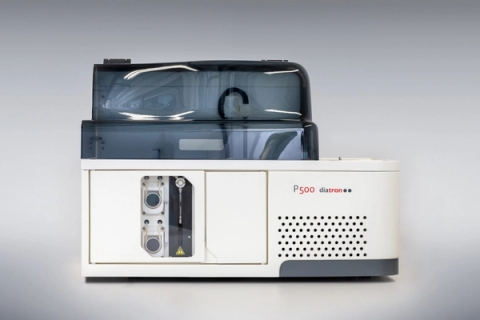
- The fully automated benchtop biochemistry analyzer for enzyme tests is the Pictus 500, particularly suitable for handling stable, ready-to-use liquid reagents, such as the Enzytec™ Liquid from R-Biopharm. All test processing steps such as sample detection, sample dilution, liquid handling, reagent preheating and cooling, as well as optical result reading and result calculation are automated.
2. Automation with the Pictus 500 automatic biochemistry analyzer offers many advantages
- Time saving: automated system, multiple tests for large sample series.
- User-friendly: ready-to-use, stable liquid reagents, automatic sample dilution and result calculation.
- Powerful and stable: long calibration life and reagent stability.
- Flexible: continuous sample and reagent loading.
- Cost-effective and sustainable: lower reagent consumption and reusable cuvettes.
3. Learn more about the Pictus 500 automatic biochemistry analyzer in our video and product information
https://pacificlab.vn/vi/shops/thuc-pham/may-phan-tich-sinh-hoa-tu-dong-pictus-500-r-biopharm.html