
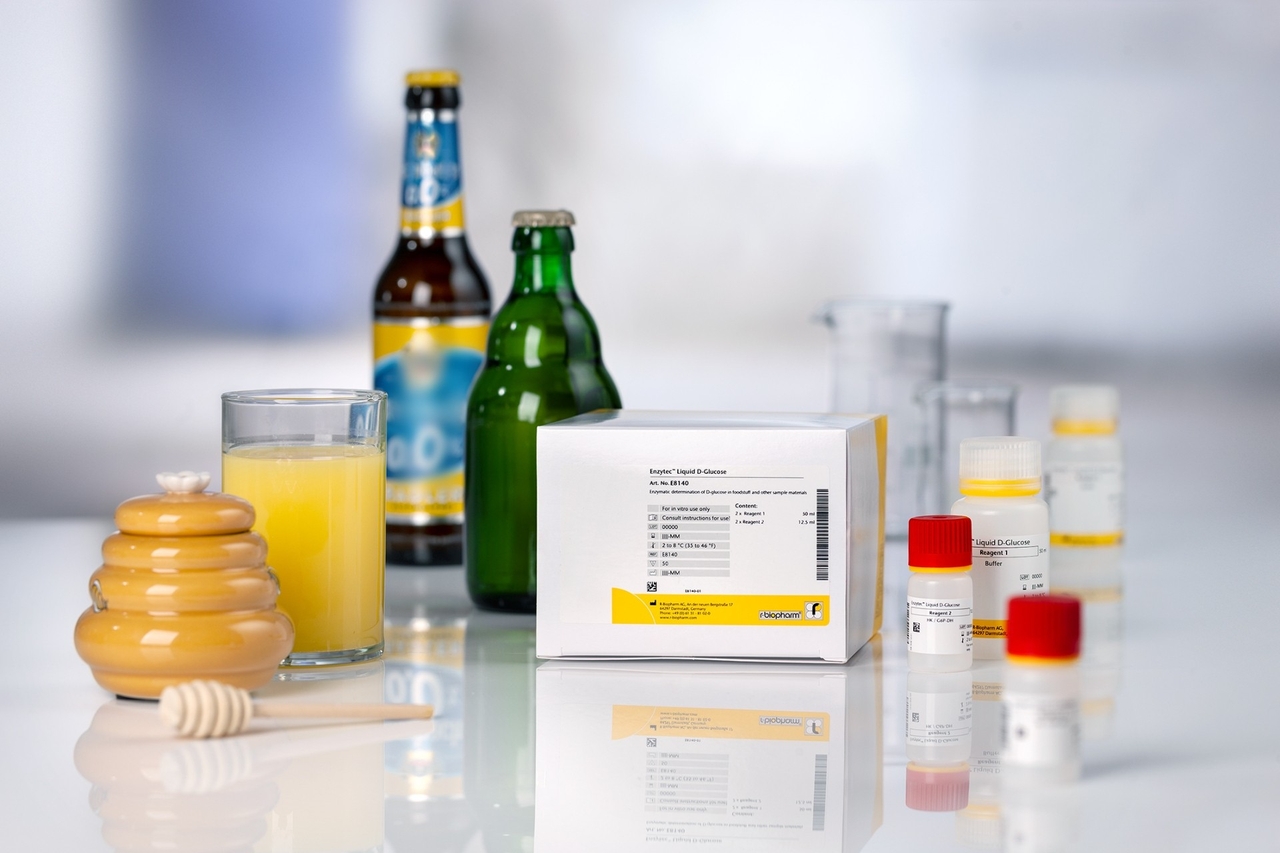
Among the analytical methods available today, the Enzymatic method stands out for its high specificity, accuracy and ability to accurately quantify individual sugars in complex mixtures.
1. General principle of the Enzymatic method
The Enzymatic method is based on the specific reaction between an enzyme and the substrate (the sugar to be analyzed), in which the conversion of the sugar leads to a change in an indicator substance (usually NADP⁺/NADPH or NAD⁺/NADH). This change is measured by spectrophotometry, from which the sugar concentration in the sample can be calculated.
2. Analysis of individual parameters
* Glucose
- Principle: Glucose is phosphorylated to glucose-6-phosphate (G6P) by the enzyme hexokinase (HK) and ATP. Then, G6P is oxidized by glucose-6-phosphate dehydrogenase (G6PDH) to produce NADPH.
- Main reaction:
Glucose + ATP → G6P + ADP (catalyzed by Hexokinase)
G6P + NADP⁺ → 6-Phosphogluconate + NADPH (catalyzed by G6PDH)
- Spectrophotometric measurement: NADPH formation is measured at a wavelength of 340 nm.
* Fructose
- Principle: Fructose is phosphorylated by the enzyme hexokinase to fructose-6-phosphate (F6P), which is then converted to G6P by phosphoglucose isomerase (PGI), and then follows the same reaction as glucose.
- Main reaction:
Fructose + ATP → F6P + ADP (catalyzed by Hexokinase)
F6P ↔ G6P (catalyzed by PGI)
G6P + NADP⁺ → 6-Phosphogluconate + NADPH (catalyzed by G6PDH)
- Spectrophotometric measurement: based on the amount of NADPH produced, measured at 340 nm.
* Maltose
- Principle: Maltose is hydrolyzed by the enzyme α-glucosidase into two glucose molecules. Glucose is then processed as above by the reactions of hexokinase and G6PDH.
- Main reaction:
Maltose + H₂O → 2 Glucose (catalyzed by α-glucosidase)
Then glucose is analyzed as described in the Glucose section.
- Spectrophotometric measurement: based on the amount of NADPH produced, measured at 340 nm.
3. Key advantages of the Enzymatic method
- High specificity: thanks to the specific enzyme, interference from other sugars is avoided.
- Accurate quantitative analysis: the spectrophotometric result at 340 nm allows the sugar concentration to be calculated accurately.
- Flexible application: can be used for many types of food samples such as juice, wine, milk, honey, sports drinks and functional foods.
4. R-Biopharm – Leading supplier of Enzymatic test kits
- R-Biopharm AG (Germany) is one of the world's leading manufacturers of high-quality enzymatic test kits for the analysis of components in food and beverages. R-Biopharm kits hold international certifications such as AOAC, IFU, OIV, and are widely used in reputable testing laboratories worldwide.
Kits in the Enzytec™ Liquid range stand out for:
- Ready to use, saving preparation time.
- Easy to use: suitable both for professional labs and corporate R&D departments.
- Accurate results, high reproducibility
Analysis of glucose, fructose and maltose by the enzymatic method is an optimal solution for modern testing laboratories. With high accuracy, good specificity and broad applicability, this method is becoming increasingly popular. The company R-Biopharm with its international reputation and high-quality kit products is the first choice for businesses and laboratories that need sugar analysis according to international standards.
Customers can refer to detailed information on the R-Biopharm test kits by the Enzymatic method here.