

1. Overview of allergen testing and its importance in food safety
- Common allergens such as wheat protein, soy, milk, eggs, peanuts, tree nuts, fish, shellfish… if their residues do not comply with the regulations, they will directly affect consumer health.
👉 Allergen testing is a method that accurately determines the presence of allergenic factors in raw materials or finished products, ensuring compliance with HACCP, ISO 22000, BRC, FDA, EU Regulation 1169/2011… The use of a fast, sensitive and highly accurate test method is an indispensable part of a modern food safety management system.
2. What is the ELISA method and why is ELISA chosen for allergen testing?
ELISA (Enzyme-Linked Immunosorbent Assay) is a quantitative immunoassay technique based on the antigen-antibody reaction with very high sensitivity and specificity. ELISA is commonly used to detect proteins, antigens or antibodies in test samples — this includes the determination of allergenic proteins in food.
* Advantages of the ELISA method
Advantage | Effect |
|---|---|
High sensitivity | Detects allergens at very low concentrations (ppm/ppb) |
High specificity | Reduces errors caused by cross-reactions |
Accurate quantification | Gives numerical results instead of only yes/no |
Relatively fast to perform | Suitable for routine production testing |
Easy to standardise | Applicable in accordance with international standards |
- Therefore, ELISA food allergy testing is the first choice for testing laboratories, food factories, quality control departments and testing centres.
3. Introducing R-Biopharm – A reliable brand in allergen ELISA testing
R-Biopharm (Germany) is one of the world's leading companies in ELISA immunoassay kits for testing allergens, toxins, microbiology, GMO… R-Biopharm's ELISA test kits are famous for their quality, consistency and international certifications, and are widely accepted in the food and pharmaceutical industries.
* Why choose R-Biopharm ELISA kits?
- High detection efficiency: sensitive to allergenic proteins even at low concentrations
- Clinically validated & compliant with international standards
- Complete instructions, very easy to implement
- Technical support and training
- Flexible application to raw materials & finished products
4. Main allergen ELISA indicators of R-Biopharm
Below is the list of R-Biopharm ELISA test kits used to detect common allergens in food:
4.1. Gluten / Gliadin
- Target: Allergenic wheat protein
- Application: Flour, confectionery, cereal products
- Benefit: Detects gluten residues & allergenic proteins in food that chemical methods often miss
4.2. Soy
- Target: Allergenic soy protein
- Application: Products containing soy, mixed processed foods
- Benefit: ELISA helps to control cross-contamination on the production line
4.3. Egg
- Target: Allergenic egg protein (Ovalbumin, Ovomucoid…)
- Application: Bakery products, ice cream, processed egg products
- Benefit: Accurate detection even when eggs have been heat-denatured
4.4. Milk
- Target: Allergenic milk protein (Casein, β-Lactoglobulin)
- Application: Milk powder, yoghurt, cheese, dietary supplements
- Benefit: Clearly distinguishes milk protein from other factors in the sample
4.5. Peanut
- Target: Allergenic peanut protein
- Application: Snacks, confectionery, mixed foods
- Benefit: High sensitivity allows detection even at very low concentrations
4.6. Tree Nuts
- Target: Protein from tree nuts such as hazelnuts, cashew nuts, walnuts…
- Application: Mixed cereals, nut snacks, bakery products
- Benefit: Includes different kit lines depending on the type of nut
4.7. Shellfish
- Target: Allergenic protein from fish, shrimp, crab…
- Application: Fresh and frozen seafood and processed foods
- Benefit: Ensures traceability of allergenic raw materials in the production chain
5. Comparison of ELISA with other allergy testing methods
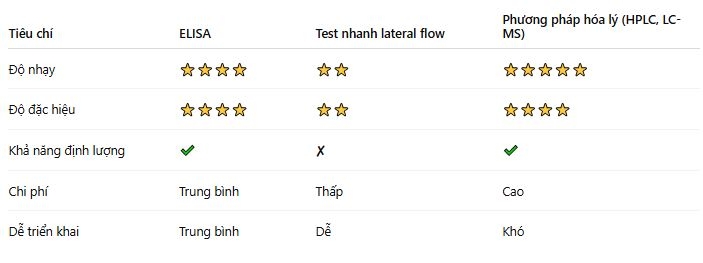
👉 In summary: ELISA is the most balanced method between accuracy and cost, suitable for daily food quality testing.
6. Guidelines for implementing ELISA allergy testing in the laboratory
6.1 Sample preparation
- Samples must be homogeneous, finely ground if necessary
- Weigh the sample weight accurately
- Dissolve the sample in a suitable solvent (according to the instructions of the R-Biopharm kit)
6.2. Basic ELISA procedure
- Apply the sample to antibody-coated microplate wells
- Wash to remove impurities
- Add enzyme-linked antibody
- Incubate the reaction
- Add the colour substrate
- Read the results with a photometer (ELISA reader)
Note: Optimise the incubation time, wash thoroughly to reduce interference, follow the standard procedure to ensure the repeatability of the results.
7. Practical applications and benefits of applying R-Biopharm ELISA allergy testing
✔ For food manufacturers
- Prevent legal disputes due to allergies
- Increase brand credibility
- Optimise the quality control process
- Meet traceability requirements
✔ For testing laboratories
- Fast – accurate – many indicators
- Standardise the testing procedure
- Increase analytical capacity
✔ For consumers
- Trust in safe products
- Reduce allergy risks
The allergen testing by ELISA method is not only a technical requirement but also a responsibility to protect consumer health and ensure brand credibility. With the R-Biopharm allergen ELISA kits, manufacturers and laboratories have an optimal, accurate solution that meets international standards.
👉 If you are looking for an allergen testing solution in food, the R-Biopharm ELISA method is the first choice – reliable, accurate and effective.