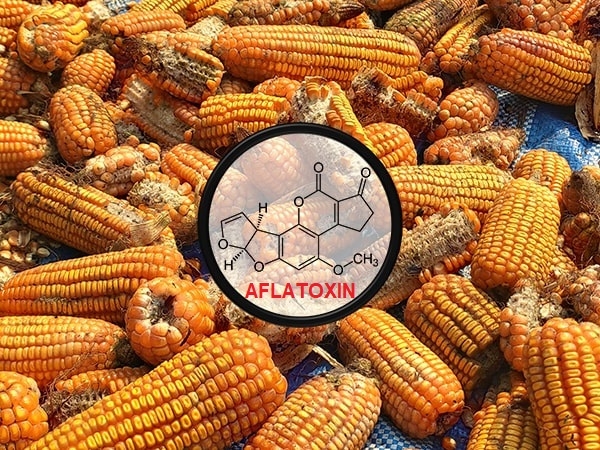
- Aflatoxin is a common toxin in food and animal feed, especially in ingredients such as corn, wheat, soybean, groundnut (peanut) and oilseed meal.
- Aflatoxin is classified into several groups, including Aflatoxin B1, B2, G1, G2, and M1, of which the mycotoxin Aflatoxin B1 is considered the most dangerous due to its carcinogenic potential and its effect on the health of humans and animals.
1. Origin and conditions for the formation of Aflatoxin
Aflatoxin usually appears when environmental conditions favour the growth of moulds, including:
- High humidity: ingredients stored at a humidity above 70% are easily contaminated by moulds.
- High temperature: moulds grow strongly at temperatures from 25–30°C.
- Long storage time: toxin accumulation increases over time if there are no suitable control measures.
2. The effects of the Aflatoxin toxin
2.1. For animals
- Reduced productivity: aflatoxin reduces the growth, fertility, and resistance of livestock.
- Acute poisoning: at high levels, Aflatoxin causes liver damage, impaired immune function, and can lead to death.
- Accumulation in livestock products: Aflatoxin can be metabolised and accumulate in milk, eggs, and meat, thereby affecting human health.
2.2. For humans
Humans can be exposed to Aflatoxin indirectly by consuming animal products or foods contaminated with this toxin. Aflatoxin B1 is a leading cause of liver cancer and has been classified by the World Health Organization (WHO) as a group 1 carcinogen.
3. Methods for testing Aflatoxin
3.1. Chromatographic methods
3.1.1. High-performance liquid chromatography (HPLC)
- Principle: HPLC uses a chromatography column to separate Aflatoxin based on physicochemical properties such as solubility and polarity.
* Advantages:
- High sensitivity and accuracy.
- Can detect Aflatoxin at very low levels (ppt - parts per trillion).
* Disadvantages:
- High equipment cost.
- Requires highly skilled technicians.
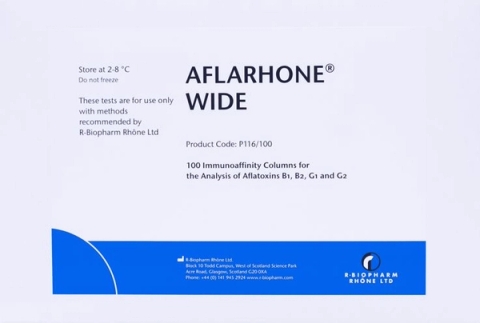
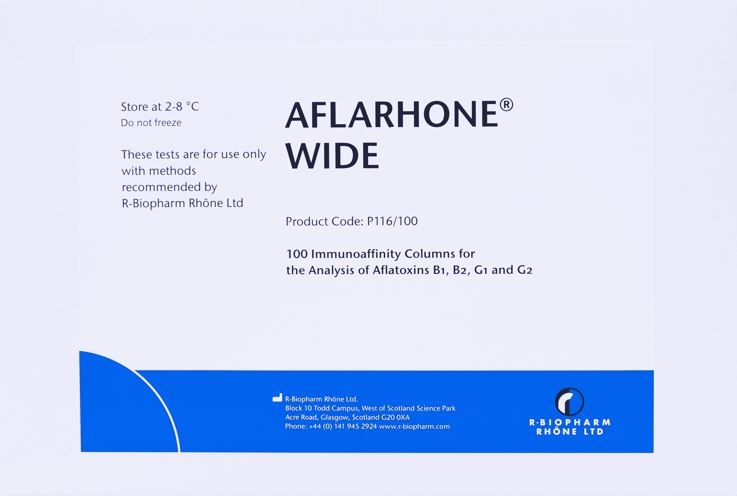
See the immunoaffinity column product for Aflatoxin by the HPLC method here.
3.2.2. Gas chromatography (GC)
- Principle: uses a carrier gas to separate and detect Aflatoxin in the sample.
* Advantages: effective with samples that have very low Aflatoxin concentrations.
* Disadvantages:
- A derivatisation agent must be used to convert Aflatoxin into a volatile form.
- Requires complex equipment and thorough sample preparation.
3.2.3. LC-MS/MS (Liquid Chromatography-Tandem Mass Spectrometry)
- Principle: combines liquid chromatography with mass spectrometry to analyse and quantify substances, even at trace levels.
* Advantages:
- The highest sensitivity and accuracy among the methods.
- Can detect many different toxins simultaneously, not only Ochratoxin.
* Disadvantages:
- Requires modern equipment and complex operation.
- High analysis cost.
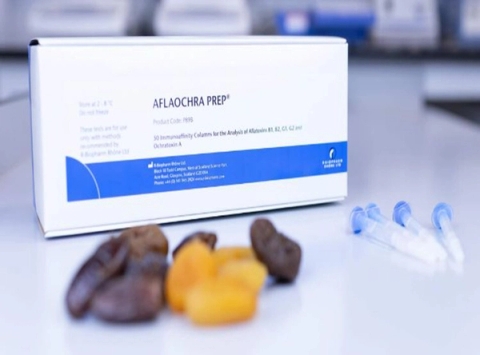
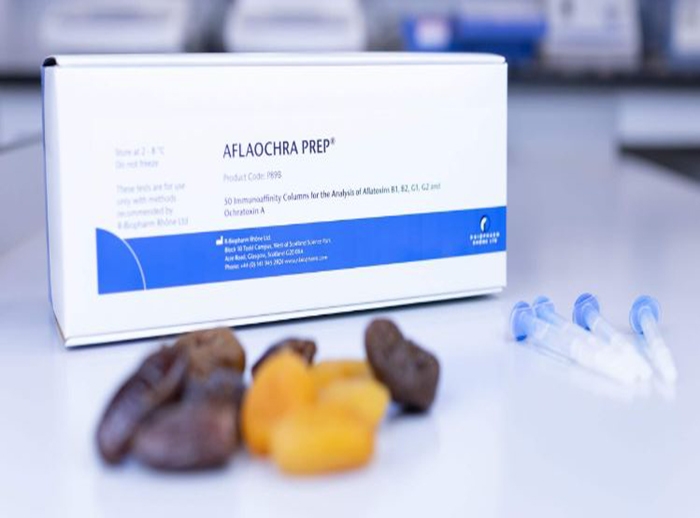
See the immunoaffinity column product for the simultaneous analysis of Aflatoxin and Ochratoxin A by LC-MS/MS here.
3.2. Spectroscopic methods
3.2.1. UV-Vis spectroscopy
- Principle: the Aflatoxin toxin absorbs light at characteristic wavelengths in the UV range.
* Advantages:
- Simple, easy to perform.
- Suitable for rapid analysis.
* Disadvantages: low sensitivity, only suitable for samples with a high Aflatoxin content.
3.2.2. Fluorescence spectroscopy
- Principle: Aflatoxin emits fluorescent light when excited by UV rays.
* Advantages: more sensitive than the UV-Vis method.
* Disadvantages: requires specialised equipment and stricter analysis conditions.
3.3. The ELISA method (Enzyme-Linked Immunosorbent Assay)
- Principle: uses specific antibodies to detect and quantify Aflatoxin.
* Advantages:
- Fast and easy to perform.
- Suitable for analysing a large number of samples in a short time.
* Disadvantages:
- Accuracy depends on antibody quality.
- Cross-reactions with other compounds sometimes occur.
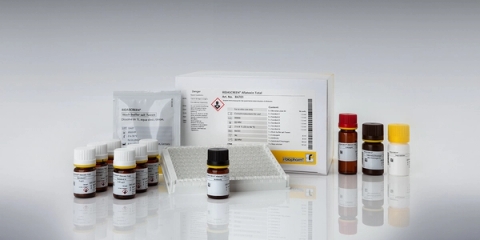
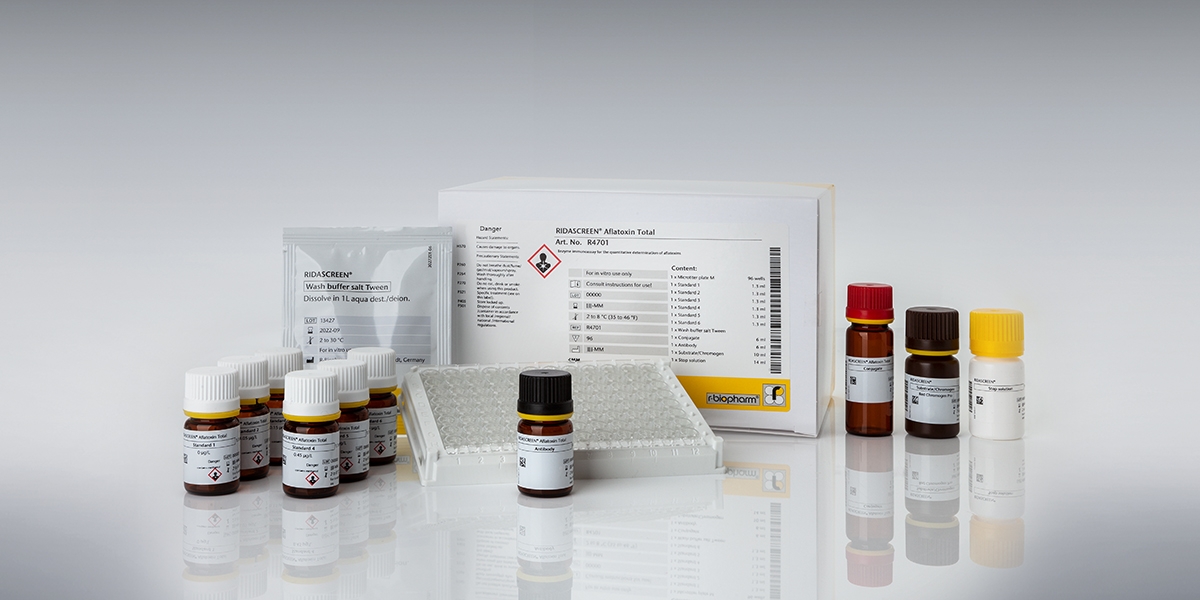
See the ELISA test kit product for Aflatoxin analysis here.
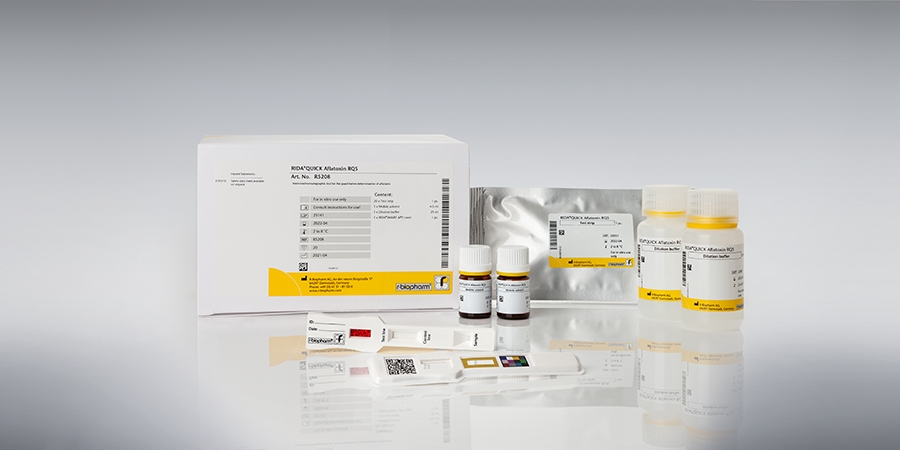
3.4. Lateral Flow Assay method (Rapid test strip)
- Principle: based on the immune reaction between Aflatoxin and the antibody attached to the test strip.
* Advantages:
- A simple method that does not require high skill.
- Can be used directly on site.
* Disadvantages:
- Lower sensitivity and accuracy than other methods.
- Mainly used for initial screening.
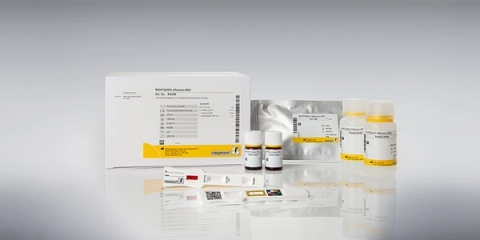
See the rapid test strip product for the mycotoxin Aflatoxin here.
3.5. The PCR method (Polymerase Chain Reaction)
- Principle: detects the DNA of the moulds that produce Aflatoxin (Aspergillus flavus and Aspergillus parasiticus).
* Advantages:
- Detects the risk of Aflatoxin contamination even before the toxin is produced.
- High accuracy in identifying the source of contamination.
* Disadvantages:
- Only indirectly assesses the presence of Aflatoxin.
- Requires advanced equipment and technique.
3.6. Biological methods
- Principle: uses microorganisms sensitive to Aflatoxin to detect the presence of the toxin.
* Advantages:
- Low cost.
- Environmentally friendly.
* Disadvantages:
- Accuracy is not high.
- Long turnaround time.
Combined methods such as ELISA-HPLC or PCR-HPLC are increasingly applied to take advantage of the strengths of each method. For example, ELISA is used for initial screening, after which HPLC is used for confirmation and accurate quantification.
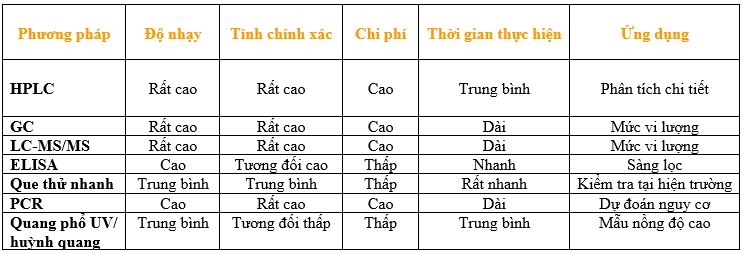
4. Comparing methods for testing Aflatoxin
5. Measures to manage and control Aflatoxin
5.1. During production and storage
- Humidity and temperature control: maintain humidity below 14% and a low temperature.
- Proper storage: use sealed silos with a ventilation system and temperature control.
- Use of preservatives: substances such as propionic acid can inhibit the growth of moulds.
5.2. In animal feed
- Use of toxin binders: types such as bentonite or zeolite can reduce toxins in the digestive tract.
- Choose clean ingredients: ingredients must be tested before use to ensure they are not contaminated with Aflatoxin.
- Biotechnology: some enzymes and microorganisms are being studied to degrade Aflatoxin.
5.3. Quality control
Build a quality management system such as HACCP or GMP to ensure that raw materials and the final product are not contaminated with the toxin.
6. Regulations and standards
Many countries have issued regulations on Aflatoxin limits in food and animal feed. For example:
- European Union (EU): Aflatoxin B1 must not exceed 20 µg/kg in animal feed.
- United States: the maximum permitted limit is 20 ppb in feed.
Testing for Aflatoxin in animal feed is an important step to ensure the safety of livestock and prevent the risk of indirect exposure to humans. Depending on the goal and scale of analysis, manufacturers and regulatory bodies can choose a suitable Aflatoxin testing method. Combining several methods in the testing process will ensure accuracy and effectiveness, thereby helping to better control the toxin in animal feed.
Aflatoxin is a major challenge in agriculture and livestock farming, directly affecting the health of livestock and humans and economic efficiency. Therefore, controlling Aflatoxin requires close coordination between manufacturers, regulators and consumers through effective monitoring and management measures.
By investing in modern technology and complying with strict regulations, the livestock industry can minimise the risk from Aflatoxin, helping to protect public health and ensure food safety.