
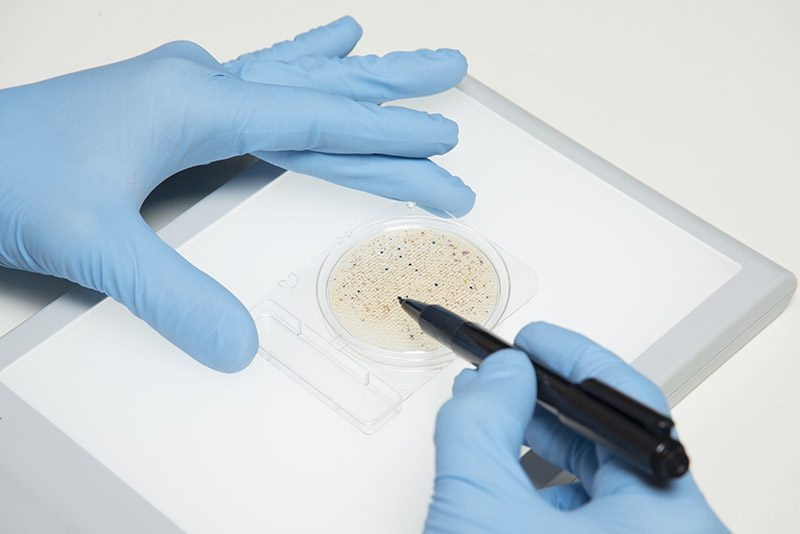
- Especially in industries such as food, beverages, cosmetics, and pharmaceuticals, where microbiological results directly affect product quality and consumer safety, choosing a suitable testing method is extremely important.
- In recent years, the pre-poured Compact Dry medium plate has been highly rated by many laboratories and businesses for its ability to standardize processes, reduce handling errors, and deliver stable results. So how is the accuracy and repeatability of Compact Dry plates in microbiological testing expressed? Do they meet international standards? This article analyzes those aspects in detail.
1. What are accuracy and repeatability in microbiological testing
1.1. Accuracy
- Accuracy in microbiological testing is how close the measured result is to the sample's true value. A highly accurate method reflects the actual microbial density in the sample correctly.
In laboratory practice, accuracy is affected by:
- The quality of the culture medium
- The operating procedure
- Incubation conditions
- The skill of the person performing the test
1.2. Repeatability
- Repeatability is the ability to produce similar results when the same sample is tested several times under the same conditions.
* Example:
- One sample is plated onto 3 plates
- If the results differ too much → the method lacks stability
- If the results are nearly the same → the method has high repeatability
👉 This is an extremely important factor when:
- Comparing production batches
- Tracking microbial contamination trends
- Assessing the effectiveness of factory hygiene
2. The factors affecting the accuracy of the traditional method
The traditional plate-pouring method is still widely used, but its accuracy and repeatability depend heavily on people, including:
- Errors in preparing media
- Non-uniform agar temperature
- Different plating techniques between technicians
- Uneven handling times
👉 This explains why the same sample can give significantly varying results between tests or between different laboratories.
3. The design of Compact Dry plates and its effect on accuracy
3.1. The standardized culture medium
Compact Dry plates are manufactured with:
- A fixed culture medium
- Selective enzyme components
- Distinctive color-indicator compounds
All are standardized during production, which helps to:
- Reduce errors from media preparation
- Ensure every plate has identical components
👉 This is an important foundation for improving the accuracy of microbiological test results.
3.2. The sample-wicking and even gel formation mechanism
Unlike the traditional method that spreads the sample with a spreader, Compact Dry:
- Draws the sample in automatically
- Distributes the sample evenly over the whole plate surface
- Limits the clumping of colonies in one spot
👉 As a result, the number of colonies that grow reflects the microbial density in the sample accurately.
4. The repeatability of results when using Compact Dry plates
4.1. Stable results between parallel plates
In practice, many laboratories have observed that:
- When the same sample is plated onto several Compact Dry plates
- The colony counts obtained have a low spread
This shows that:
- The simple inoculation procedure reduces handling errors
- The uniform medium lets microorganisms grow stably
4.2. Repeatability between production batches
A major advantage of Compact Dry plates is:
- High uniformity between production batches
- Few result fluctuations over time
👉 This is very important for businesses that need to:
- Track long-term microbial trends
- Compare data between testing periods
5. Compact Dry plates and international standards and studies
5.1. Compatible with quality management standards
Compact Dry plates are designed for use within:
- HACCP
- ISO 22000
- GMP
Using pre-poured medium plates helps to:
- Standardize the process
- Make writing SOPs easy
- Reduce result variation caused by people
5.2. Results that correlate with the traditional method
In many practical evaluations:
- Colony counts on Compact Dry
- Correlate well with the traditional plate-pouring method
👉 This demonstrates that Compact Dry delivers the required accuracy while improving the repeatability of results.
6. Comparing data reliability between Compact Dry and the traditional method

👉 For in-house QC laboratories, the data reliability of Compact Dry is usually higher and easier to control.
7. The practical applications of Compact Dry in quality control
Thanks to its high accuracy and repeatability, Compact Dry is widely applied in:
- Food microbiological testing
- Testing the microbiology of drinking and domestic water
- Monitoring the production environment
- Checking surfaces and tools
Particularly suitable for:
- Businesses that need frequent microbiological testing
- Laboratories with large sample volumes
- Systems that need stable data for trend assessment
8. Notes for reaching the highest possible accuracy with Compact Dry
To get the most out of Compact Dry plates you need to:
- Prepare and dilute samples with correct technique
- Drop the correct sample volume as instructed
- Incubate at the right temperature and for the right time
- Read results according to each plate type's criteria
👉 Complying with the procedure maintains the accuracy and repeatability of results.
9. Conclusion
The accuracy and repeatability of Compact Dry plates in microbiological testing are among the main reasons this product is trusted worldwide. Through its standardized design, reduced dependence on human handling, and stable results, Compact Dry helps laboratories:
- Raise data reliability
- Compare results over time with ease
- Optimize their microbiological testing processes
👉 Compact Dry is not just a testing tool — it is also a solution for standardizing microbiological data in the modern laboratory.