
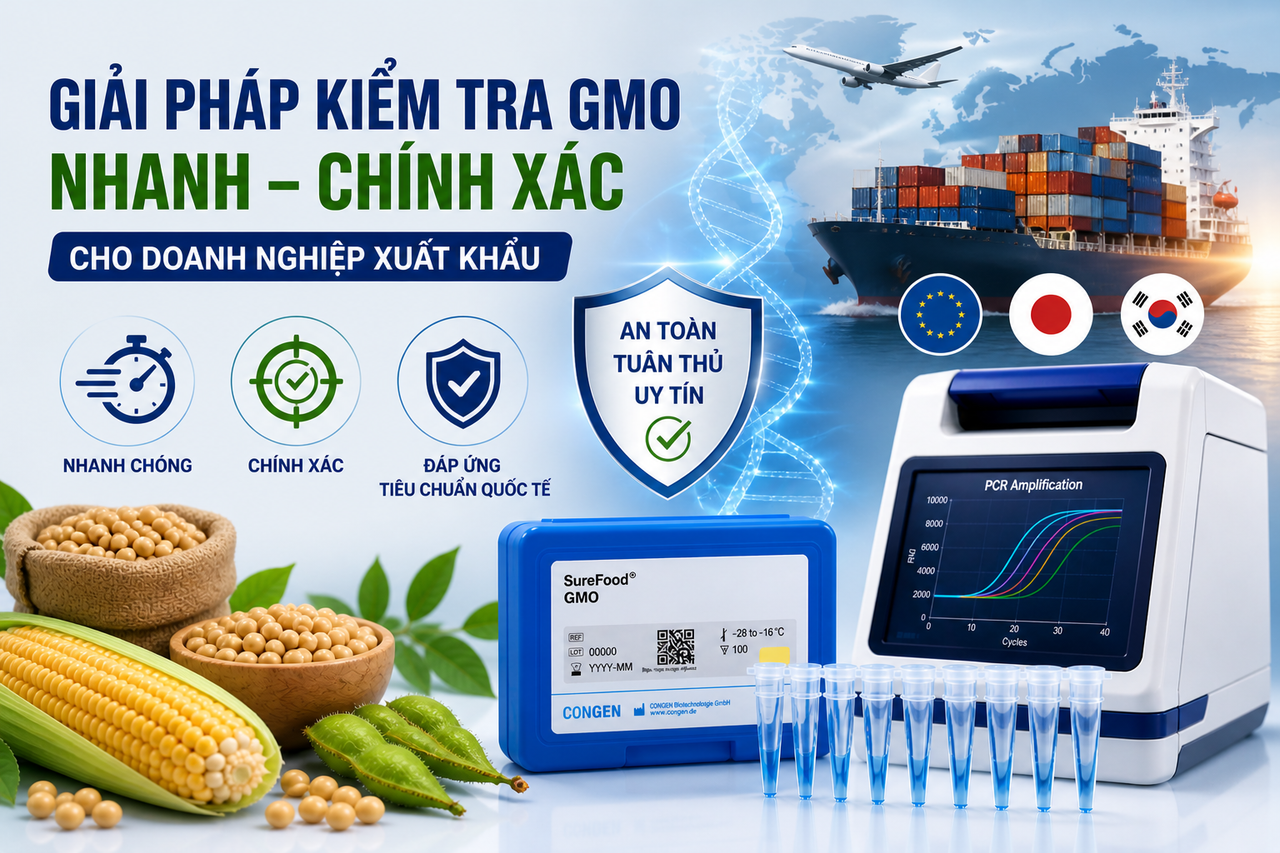
Why is GMO testing mandatory for export businesses?
- In the context of international integration, GMO testing in food is no longer an option but a mandatory requirement for exporters.
👉 Especially for demanding markets such as: the EU, Japan, and South Korea.
- If GMOs are not controlled:
- Shipments can be rejected
- Returned or destroyed
- Loss of brand reputation
⚠️ The risk of returned shipments from not testing GMO
Many businesses have experienced:
- No GMO testing before export
- Using raw materials of unclear origin
- No testing certificates
👉 Consequences:
- Losses of hundreds of millions to billions of dong
- Lost long-term partners
- Tighter inspection on subsequent shipments
🌍 GMO regulations in international markets
EU – the most demanding market
- GMO limit: ≤ 0.9%
- Mandatory labeling if the threshold is exceeded
- Requires clear testing results
🇯🇵 Japan
- Controls GMOs in many food groups
- Requires traceability
🇰🇷 South Korea
- Strict GMO labeling regulations
- Random inspection of imported shipments
👉 Common points:
- Accurate testing results are needed
- The PCR method is prioritized
The role of PCR (Polymerase Chain Reaction) in GMO testing
PCR is regarded as the gold standard in GMO testing for export.
✅ Superior advantages:
- Detecting genetically modified DNA with high accuracy
- Can detect processed samples
- Meets international standards (ISO, AOAC)
👉 PCR helps:
- Accurately confirm whether GMOs are present
- Meet export dossiers
- Avoid legal risks
Rapid – accurate GMO testing solution
To optimize efficiency, businesses should apply a 2-step model:
🔹 Step 1: GMO rapid test
- Screen incoming raw materials
- Detect quickly in 5–15 minutes
- Cost-saving
🔹 Step 2: Confirmation by PCR
- Accurate analysis
- Meets export standards
- Serves as legal evidence
👉 This is the strategy: Fast – Accurate – Economical
Solutions from R-Biopharm
R-Biopharm products provide a comprehensive solution:
Including:
- GMO rapid tests
- GMO testing PCR kits
- Internationally standardized testing solutions
* Benefits:
- Easy to deploy in the QC room
- Stable results, high reliability
- Suited to export businesses
Benefits of testing GMO with the right procedure
The business will achieve:
- Fewer rejected shipments
- Assurance of international regulation compliance
- Higher brand reputation
- Greater competitiveness
⚠️ Mistakes to avoid
- Not testing GMO before export
- Using only rapid tests without PCR confirmation
- Using substandard methods
👉 This is the main cause of:
- Businesses losing money
- Rejected shipments
Conclusion
In export operations, GMO testing is not just a technical requirement but a survival factor.
👉 Businesses need to:
- Combine rapid tests and PCR
- Apply strict control procedures
- Use reliable solutions from R-Biopharm
👉 This is precisely the key to:
- Sustainable exports
- Reduced risks
- Long-term growth