
1. Pseudomonas spp. (aerobic bacteria spoiling protein-rich food)
🔹 Characteristics:
- They are aerobic bacteria that grow strongly at low temperatures (0-10°C) => they spoil refrigerated food.
- They adapt to nutrient-rich environments such as meat, fish, milk, and dairy products.
- They produce protease and lipase enzymes, decomposing protein and fat and creating off-odors.
🔹 Spoilage mechanism:
- They break down protein → producing ammonia, trimethylamine (TMA) → creating fishy odors.
- They break down lipids → producing free fatty acids → making food rancid.
- Some species produce pigments such as pyocyanin and pyoverdine → changing the food's color.
🔹 Foods affected:
- Meat, fish, seafood: they form a slimy film on the surface and turn it green or black.
- Milk and dairy products: they curdle milk and give it a bitter taste.
- Vegetables: they form slime on the surface by producing exopolysaccharide.
2. Lactic Acid Bacteria (LAB – lactic bacteria such as Lactobacillus, Leuconostoc, Pediococcus)
🔹 Characteristics:
- They are facultative anaerobes that ferment sugar into lactic acid.
- They are not pathogenic but spoil food by souring it and changing its flavor.
- They grow strongly in low-pH environments and under refrigeration.
🔹 Spoilage mechanism:
- They ferment sugar → producing lactic acid and acetic acid → lowering the pH and souring the food.
- Some species such as Leuconostoc produce CO₂ → bloating food packaging.
- Some species create slime (exopolysaccharide) → making food slimy.
🔹 Foods affected:
- Milk and dairy products: they sour milk and make it slimy.
- Fruit juices: they ferment and sour, generating CO₂ and bloating bottles.
- Processed foods (cold cuts, sausages): they create slime and sour flavors.
3. Bacillus spp. and Clostridium spp. (spore-forming bacteria spoiling canned and heat-processed food)
🔹 Characteristics:
- They form spores that let them survive harsh conditions (high temperature, dryness).
- They grow well in heat-processed and canned food.
🔹 Spoilage mechanism:
- Bacillus spp. (aerobic): they secrete enzymes that break down protein and starch, causing off-odors. Some species such as Bacillus cereus produce toxins that cause food poisoning.
- Clostridium spp. (anaerobic): they ferment protein and produce H₂ and CO₂ gas → bloating food cans. Some species such as Clostridium botulinum produce the very dangerous botulinum toxin.
🔹 Foods affected:
- Canned food (canned meat, canned fish, canned vegetables): swollen cans, putrid smell.
- Milk powder, leftover rice (Bacillus cereus): cause food poisoning.
- Processed meat, sausages (Clostridium perfringens): produce gas and unpleasant odors.
4. Molds (Aspergillus, Penicillium, Fusarium)
🔹 Characteristics:
- Molds produce spores and can grow on the surfaces of dry, long-stored food.
- Some species produce mycotoxins causing cancer and poisoning.
🔹 Spoilage mechanism:
- They create enzymes that break down starch, protein, and lipids → softening and discoloring food.
- They form mycelium and spores → giving the food green, black, or white spots.
- They produce mycotoxins (aflatoxin, ochratoxin, fumonisin) → dangerous for health
🔹 Foods affected:
- Cereals (corn, wheat, peanuts): aflatoxin contamination from Aspergillus flavus.
- Bread, dried fruit: contaminated by Penicillium, forming green/black spots.
- Nuts (hazelnuts, sunflower seeds, coffee): easily contaminated with ochratoxin.
5. Yeasts (Saccharomyces, Candida, Zygosaccharomyces)
🔹 Characteristics:
- Yeasts grow well in environments with high sugar content (jams, fruit juices, honey).
- Some species cause alcoholic fermentation, generating CO₂ gas that bloats packaging.
🔹 Spoilage mechanism:
- They ferment sugar → producing ethanol and CO₂ → giving food a wine-like odor and bloating bottles.
- Some species such as Candida create slime and change the food's color.
🔹 Foods affected:
- Fruit juices, beverages: fermentation, bubbles, a wine-like odor.
- Jams, honey: CO₂ production, bulging lids, sour taste.
- Yogurt, cheese: slime formation and color change.
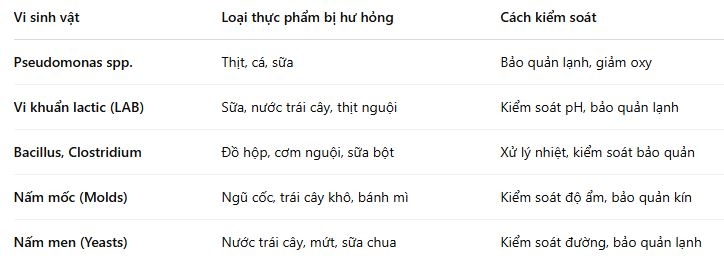
* Summary of how to control food-spoiling microorganisms
Please contact us for specific advice on control methods for the above bacteria!