
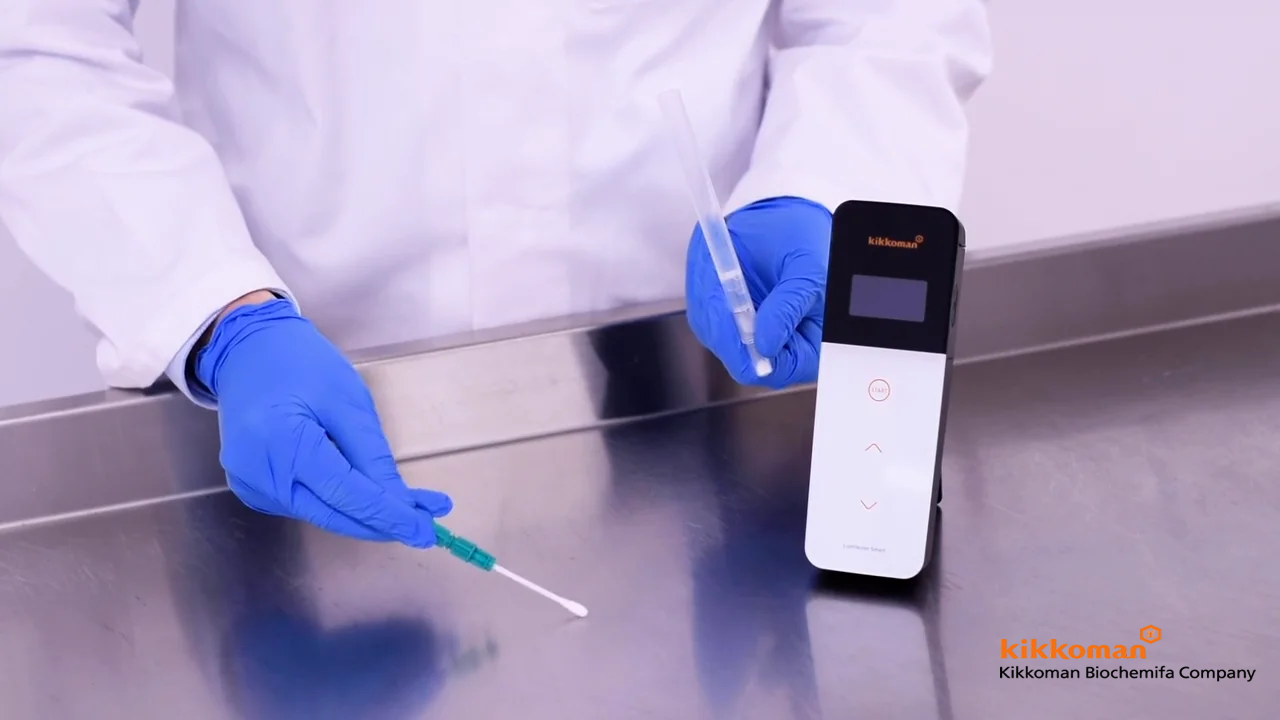
- Among them, the Lumitester Smart system combined with Kikkoman's LuciPac A3 (Surface/Water) swabs is considered one of the most accurate and easy-to-use solutions today.
- However, many organizations still encounter errors in the testing process because their operations do not meet the standard. Below are the 5 most common mistakes and how to correct them to help businesses improve the reliability of ATP results.
1. Incorrect sampling technique – the biggest cause of result deviations
- Swabbing the surface too lightly, with insufficient force → the amount of ATP collected is too small.
- Only swabbing one point or not following the Ziczac/W pattern.
- Not taking the standard area (usually 10×10 cm).
* How to correct
- When using LuciPac A3 Surface swabs, use moderate hand force and swab the surface following the Ziczac or crisscross pattern.
- Rotate the tip of the swab while wiping to increase the contact area.
- Ensure the correct sampling area according to the factory SOP.
2. Slow measurement after sampling – enzyme activity is reduced
- Leaving the sample for more than 3–5 minutes before measuring.
- Swabs left in a hot environment cause the enzyme to weaken.
* How to correct
- After activation, insert the swab into the Lumitester Smart instrument within 30–60 seconds.
- Avoid leaving swabs in direct sunlight, near steam pipes, in areas > 30°C.
3. Incorrect swab activation – reagent is not fully released
- Activating the swab not firmly → the solution does not flow all the way down.
- Shaking too hard or not shaking → affects the enzyme – luciferase reaction.
* How to correct
- Activate the swab firmly so that the solution above flows all the way down
- Shake gently 5–10 times in a vertical direction.
- Ensure the tip of the swab is fully immersed in the reagent solution.
4. Storing LuciPac A3 swabs at the wrong temperature – enzyme life is reduced
- Leaving swabs at room temperature for too long.
- Not letting the swabs “equilibrate to temperature” after taking them out of the refrigerator.
- Using expired swabs or swabs whose package has been open for a long time.
* How to correct
- Store LuciPac A3 swabs in the refrigerator compartment at a temperature from 2–8°C.
- After taking them out of the refrigerator, stabilize the temperature for 10–15 minutes before opening.
5. Lumitester Smart instrument is not checked, cleaned periodically
- The measurement chamber is dusty or contaminated with chemicals.
- Not using the Control Kit to check the stability of the instrument.
- The software/application is not updated.
* How to correct
- Clean the measurement chamber with a clean, lint-free cotton swab.
- Perform periodic calibration checks using the Lumitester Control Kit + filter replacement according to Kikkoman's instructions.
- Regularly update the Lumitester firmware and application.
Why should you use LuciPac A3 instead of ordinary ATP swabs?
- The A3 (ATP + ADP + AMP) technology detects both residual ATP and degraded ATP → sensitivity many times higher than traditional ATP testing.
- Gives stable results, good repeatability, suitable for factories with strict quality requirements.
- Optimized for both surface (Surface) and water/ice/wash water (Water).
Conclusion
Avoiding the 5 common mistakes above helps businesses:
- Increase the reliability of ATP results
- Reduce errors and retesting costs
- Ensure hygiene – food safety according to HACCP/GMP standards