
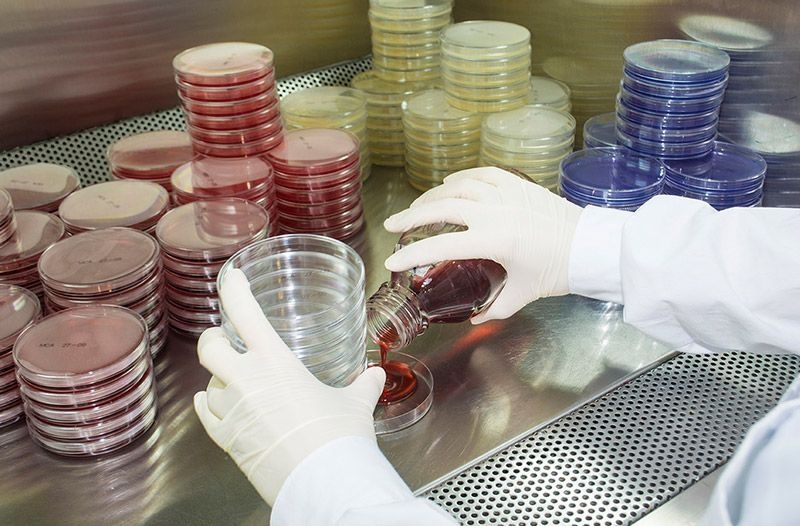
- However, at many companies today, the manual agar media pouring process is still used as a traditional method. Although familiar, this process harbors many technical risks that can directly affect the accuracy of the test results.
- This article analyzes the 5 common mistakes when pouring manual agar media, and also introduces an optimal solution that helps modern QC departments modernize their microbiological testing process.
1. Wrong media preparation ratio – the risk of false negatives or false positives
* Common problem
In the traditional method, the technician must:
- Weigh out the dry medium
- Dissolve it at the specified ratio
- Adjust the pH if necessary
- Sterilize by autoclaving
Even a small error in the weighing or the water volume can lead to:
- A medium that is too dilute → weak microorganism growth → false negatives
- A medium that is too concentrated → growth is inhibited → inaccurate colony counts
This mistake is particularly dangerous when testing:
- Total plate count (TPC)
- Coliform
- E. coli
- Yeast and mold
* Corrective solution
Pre-poured media plates such as the plate Compact Dry plate already have a standardized media composition from production. The user only needs to:
- Pipette 1 mL of sample onto the plate
- Incubate at the specified temperature
There are no more weighing, mixing or adjusting steps – completely eliminating operator error.
2. Non-uniform agar thickness – affects colony development
* Common problem
When pouring agar manually, the thickness of the media layer depends on:
- The amount of medium poured into each plate
- The surface of the workbench
- The skill of the technician
If the plate is too thick:
- The solidifying time is longer
- More material is consumed
- Heat is not evenly distributed during incubation
If the plate is too thin:
- The medium dries out quickly
- Colony development is affected
- Results are difficult to read
Especially with the pour plate method, non-uniform thickness can distort the quantitative results.
* Modern solution
With the plate Compact Dry, the medium is designed in dry form, and the thickness and nutrient density have been standardized in each production lot. When the sample is added, the medium rehydrates evenly, ensuring:
- An optimal growth surface
- Clearly formed colonies
- Easy reading and accurate counting
3. Water condensation on the plate surface – the cause of colony spreading
* Common problem
After pouring hot agar, if it is not cooled properly, water condensation appears on the lid or on the media surface. The consequences:
- Colonies spread out
- It is hard to distinguish individual CFUs
- Errors when counting density
In high-humidity environments or rooms with poor temperature control, this happens frequently.
* How to solve it
The Compact Dry plate does not require pouring hot agar, so water condensation caused by temperature differences does not occur. Its sample-absorbing structure design helps:
- Distribute the liquid evenly
- Limit microbial spreading
- Keep colonies clearly separated
This makes reading the results faster and more accurate, especially with samples that have a high microbial density.
4. The risk of cross-contamination during handling
* Common problem
The manual media pouring process consists of many steps:
- Dissolving
- Autoclave sterilizing
- Pouring plates
- Cooling
- Storage
Each step harbors a risk:
- Contamination with microorganisms from the surroundings
- Cross-contamination between batches
- Opening the plate lid multiple times
When an error occurs, it is very difficult to trace the cause.
* Standardization solution
With Compact Dry, the process is reduced to the maximum:
- No autoclaving needed
- No media pouring needed
- No waiting for solidification
The number of handling steps is significantly reduced → the risk of cross-contamination falls accordingly.
This technology was developed by Shimadzu Diagnostics, a company with many years of experience in microbiology and diagnostics.
5. Variation between batches – difficult to control consistency
* A serious but little-noticed problem
In a QC laboratory, repeatability and consistency are essential. When using the manual method:
- Each batch of medium may have small variations
- Different operators → different results
- Environmental conditions change from day to day
This directly affects:
- ISO documentation
- Export documentation
- Traceability in case of an incident
* Optimal solution
Pre-poured media plates are produced industrially under a strictly controlled process, which helps:
- Ensure consistency between batches
- Reduce operator variation
- Make it easier to standardize internal SOPs
This is an important factor when a company wants to upgrade its microbiological control system to international standards.
Why should companies review their microbiological testing process?
In a context of:
- Increasingly strict legal requirements
- Customers demanding transparent test documentation
- Pressure for fast delivery
An effective microbiological testing process needs not only to be accurate, but also to be:
✔ Stable
✔ Fast
✔ Standardized
✔ Easy to train new staff on
Maintaining the manual process can make the company pay hidden operating costs without realizing it.
Pacific company – a comprehensive microbiological testing solution
Switching to pre-poured media plates is not just a change of consumables; it is a change of quality control strategy.
Pacific company does not simply supply products such as the Compact Dry plate, but offers a comprehensive solution including:
- Advice on choosing the microbiological parameters suitable for each industry
- Building standard operating procedures (SOP)
- Training technicians to read and analyze the results
- Supplying PCR test kits, allergen and GMO testing solutions
- Support for upgrading and designing standard-compliant microbiology rooms
With practical experience in many sectors:
- Food
- Water
- Cosmetics
- Pharmaceuticals
- Feed
👉 Pacific company accompanies the company from consulting to actual operation.
Conclusion
The 5 mistakes of pouring manual agar media are not human errors, but the limits of an outdated process.
Meanwhile, pre-poured media plates such as the Compact Dry plate deliver:
- Standardized results
- Reduced handling risks
- Time savings
- Improved consistency
- Increased reliability of test documentation
For companies that want to modernize their microbiology testing laboratory, this is a strategic move. If you are considering optimizing your QC system, Pacific company is ready to accompany you in building a comprehensive, efficient and sustainable microbiological testing solution.