1 . Scope
This standard specifies a method for using Compact Dry YMR discs to rapidly enumerate yeasts and moulds in food.
Annex A provides information on the method validation results and on the results of the collaborative studies performed by AOAC and NMKL - NordVal.
2. Terms and definitions
Yeast
Yeasts are aerobic mesophilic microorganisms which, at 25 ºC on the medium under the conditions specified in TCVN 13876 2023, develop into round, shiny or dull colonies on the surface of the medium, usually with regular margins and a slightly or strongly convex surface
Mould
Moulds are filamentous aerobic mesophilic microorganisms which, under the conditions specified in this standard, develop into spreading mycelia or buds that are downy or flat, or into colonies on the surface of the medium, usually green in colour or with a spore-bearing structure
Colony
A visible mass of microorganisms growing on or within a solid nutrient medium, developed from a single living cell
3. Principle
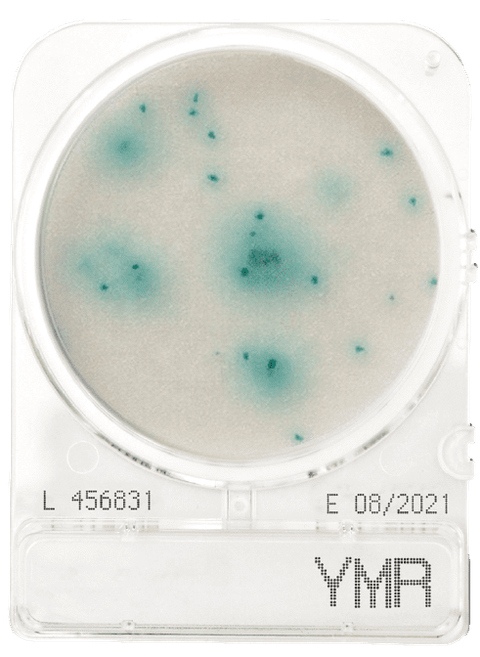
Use a ready-to-use medium disc containing culture medium, a cold-water-soluble gelling agent, a colour-forming enzyme substrate and the antibiotic chloramphenicol. Inoculate 1 mL of the diluted test sample onto the centre of the culture medium and allow the test sample to diffuse by itself. Yeasts and moulds grow and develop on the nutrients; the colour-forming enzyme substrate (X-phos) is used to detect and enumerate yeasts and moulds after incubation at 25 °C ± 1 °C for 3 days; chloramphenicol inhibits bacterial growth. Count colonies of any colour (most colonies are green and blue) and filamentous (cottony) colonies.
4. What is the Compact Dry YMR disc?
The Compact Dry YMR disc contains nutrients, chloramphenicol, a colour-forming enzyme substrate (X-phos 2) ) and a gelling agent soluble in cold water. The disc measures 20 cm2 , and the reverse side of the disc has a 1 cm × 1 cm square grid to make colony counting easier. Store this disc at a temperature from 1 ºC to 30 ºC
See detailed product information:
https://pacificlab.vn/vi/shops/phong-thi-nghiem/dia-compact-dry-men-moc-nhanh-compact-dry-ymr-yeast-and-mold-rapid-nissui.html
5. Method validation results and collaborative study
5.1 Selectivity
Results of the selectivity testing for the target according to the method specified in this standard for 51 yeast and mould species.
5.2 Comparison with the reference method
Testing according to the method specified in this standard compared with the reference method given in TCVN 8275-1:2010 (ISO 21527-1:2008)[4]. The testing was carried out on 10 sample matrices including: cooked rice; mixed diced beetroot salad; canned tuna; strawberry-flavoured drinking yoghurt containing probiotics; mixed pak choi and cheese; egg cake; fruit and vegetable juice; cream cheese; cheese sandwich bread and pasta salad mixed with chicken and pork. The test samples were incubated at temperatures in the range 25 °C ±1 °C for 3 days.
The results are shown in Table A.3 of the standard.
5.3 Comparison with the method performed by NMKL- Nordval
A method validation study of the method specified in this standard compared with the reference method given in TCVN 8275-1:2010 (ISO 21527-1:2008)[4] was carried out by NMKL - NordVal in 2021 [9] and supplemented in 2022 [10] . The test samples were incubated at temperatures in the range 25 °C ±1 °C for 3 days. The test results evaluate the difference between the two methods for some of the parameters given in Table A.4. The testing was carried out using both methods on 85 test samples belonging to 5 sample matrix groups

5.4 Repeatability
A study evaluating the repeatability of the method was carried out on a canned salmon matrix with 14 participating laboratories.

References: TCVN 13876:2023