

Microorganisms are extremely small organisms, mainly organized as unicellular organisms, while some bacteria may appear multicellular. They can be found everywhere in the natural environment (water, soil, air…). Microorganisms are naturally present in and on the surface of food, or arise from contamination during food production and processing.
For microbiological testing in food, many methods can be used, such as sample cultivation, PCR and RT-PCR techniques, enzyme – substrate methods, etc. Each food microbiological testing method has its own advantages and limitations. Cultivation, long regarded as the "gold standard" in microbiological testing, still has difficulties with microorganisms that are alive but cannot be cultivated, and in addition the time to return test results is very long. Therefore, non-cultivation methods are still being researched and developed to replace the traditional cultivation method. Among them, rapid microbiological testing devices have emerged, helping to overcome the drawbacks of the traditional testing method.
PacificLAB is currently the official distributor in Vietnam of the brands R-Biopharm, Kikkoman, Nissui, Silicycle, Euroclone, Polyskope, Promicol, Nasco Whirl Park, Fluka pure chemicals, Hydranal chemicals, Honeywell HPLC solvents, and laboratory equipment for food processing plants, animal feed plants, dairy plants, agricultural product plants, seafood processing plants…
Among them, the rapid microbiological testing device for finished products manufactured by Promicol (Netherlands) consists of an ATP measuring instrument (Promilite M4), software, and a test kit dedicated to the soy milk product line; the kit includes chemicals that help measure the amount of ATP from microorganisms in the product within 45 minutes after 2 days of incubation.
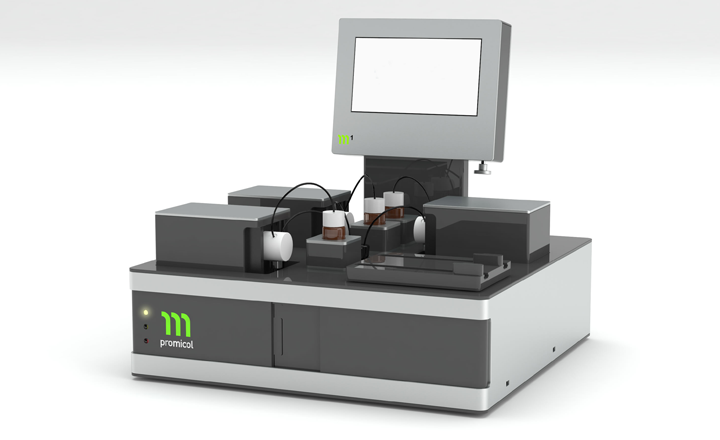
Specifically, the Prosox solution used releases ATP from somatic cells, and the Proase solution breaks down free ATP. The Promex solution releases ATP from microbial cells, while the Prolux solution produces a luminescent reaction with the ATP released from microbial cells, and the instrument collects the light and displays the result in RLU units. The entire process from adding the reaction reagent to obtaining the result is performed automatically within the instrument system.
The advantage of this ATP method is fast results, only 45 minutes for samples after incubation. Meanwhile, the traditional method gives results after at least 24 – 30 hours for samples after incubation.
Only 1 technician is needed to process about 300 samples/day, helping to save labor. The laboratory space needs to be small and compact. In the case where the number of samples increases sharply, doubling the current volume, the device can still meet the demand without additional staff, equipment, or laboratory space. With the traditional method, more technicians, equipment (incubators, microbial culture incubators, autoclaves…) and a larger laboratory space (if there are many samples) are required.
In addition, when relying on the pH measurement method, the traditional method cannot control the risks and takes a lot of time to keep products in the warehouse while waiting for shipment, with results only after 5-7 days. If the device is used, it takes only about 2 days after sample incubation.
The device can be applied to milk and soy milk plants using the UHT/ESL sterilization method. It is used to test finished products that have passed the pre-incubation stage (2 or 3 days depending on the process).
Currently, many food processing, agricultural product and seafood processing plants… use the device and receive training and technology transfer from the Company, support for technical requirements, assistance in improving the ability to operate the device, and at the same time exploit the device efficiently and optimally.
According to,
Techport.vn
Contact information
PacificLAB Scientific and Technical Equipment Co., Ltd
Address : No. 28, Street No. 20, Him Lam Residential Area, Tan Hung Ward, Dist. 7, HCM
Phone : 028 62 65 46 83
Email : sales@pacificlab.vn
Website : https://pacificlab.vn/
Source: techport.vn